
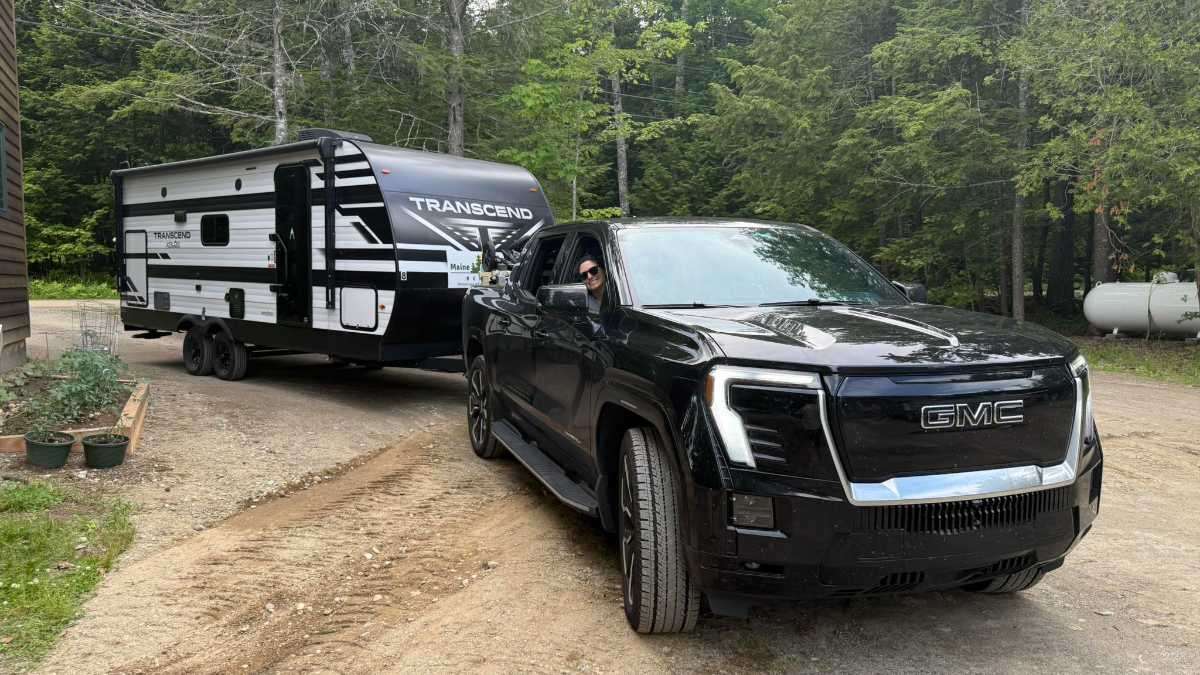

It doesn’t matter whether your ride drinks gasoline, sips electricity, or runs on vaporized kombucha; getting from Western Georgia to Northern Maine is a haul. We’re talking over 1,500 miles of tarmac, treelines, thunderstorms, and that endless conveyor belt of Cracker Barrels and Sheetz bathrooms. The route slices through red clay backroads, Appalachian switchbacks, Jersey traffic, and the moose-ridden backwoods of the Pine Tree State.
It’s the kind of drive that tests any machine’s mettle and every bladder in the cabin. So when Lucas Johnston packed up his 2025 GMC Sierra EV Max Range, a ten-month-old in the backseat, and a trailer hitch juggling both camper and boat, this wasn’t a stunt. It was a real-world trial of the modern American road trip, electric edition.
“We took the Sierra EV (2025 Max Range) on a road trip from Western Georgia to Northern Maine to kickstart July. We just returned, so I wanted to share some bullet points about the experience because this group has been so helpful to me. If there are any questions about traveling, the accessories we used, towing with it, or anything else, I'm happy to try to answer them.
Road trip charging - this was easy. The built-in map makes it easy to search for charging stations on the way and filter by speed. The app includes amenities nearby. This was a huge help. I felt I could navigate it safely while on supercruise in low traffic, rendering so much of my preplanning unnecessary.
Worth noting: my proprietary GM-issued Tesla adapter was not reliable at Tesla charging stations, which I have used prior to this trip successfully. Idk why, it may just be my adapter. Even with this, no issues finding good charging.
Networks I used:
Electrify America - great, most common fast charger
EVGo - loved it, but expensive.
Tesla - some adapter issues, didn't use
Rivian Charging Network - loved it
Hotel overnight charging - this was so variable. Some were complimentary and easy to use, one was a network I didn't recognize and I had to make a guest account on, one didn't work, and none were giving me a rate fast enough to charge completely overnight. Overall, I didn't count on hotel chargers being available or helpful, though it sometimes was a wonderful convenience.
Advertising
Range - started at 100% but never charged that high again en route. We stopped every 2-3 hours as we were traveling with a ten-month-old old we wanted to keep moving a bit, fed, and changed. We never experienced any "range anxiety".
In Maine, we did so much highway and backcountry driving, and the efficiency was so high relative to what I usually get on the interstate. It gave me estimates well over 500mi per full charge that correlated well with drives across the state to Acadia National Park and to Baxter State Park areas.
Interstate, I'd say the true range was closer to 440 at 79mph average. The infotainment map gave estimates per destination I found to be conservative, but we never went below 20% battery, so it wasn't truly stress tested.
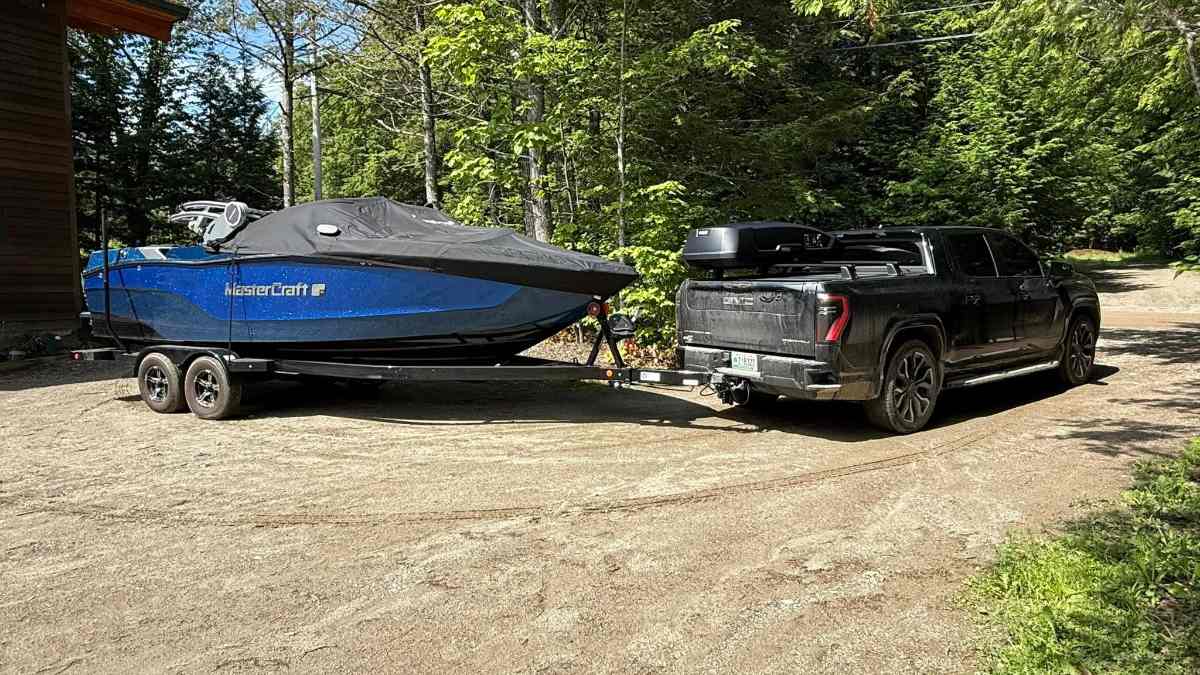
Towing - we towed for about 80 miles through Maine highways and backroads. The truck did great, and I always felt confident we had good control and responsiveness of both a 26 ft, 7000lb camper and a 23 ft, 9000lb boat. Some previous comments said you hardly feel it, which was probably true on cleaner interstates or highways, but an exaggeration on these rougher roads. My efficiency was about 1.0 kWh/mi while towing both, so somewhere near a 1/2 drop in my range, I'd estimate. I didn't travel interstate at all, but up did go up some long and steep inclines.
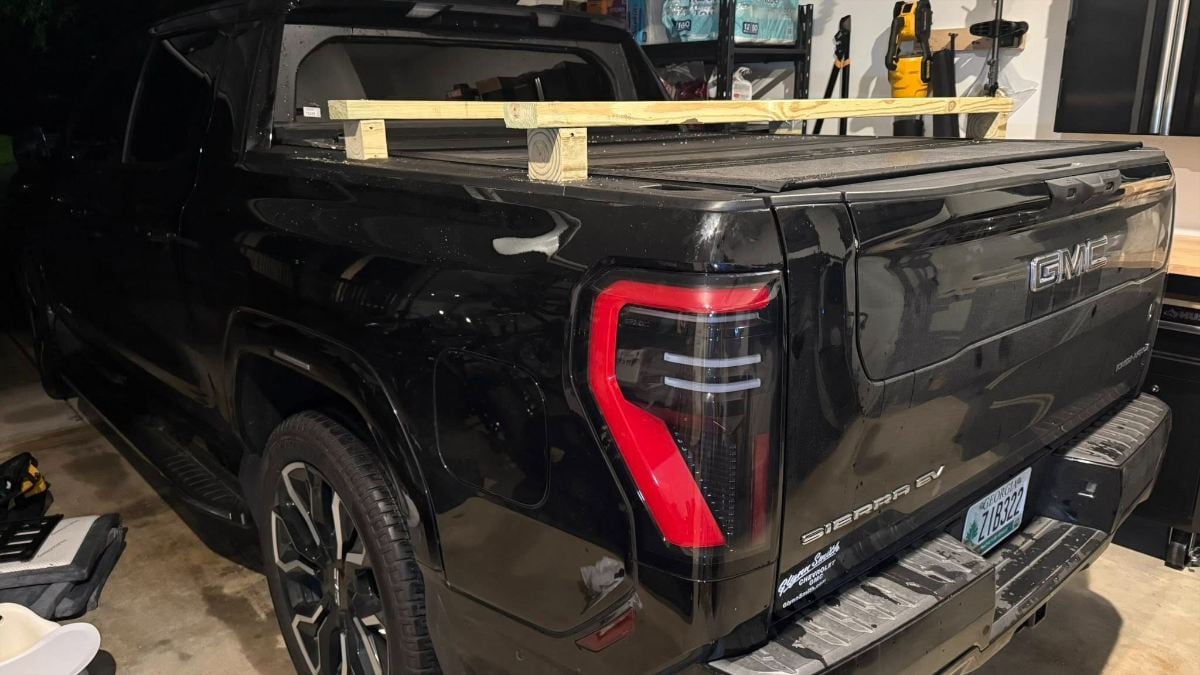
Accessories - I used bedrails to hold a Thule container and an off-road stroller. We packed a ton, mostly for traveling with a baby. The bedrails came wayyy late (past departure date,) so I had to stay up late the night before leaving to make wooden ones to fit the predrilled holes of the bed (you need to cut some plastic to access these). Someone with better tools (specifically a drill press for straighter pilot holes) could have made this a relatively easy task. I had GM change the shipping address and eventually installed their proprietary bedrail system. It works well over the hard cover, but comes with the inconvenience of less practical bed access. Overall, they worked great.
I didn't take notes traveling, and these are mostly just my subjective, offhand observations. If this is helpful to many people, I'll take time to revise for clarity and add any details you may find helpful. I appreciate hearing the experience of others.”
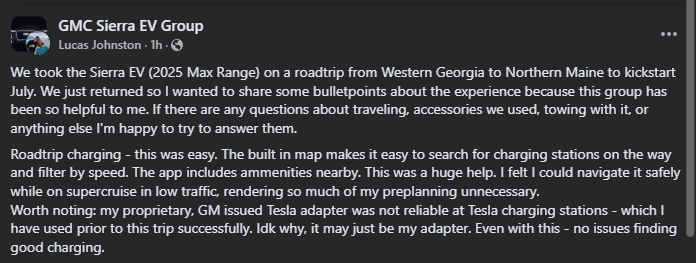
Johnston didn’t set out to prove anything, but he came back with numbers that tell a compelling story: 550 miles of real-world range while driving the rolling backcountry of Maine, and 440 miles on interstates cruising at 79 mph, numbers that, frankly, would have sounded like fantasy even five years ago.
Charging, as it turns out, wasn’t the headache we’ve been conditioned to expect. Electrify America proved the most dependable, plentiful, fast, and fully integrated with GM’s built-in navigation system. EVGo impressed as well, albeit at a premium price point. Tesla’s Supercharger network, newly accessible to non-Teslas, stumbled due to a flaky GM adapter.
Johnston chalked it up to his individual unit, but the glitch is a reminder that interoperability still has growing up to do. The Rivian Adventure Network earned high marks for its user experience and strategic placement in scenic corridors, a thoughtful addition to the ecosystem for EVs with hiking boots and tow hitches.
GMC Sierra EV: 9,000 lb Tow Capacity & 500+ Mile Range
- Capable of towing up to 9,000 lb when properly equipped, while still delivering over 500 km of usable range in real-world tests
- Dual‑motor setup with air suspension and four‑wheel steering enhances control and safety while towing heavy loads
- Regenerative braking and one‑pedal driving significantly reduce brake wear and driver fatigue during extended tow trips
- Real‑user towing stories consistently show the Sierra EV performing “beyond expectations,” disproving myths that electric trucks aren’t real haulers
Hotel overnight charging, the supposed grail of long-distance EV travel, was hit or miss. Some were plug-and-play. Others required on-the-spot account creation and offered charge rates too slow to top up overnight. One didn’t work at all. “I didn’t count on hotel chargers being available or helpful,” Johnston wrote, “though it sometimes was a wonderful convenience.” That cautious optimism sums up the current state of EV infrastructure: promising, but still inconsistent across ZIP codes.
Efficiency varied by geography and mission. On the smooth, scenic byways of Maine, the Sierra EV teased out over 500 miles of range, helped along by regenerative braking and low-speed driving. On the interstates, where aerodynamic drag rules all, that number dropped to a respectable 440 miles at a steady 79 mph.
440‑Mile Towing Range of GMC Sierra EV with 9,000 lb Load
And when it came time to tow, a 26-foot, 7,000-pound camper and a 23-foot, 9,000-pound boat, the range predictably halved, averaging about 1.0 kWh per mile. Johnston didn’t mince words: “It didn’t feel invisible,” he said of the load, “but I always felt confident.”
But perhaps the most insightful part of Johnston’s account wasn’t about charging speeds or watt-hours; it was about the rhythm of travel itself. With a baby on board, they stopped every 2–3 hours anyway. That cadence, dictated by diapers and snacks, lined up surprisingly well with the EV’s natural charging cycle. The truck didn’t run out of juice; the humans did. That harmony between machine and life rhythm is something we’ve overlooked in our obsession with range anxiety and recharge times.
GM Ultium Platform & 62K+ EV Sales Performance
- GM leveraged its Ultium platform across multiple brands, including GMC Sierra EV, Chevrolet Silverado EV, Hummer EV, Cadillac Lyriq, and BrightDrop vans.
- GM nearly doubled U.S. EV sales to over 62,000 units through May 2025, making it the #2 EV maker behind Tesla
- Battery handling and reliability challenges are emerging. GM has initiated unsolicited battery swaps and recalls on Sierra EVs, indicating active fleet-wide monitoring and product refinement
Accessories? Johnston went full frontier. When GM’s proprietary bed rails didn’t arrive on time, he stayed up late the night before departure, fabricating wooden rails to fit the Sierra’s predrilled mounting holes. Once the factory parts finally arrived, he swapped them in and found them useful, though they made bed access trickier with the hard tonneau cover in place. “Someone with better tools could’ve done it easily,” he said, in the kind of throwaway aside that says more about the EV owner demographic than any market report.
What Lucas Johnston discovered, across 1,500 miles of real America, is this: the Sierra EV is not a science project. It’s a truck. A tool. A machine that, when paired with the right apps, adapters, and a little patience, can move family and freight across a continent. No shouting from the rooftops. No evangelizing. Just a quietly capable rig doing its job in the tradition of every great American hauler. The road trip is still alive, and for electric trucks, it's not just possible. It’s already happening.
Image Sources: GMC Media Center
Noah Washington is an automotive journalist based in Atlanta, Georgia. He enjoys covering the latest news in the automotive industry and conducting reviews on the latest cars. He has been in the automotive industry since 15 years old and has been featured in prominent automotive news sites. You can reach him on X and LinkedIn for tips and to follow his automotive coverage.
Set Torque News as Preferred Source on Google
Follow us today...


Comments
He did not tow on the…
Permalink
He did not tow on the interstate... The 440mi range was unhooked.
"Towing - we towed for about 80 miles through Maine highways and backroads. The truck did great, and I always felt confident we had good control and responsiveness of both a 26 ft, 7000lb camper and a 23 ft, 9000lb boat. Some previous comments said you hardly feel it, which was probably true on cleaner interstates or highways, but an exaggeration on these rougher roads. My efficiency was about 1.0 kWh/mi while towing both, so somewhere near a 1/2 drop in my range, I'd estimate. I didn't travel interstate at all, but up did go up some long and steep inclines."
Isn’t it odd that that isn’t…
Permalink
Isn’t it odd that that isn’t part of the story? Instead it sounds like he towed a camper and a boat at the same time for 440 miles at 79 mph on the interstate