


There is a particular charm in watching owners gather in a forum to puzzle out their machines. It carries the same quiet camaraderie once found in service bay conversations, only now the grease has been replaced by software logs and data charts.
That spirit is alive on the Tesla Cybertruck Forum, where several owners have been comparing notes after sensing that something in the latest update has shifted. The discussion that emerged is not a panic but a methodical group effort to understand why Sentry Mode appears to be consuming more battery than it did only a few weeks ago.
The inquiry began when forum member docowen posted his data for everyone to see. As he put it,
“Sentry seems to be consuming more power with the current update. I was parked for 2 hours and consumed 3.7% with Sentry during that time. Two saved recordings during that time. This seems significantly higher than it was previously. Has anyone else noticed this?”
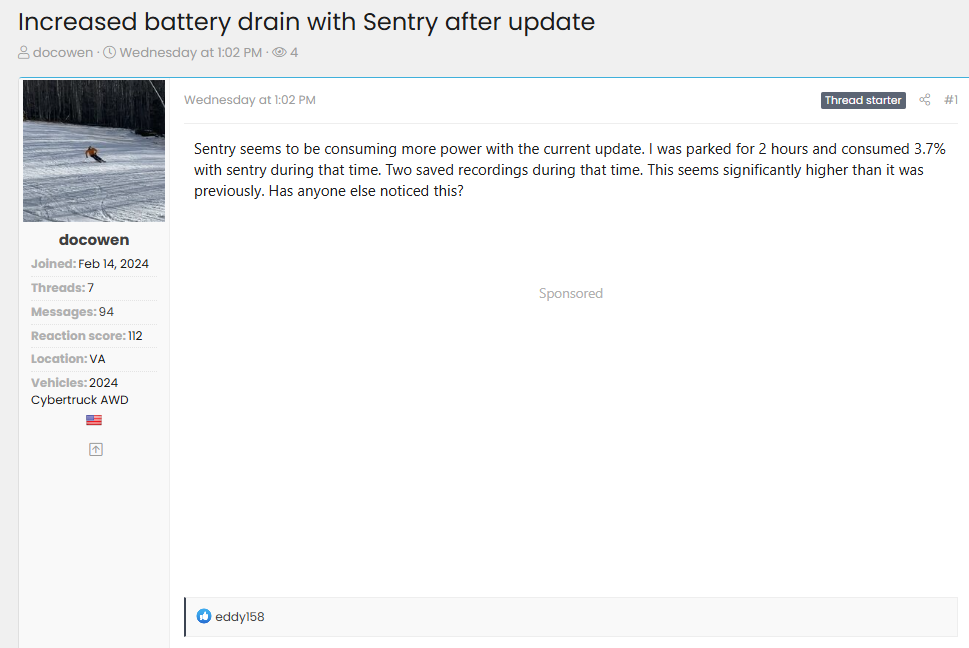
His numbers were specific, which made the thread immediately relevant. Owners know how their trucks behave under normal conditions, and any measurable deviation is worth examining.
Soon after, an engineer on the forum known as BrockN provided a confirming voice. He noted that his own consumption had risen since the update and added that his truck had begun preferring medium ride height for reasons he could not yet determine. None of these details were presented as complaints for the Cybertruck. They were observations offered in the same tone as someone noticing a new sound from an engine or a different feel in a shift pattern. Together, they established a pattern worth investigating and lent credibility to the idea that the change was not isolated.
Tesla Cybertruck: What Journalists Say About It
- Several road testers have remarked that visibility is better than expected, with the angular design and high seating position providing a clear view forward even though the bodywork appears imposing from the outside.
- The adaptive air suspension often attracts positive attention because it allows the Cybertruck to shift personalities, raising for off-road travel and lowering for improved highway efficiency and stability.
- Analysts reviewing its technology package consistently mention the real-time energy data and software interface, which give the driver a detailed understanding of how the truck consumes and recovers power during everyday use.
- Journalists examining towing behavior have noted that the Cybertruck’s electric torque delivery makes pulling trailers feel more controlled at launch, reducing the strain that usually comes with heavy loads.
Technical speculation arrived from CyberGus, whose mixture of IT expertise and hands-on ownership experience helped frame a possible cause. He pointed out that Sentry Mode for the Cybertruck now records from the B-pillar cameras, expanding the amount of video being captured and processed. This explanation fits neatly into the numbers. More streams mean more encoding operations and more activity from the computer responsible for handling them. Even without mechanical parts in motion, these processes can draw significant power, especially over hours of parking in a lot or garage.

Another owner, Fugue, added further context by citing two factors that often influence vehicle behavior after a major update. He mentioned that the Full Self Driving upgrade might be contributing, and that weather could be a variable. Both points carry weight. Software suites like FSD often continue background tasks even when the Cybertruck is off, and certain environmental conditions, particularly temperature extremes, can raise the demand on thermal management systems that protect the battery.
What makes this story compelling is not the absolute drain itself, since 3.7 percent over two hours will not strand anyone. The significance lies in the precision with which these owners track the smallest changes in their vehicles. They bought trucks that evolve, and they understand that evolution involves examining the details. When something shifts, they take note, compare experiences, and assemble a shared picture of what might be happening beneath the stainless bodywork.

This moment also highlights the modern reality of software-defined vehicles. A change in consumption may not stem from a mechanical flaw. It might instead be the side effect of expanded capability or an algorithm behaving differently than before. Over-the-air updates allow manufacturers to refine features quickly, yet they also create periods where owners sense unfamiliar behavior and turn to each other to map out what has changed. In this case, the community chose collaboration over speculation.
Until Tesla issues clarification or a follow-up update, the working theories remain centered on expanded camera activity, background FSD processes, or seasonal weather. None are unreasonable, and all fit the real-world experiences being shared. What stands out most is the collective approach these owners take. They analyze, share data, and refine their assumptions with a level of attention once reserved for timing lights and vacuum gauges. It is a new kind of enthusiast culture, and it is writing its own playbook one forum thread at a time.
Image Sources: Tesla Media Center
Noah Washington is an automotive journalist based in Atlanta, Georgia. He enjoys covering the latest news in the automotive industry and conducting reviews on the latest cars. He has been in the automotive industry since 15 years old and has been featured in prominent automotive news sites. You can reach him on X and LinkedIn for tips and to follow his automotive coverage.
Set Torque News as Preferred Source on Google
Follow us today...






Comments
Thank you to Noah Washington…
Permalink
Thank you to Noah Washington for writing excellent technical articles.