
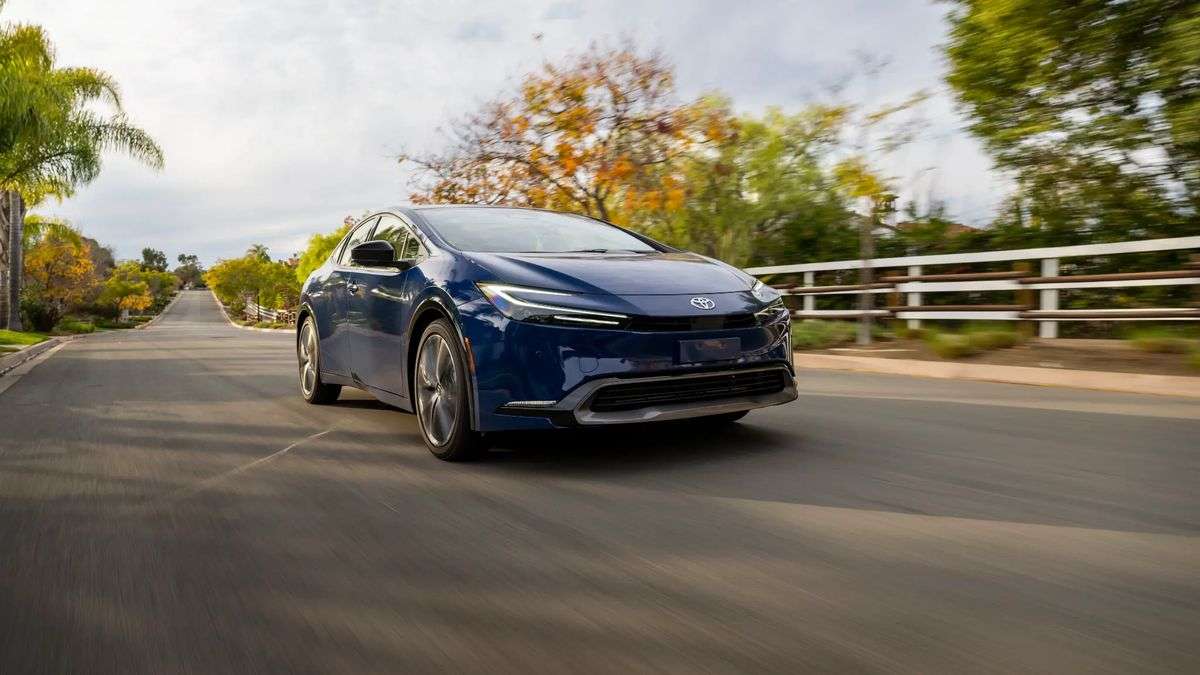

There was a time when the Toyota Prius existed mainly as a cultural shorthand, a car more often discussed than driven, usually by people who had not spent much time behind its wheel. That reputation has grown increasingly stale.
The current Prius is a sharp, well-sorted piece of transportation that rewards smooth inputs, carries real composure through corners, and makes the everyday act of driving feel thoughtfully engineered rather than merely endured.
Yet even a car built on good sense can stumble, and in this case, the misstep is literal, arriving in the form of oversized factory wheels that leave little room for forgiveness when pavement quality deteriorates.
One person went to Reddit to talk about it:
“As an update to my post from yesterday and for future awareness, since there's only a couple of posts from people doing this before on this subreddit
I decided to make the switch to 16" wheels instead of sinking more cost into these hopeless 19" wheels that shouldve never come on this car. I was already considering getting smaller wheels, so I figured this was a good time. I got wheels for around $100 each, and 205/65/16 michelin tires for about $170 each, bringing the total cost of this change to $1270 with the other misc. Fees from Discount Tire
I got the TPMS switched over from my tires, disposed of them since they were on their way out anyway, and now I have 3 OEM wheels to sell over time. I already have a spare tire, which saved my car from getting towed after hitting a pothole.
Advertising
Since it's the AWD model, the calipers are bigger than the non-AWD model,l so not all 16" wheels fit as nicely, but the MB Wheels Crux did with minor room to spare between the wheels. Only drove it for a little afterwards, but already it is indeed a better ride on tires that have sidewalls to them.”
I decided to make the switch to 16" wheels instead of sinking more cost into these hopeless 19" wheels that shouldve never come on this car. I was already considering getting smaller wheels, so I figured this was a good time. I got wheels for around $100 each, and 205/65/16 michelin tires for about $170 each, bringing the total cost of this change to $1270 with the other misc. Fees from Discount Tire
I got the TPMS switched over from my tires, disposed of them since they were on their way out anyway, and now I have 3 OEM wheels to sell over time. I already have a spare tire, which saved my car from getting towed after hitting a pothole.
Since it's the AWD model, the calipers are bigger than the non-AWD model, so not all 16" wheels fit as nicely, but the MB Wheels Crux did with minor room to spare between the wheels. Only drove it for a little afterwards, but already it is indeed a better ride on tires that have sidewalls to them.”
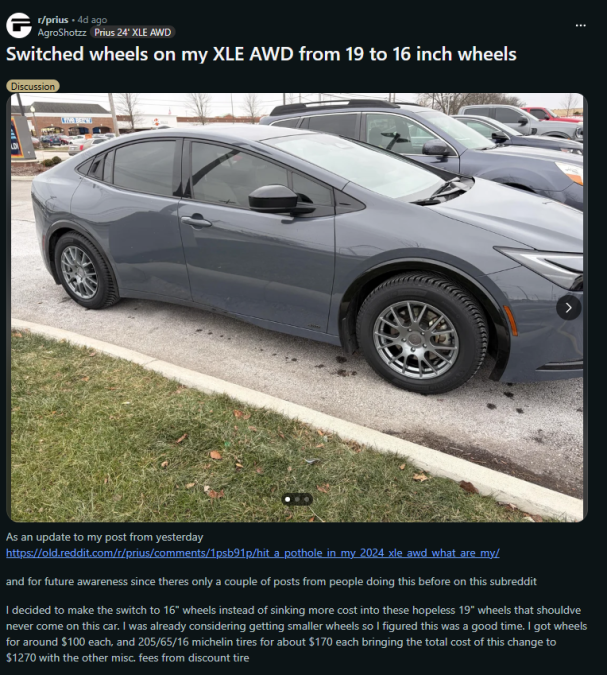
Anyone who has spent time around cars recognizes this narrative immediately. Large wheels photograph well, signal modernity, and suggest performance even when the mission brief does not require it. In practice, they ask a lot of public roads that are rarely prepared to give it. What reads in the Reddit post is not anger so much as pragmatism. This is a driver who looked at the cost of continuing down one path and chose instead to realign the car with its purpose.
Toyota Prius: Efficiency, Hybrid Performance, and Comfort Overview
- The Prius emphasizes aerodynamic efficiency through a low, tapered profile that supports fuel economy but slightly constrains rear visibility and headroom.
- Its hybrid powertrain prioritizes smooth, predictable operation over performance, delivering consistent efficiency in both city and highway driving.
- Interior controls are arranged to support everyday usability, with clear instrumentation and physical inputs retained for frequently used functions.
- Ride tuning favors comfort and stability, making the vehicle well-suited for commuting, though handling remains oriented toward efficiency rather than engagement.
The Prius XLE AWD already walks a careful line. It must deliver efficiency, stability, and year-round usability while still meeting modern expectations for style. Nineteen-inch wheels complete the visual statement, but they do so by shaving away the sidewall that could otherwise absorb broken pavement and sharp edges. By moving to a 16-inch wheel and a tire with a real profile, the car gains compliance almost immediately. The owner’s first impression was not subtle, describing a ride that felt better within the first few miles.
The community response reinforced the decision with a refreshing lack of drama. One commenter pointed out that the car would ride better and that replacement tires would cost less, calling it a win on both counts. Another noted that smaller wheels typically bring an efficiency benefit as well. These observations are neither controversial nor theoretical. They are the accumulated wisdom of drivers who understand that comfort, cost, and efficiency tend to move in the same direction when sidewall returns to the equation.
There is also a technical nuance worth noting. The all-wheel-drive Prius uses larger brake hardware than its front-drive counterpart, which means not every 16-inch wheel will fit. The owner’s solution required careful selection, ultimately landing on a wheel that cleared the calipers with little room to spare. It is a reminder that this was not a cosmetic whim but a considered mechanical change, one that respected the car’s engineering rather than working against it.
Questions about road noise followed naturally. Taller tires generally do a better job of muting impacts and filtering harshness, and while the post stops short of formal measurement, the expectation is grounded in decades of tire behavior. For a vehicle designed to be quiet, efficient, and low-stress over long distances, that improvement matters. It aligns with what the Prius does best instead of distracting from it.
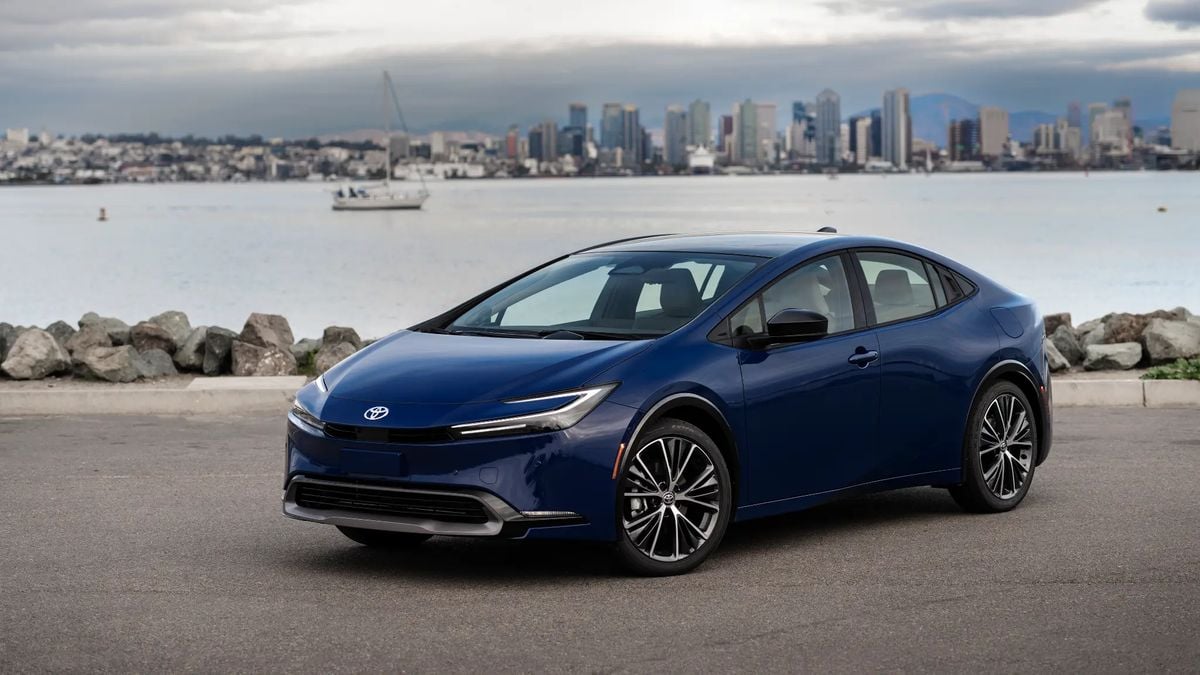
What makes this story compelling is not rebellion but restoration. The Prius emerges not diminished by the change but clarified by it, closer to its ideal form as a practical, engaging tool for daily travel. Spending $1,270 to undo a factory choice might sound counterintuitive, yet the result speaks for itself. Sometimes the most satisfying modification is the one that gives a car back its balance, reminding us that thoughtful design is not about excess, but about harmony between machine, road, and driver.
Noah Washington is an automotive journalist based in Atlanta, Georgia. He enjoys covering the latest news in the automotive industry and conducting reviews on the latest cars. He has been in the automotive industry since 15 years old and has been featured in prominent automotive news sites. You can reach him on X and LinkedIn for tips and to follow his automotive coverage.
Set Torque News as Preferred Source on Google
Follow us today...





Comments
Just curious here, but why…
Permalink
Just curious here, but why in the world would anyone go with a 19-inch wheel on a Prius? It's a Prius!!!
Simple. Car looks nice with…
Permalink
In reply to Just curious here, but why… by Buzz Wired (not verified)
Simple. Car looks nice with the 19s... horrible without!
You seem to be confused, the…
Permalink
In reply to Just curious here, but why… by Buzz Wired (not verified)
You seem to be confused, the owner did not “GO” with a 19” any more than you chose to GO with breathing. That is the way the model is optioned with no ability to change except aftermarket-wise.
Not having owned a Prius, I…
Permalink
Not having owned a Prius, I can say aesthetically, the smaller wheels are much less attractive and diminishes the cars appeal. But I can see the practicality of absorbing bumps without damaging a tire or wheel can be beneficial. Of course, I am from the old school where wire wheel discs on an Olds Ninety Eight or Buick Park Avenue was a REQUIREMENT! Oh, and white wall tires, too. I do appreciate newer cars with big wheels and black wall tires on modern vehicles. They each have-had their merit.
That’s the problem these…
Permalink
In reply to Not having owned a Prius, I… by Ty Thornburg (not verified)
That’s the problem these days, everyone is all about what looks cool and not what is functional. So quality decreases while the coolness factor increases, along with the prices. Car manufacturers are profiting off from pleasing to the eye, making less quality products, and keep you coming back for repairs. So they make money off from you both ways.
Where is there room for a…
Permalink
Where is there room for a spare in the Prius?
As the tíre rotations affect…
Permalink
As the tíre rotations affect the speedometer would one have to get the speedometer recalibrated to reflect more rotations per mile?
Why would there be more…
Permalink
In reply to As the tíre rotations affect… by Tom (not verified)
Why would there be more rotations per mile?
I had the same issue with 19…
Permalink
I had the same issue with 19" tires on 2010 Prius with Advanced Technology Package. I opted out on the low profile tires on the 2017 Prius Prime.
In addition to Not feeling…
Permalink
In addition to Not feeling every bump in the road, traction in snow is vastly superior as well on the 16s.
Yeah but much too far the…
Permalink
Yeah but much too far the other way, now it looks like someone wearing hiking boots with a suit; There's too much sidewall now, it looks like an off-road set of wheels on the wrong car. 17's would have been a better choice, and would likely have more choices that fit.
Stupid design choice for a…
Permalink
Bad design choice for an economy car that needs to stay focused on economy and comfort. Plenty of models on the market for people who want to pretend style is worth the sticker price. Oh well marketing works
Road noise will have more to…
Permalink
Road noise will have more to do with tire compound and tread design than wheel and tire size. Sounds like the Prius owner made a wise decision. My car is on 15s, you can have the rough riding and overpriced cartoon wheels and tires.
Ive the same problem with my…
Permalink
Ive the same problem with my Prius Prime. I have had 4 blown tires from potholes. What 16 inch rims do you recommend. Thanks