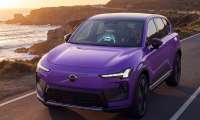

If you look at the automotive market today, the vendor landscape defining advanced driver assistance systems (ADAS) is undergoing a massive and brutal realignment. We are moving past the era where every tech CEO and legacy automaker promised fully autonomous, steering-wheel-less robotaxis by the end of the decade. Today, the reality of physics, the sheer cost of hardware integration, and the unforgiving economics of modern automotive manufacturing are forcing companies to make hard choices. Volvo, a brand historically synonymous with passenger safety and conservative engineering, has found itself navigating a peculiar strategic bind with its highly anticipated EX60.
As the electric successor to the legendary XC60—and fundamentally the vehicle that will drive Volvo’s high-volume EV adoption for the next five years—the EX60 is a masterclass in Scandinavian design and battery efficiency. But when you lift the hood on its autonomous capabilities, you see a company pivoting rapidly in response to supply chain failures and shifting corporate strategies. To understand how competitive the Volvo EX60 truly is in the self-driving arena, we must dissect the hardware, evaluate the competition, and look closely at the internal dynamics of Volvo’s parent company, Geely.
The Current Status Of Self-Driving In The EV Market
To frame Volvo’s position accurately, we first need to look at the broader state of self-driving technology in the electric vehicle sector. The industry is currently split by a massive chasm between Level 2 (supervised autonomy) and Level 3 (conditional unsupervised autonomy), based on the industry-standard SAE classification system.
For years, the market has been dominated by the hype surrounding Tesla’s Full Self-Driving (FSD) beta, which, despite its aggressive branding, remains a Level 2 system requiring constant driver supervision and legal responsibility. Tesla has famously bet the farm on a pure-vision approach, relying entirely on optical cameras and massive neural net training data, actively shedding radar and ultrasonic sensors to cut manufacturing costs and streamline software development.
On the other side of the spectrum, legacy automakers have taken a more expensive, sensor-rich approach. Companies are deploying high-definition LiDAR arrays and heavily pre-mapped highway data to achieve genuine hands-off capabilities. We recently saw a massive breakthrough when Mercedes-Benz achieved the first U.S. certification for a Drive Pilot Level 3 system. Under specific conditions—such as heavy traffic under 40 mph on mapped divided highways in states like California and Nevada—the Mercedes system actually assumes legal liability. This allows the driver to legally watch a movie, check emails, or look away from the road entirely.
However, the hardware shakeout is real. Sensors are notoriously expensive to integrate, calibrate, and maintain over the lifespan of a vehicle. We are currently witnessing a pragmatic retreat by many mid-market automakers who realize that mainstream consumers are simply not willing to pay a $10,000 premium for a sensor suite that only works on a handful of pre-approved highways. The broader EV market is rapidly shifting from the philosophy of "promise everything, everywhere" to delivering highly reliable, localized safety nets that reduce driver fatigue without removing the driver from the loop.
Unpacking The ADAS Technology Inside The Volvo EX60
Volvo initially seemed poised to lead the hardware charge. The flagship EX90 was marketed heavily on its inclusion of standard roof-mounted LiDAR, promising unparalleled safety through laser precision. However, vendor dependencies are a double-edged sword in the technology industry. When Luminar—the company supplying Volvo’s LiDAR sensors—faced catastrophic financial hurdles and restructuring, Volvo had to aggressively alter its product roadmap. As industry watchers noted, this failure forced a pivot away from standard LiDAR for the brand's subsequent rollouts.
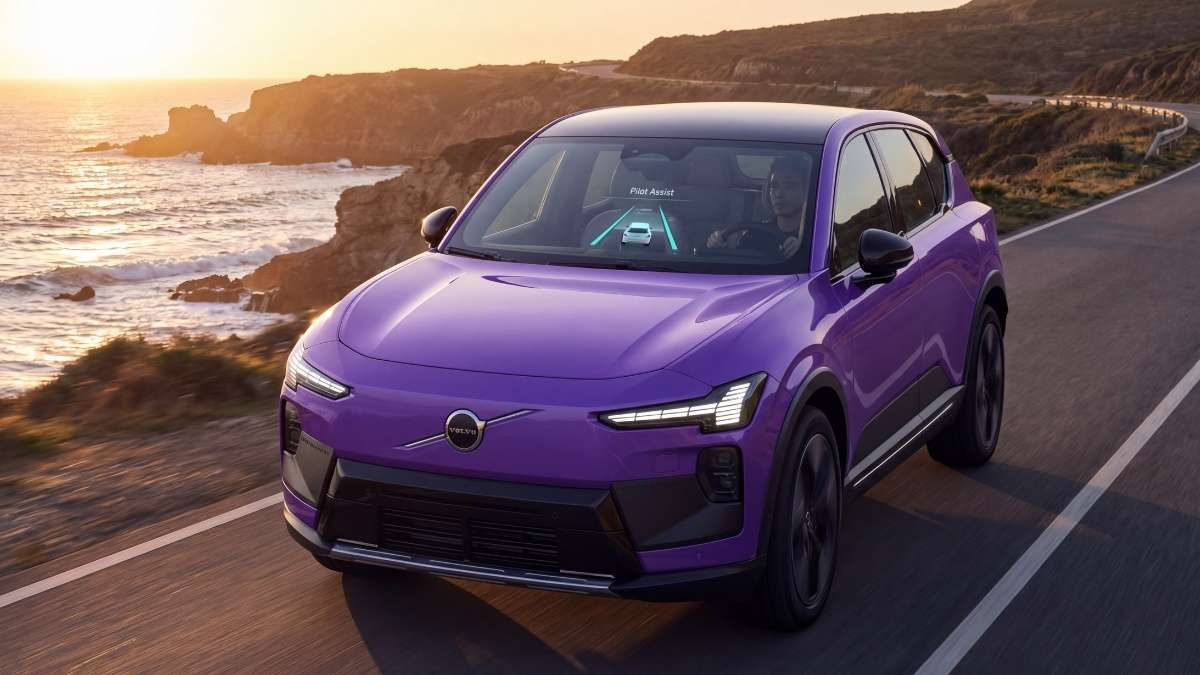
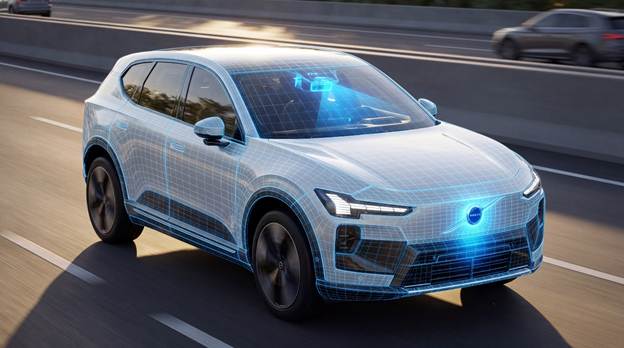
The EX60, built on Volvo's revolutionary SPA3 architecture, represents this new pragmatic baseline. Instead of complex and expensive laser arrays, the EX60 utilizes a single Nvidia Drive AGX Orin X system-on-a-chip capable of roughly 254 Tera Operations Per Second (TOPS). This highly capable silicon is paired strictly with standard optical cameras and high-resolution radar.
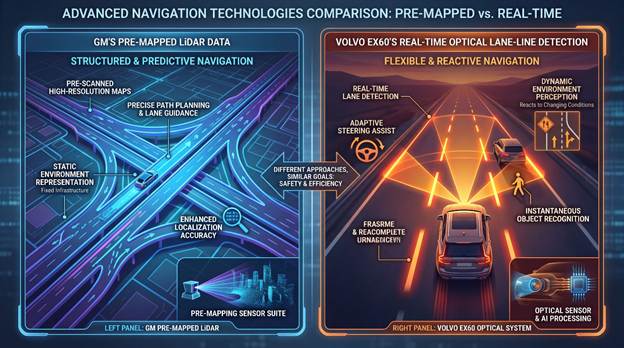
It runs Volvo’s next-generation Pilot Assist, which is fundamentally a vision-and-radar-based lane-centering and adaptive pacing system. Without HD LiDAR maps to rely on, the EX60 processes the environment dynamically in real-time. If the vehicle encounters a situation where lane lines fade, where heavy sun glare blinds the optical cameras, or where a highway curve is sharper than the predictive models anticipate, the system is programmed to degrade gracefully or demand immediate driver intervention.
In engineering terms, having a powerful Nvidia Orin chip without LiDAR is like having a brilliant mind processing information through blurry glasses. The compute power is certainly there, but the perception inputs are fundamentally limited by the nature of standard optics. For those tracking this capability gap closely, the community analysis regarding point-to-point self driving capability in the EX60 provides a sobering look at what the hardware can actually deliver on public roads, confirming that buyers should expect a highly refined driver-assist experience rather than a hands-free chauffeur.
Comparing The EX60 Autonomy Against The EV Competition
When we stack the EX60 up against its direct rivals in the premium electric SUV space, the capability gap becomes highly apparent.
Consider General Motors’ Super Cruise, widely regarded as one of the best hands-free highway driving systems available today. Super Cruise operates on an entirely different logic model than Volvo’s Pilot Assist. GM relies on heavily pre-mapped, high-definition LiDAR data of the North American highway system, encompassing hundreds of thousands of miles of roads. When you engage Super Cruise on a mapped interstate, the vehicle acts like a localized train on virtual rails. It knows exactly where a curve is before the vehicle’s optical cameras even register it. On complex highway geometries, GM’s system holds the center of the lane with a confidence and reliability that a purely dynamic vision system like the EX60 simply cannot match.
Compared to Tesla’s Autopilot and HW4 FSD suite, Volvo offers a more relaxed, less aggressive system. Tesla’s system is highly capable in complex urban environments but is often criticized for "phantom braking" and abrupt steering corrections due to its stubborn pure-vision reliance. Volvo’s inclusion of radar provides a crucial layer of physical redundancy for distance pacing that Tesla lacks. This makes the EX60 vastly smoother in stop-and-go highway traffic, even if it lacks the point-to-point urban navigation features that Tesla beta testers enjoy on city streets.
Ultimately, compared to the broader EV landscape, as noted in recent test drives, the EX60 is an exceptionally well-balanced vehicle that hits the center of the market perfectly, but its ADAS suite feels distinctly entry-level compared to the heavyweights. It operates more in the tier of Toyota Safety Sense 3.0 or Hyundai’s Highway Driving Assist II—competent, impeccably safe, but strictly demanding the driver's full attention at all times.
Evaluating The Self-Driving Hierarchy Within The Geely Portfolio
To truly understand Volvo’s current technological position, you have to zoom out and look at its parent company, Geely. Geely operates a vast umbrella of automotive brands, and they execute a highly calculated technological tiering strategy across their massive global portfolio.
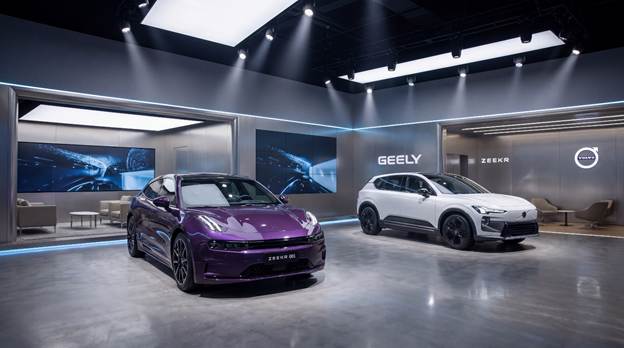
If you want the bleeding edge of self-driving tech within the Geely ecosystem, you do not look at Volvo; you look at Zeekr and Lotus. Zeekr, Geely’s premium tech-forward brand, operates as the vanguard for autonomous testing and deployment. Vehicles like the Zeekr 001 and 009 utilize Mobileye SuperVision, a robust ADAS that acts as a bridge between assisted and consumer autonomous driving. This advanced system utilizes 11 cameras, crowdsourced Mobileye Roadbook maps, and dual EyeQ5 chips to achieve highly advanced, point-to-point automated navigation. Zeekr’s system is actively executing autonomous highway lane changes and navigating complex interchanges in real-world scenarios today.
Lotus, completely reinvented as an electric performance brand under Geely, takes this philosophy even further. They are integrating deployable roof and fender LiDAR systems alongside dual Nvidia Orin chips, providing massive compute redundancy aimed at future Level 4 track and highway autonomy.
Within this internal corporate hierarchy, Volvo has been deliberately repositioned. No longer the experimental tip of the spear, Volvo serves as Geely’s mass-market, high-margin prestige brand. The EX60 is designed for mainstream volume adoption across Europe and North America. Consequently, Geely is keeping the vehicle's bill of materials aggressively low. By stripping out LiDAR and avoiding the expensive licensing fees associated with Mobileye's highest-tier mapping services, they are maximizing the EX60's profitability. Geely is banking on the Volvo brand’s intrinsic, decades-long reputation for passive crash safety to appease consumers, rather than pushing the envelope on active autonomy.
Forecasting How Self-Driving Will Evolve At Volvo
Looking forward, how will the self-driving experience in the EX60 and future Volvo models evolve? The operative word is incremental.
Volvo has transitioned fully to a Software-Defined Vehicle (SDV) framework. The 254 TOPS provided by the Nvidia Orin chip in the EX60 is currently underutilized by the baseline software available at launch. Over the next five to seven years, Volvo will push continuous Over-The-Air (OTA) updates to refine the perception stack. Drivers will notice the vehicle getting slightly better at holding lane center in the rain, pacing traffic more naturally during rush hour, and executing driver-initiated lane changes more smoothly.
However, the hardware ceiling is rigidly fixed. Without a hardware retrofit to include LiDAR or high-definition integrated mapping, the EX60 will never magically become a Level 3 vehicle where you can legally read a book on the highway. Volvo’s foundational corporate mandate remains "zero serious injuries," and their internal software development will prioritize extreme caution—such as superior automatic emergency braking, pedestrian detection, and cross-traffic mitigation—over party tricks like hands-free urban navigation.
If Volvo wishes to regain the autonomous crown in the latter half of the decade, they will likely have to reach back into the Geely parts bin. A future mid-cycle refresh of the EX60 could theoretically abandon the in-house Pilot Assist development entirely and license the next generation of Mobileye's Chauffeur system from their sister brand Zeekr, ensuring they stay competitive as the regulatory hurdles for hands-off driving continue to fall across the globe.
Wrapping Up
The Volvo EX60 is a masterfully engineered electric vehicle built on a highly efficient platform that will undoubtedly drive massive volume for the brand. It succeeds spectacularly as a premium EV. However, when evaluating its self-driving competitiveness, the EX60 is an exercise in carefully managed expectations. By relying strictly on vision and radar, and purposefully bypassing the expensive LiDAR and HD mapping systems embraced by GM and Mercedes, Volvo is fielding a safe, competent, but distinctly entry-level ADAS experience. It is a pragmatic, margin-friendly vehicle that requires you to keep your hands on the wheel and your eyes on the road at all times, signaling that the era of automated hype has officially yielded to the era of automotive reality.
Disclosure: Images rendered by Artlist.io
Rob Enderle is a technology analyst at Torque News who covers automotive technology and battery developments. You can learn more about Rob on Wikipedia and follow his articles on TechNewsWord, TGDaily, and TechSpective.
Set Torque News as Preferred Source on Google
Follow us today...