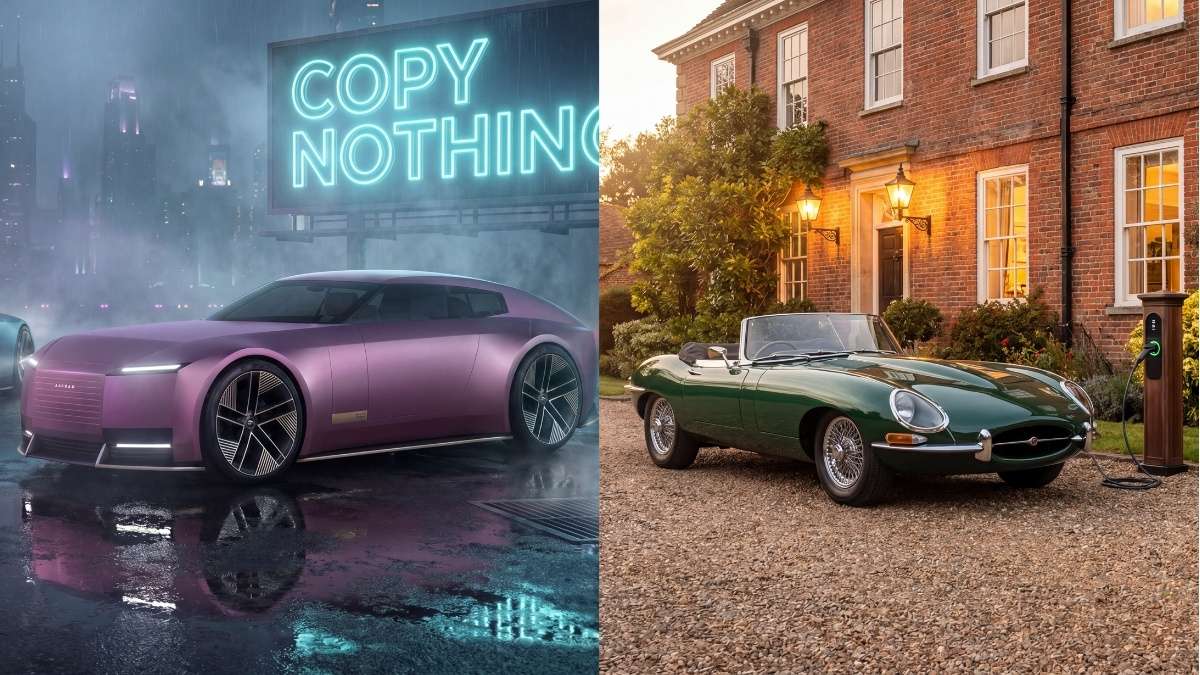

Jaguar is navigating one of the most radical, bet-the-company brand reinventions in modern automotive history. Moving entirely away from its internal combustion heritage, the storied British marque is staking its survival on a highly polarized, ultra-premium electric future. As recently confirmed by industry trackers, Jaguar’s 1,000-hp electric flagship is officially called the Type 01. Priced well into the six-figure range, this impending vehicle is designed to compete directly with titans like Porsche and Bentley. It promises blistering acceleration, bleeding-edge architecture, and a design language that aggressively severs all visual ties with the company's illustrious past.
But for the true automotive enthusiast - the discerning buyer who has $130,000 or more to spend on an electrified statement piece - there is a highly compelling alternative that seamlessly blends the turn-key reliability of a modern EV with the undeniable romance of mid-century industrial design. That alternative is the classic Jaguar E-Type "electromod."
As a technology analyst who spends an inordinate amount of time evaluating the future of personal transportation, and who happens to have a very personal stake in classic Jaguars—specifically, maintaining and enjoying my 1970 restomod E-Type speedster - I find this crossroads utterly fascinating. Is buying an ultra-modern, 1,000-horsepower Type 01 actually a better purchase than dropping a low-maintenance electric conversion kit into one of the most beautiful cars ever manufactured? To answer that, we must dive into the financial realities of modern restomods, the economics of EV conversions, and the fundamental differences in what these two vehicles deliver to the driver.
 .
.
The Cost and Craft of Electrifying an E-Type
Converting a classic Jaguar E-Type to electric power is no longer a fringe, weekend-garage experiment; it has evolved into a highly refined, brilliantly engineered boutique industry. If you are considering this path, the financial calculus is significant but surprisingly competitive with the purchase of high-end modern luxury EVs.
First, you must acquire a donor car. Depending on the condition, a Series 1, 2, or 3 E-Type can range anywhere from $50,000 for a rolling restoration candidate to well over $150,000 for a pristine, numbers-matching example. (Though, to be clear, purists and preservationists generally advise against ripping the beating heart out of a concourse-level, historically significant classic). The conversion process itself typically costs between $90,000 and $150,000, depending heavily on the desired battery capacity, motor output, and the level of modernization applied to the suspension, brakes, and interior amenities.
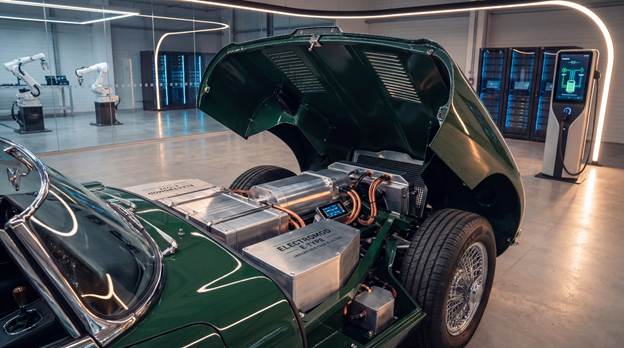
Several companies now execute this conversion exceptionally well. Electrogenic, a UK-based engineering firm, has pioneered brilliant "drop-in" kits. As someone who builds custom high-performance PCs every quarter, I deeply appreciate their modular approach. Their system utilizes the existing engine and gearbox mounts, ensuring that the E-Type's historic chassis requires absolutely no cutting, welding, or permanent modification. The battery packs are meticulously shaped to fit precisely where the original straight-six engine and fuel tank resided, perfectly preserving the car's legendary weight distribution. Lunaz Design takes a slightly different, more comprehensive approach, offering full, ground-up restorations that integrate electric powertrains alongside modernized HVAC, bespoke infotainment, and dramatically uprated driving dynamics, resulting in vehicles that easily cost north of $400,000. Stateside, ECD Auto Design has expanded from their legendary Land Rovers to offer beautifully tailored electric E-Types using proven, high-output EV drivetrains.
Are people actually pleased with the result? Overwhelmingly, yes. The primary pain point of classic British car ownership has always been the unpredictable reliability of older Lucas electronics—often jokingly referred to as the "Prince of Darkness" - and temperamental dual-carburetor setups. By entirely removing the volatile combustion components and installing a virtually maintenance-free electric powertrain, owners report a profound sense of relief. The car starts every single time, it doesn't overheat while sitting in summer traffic, and the instantaneous torque transforms the driving dynamic from a nostalgic chore into an effortless, modern thrill.
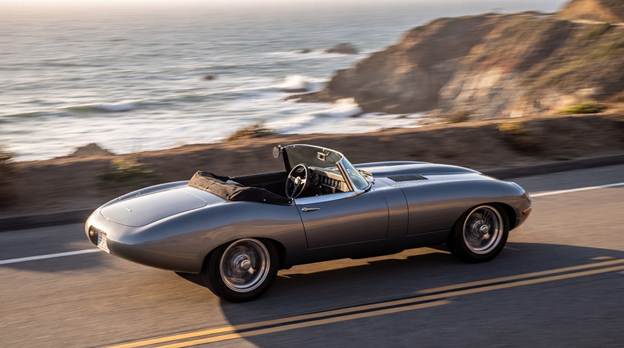
Performance and Driving Dynamics
When comparing a modern hyper-EV to an electrified classic, the performance metrics tell two very different, distinct stories. The upcoming Jaguar Type 01 boasts a staggering 1,000 horsepower. Thanks to its advanced 800-volt architecture, it will feature incredible power delivery and rapid charging capabilities. Having recently toured the state-of-the-art Kia Metaplant in Georgia and examined vehicles like the 2026 Kia EV6, I can attest that 800V systems are the absolute standard for premium EVs going forward, allowing for thinner wiring, less thermal degradation, and superior sustained performance.
The Type 01 will utilize all this power alongside torque vectoring, adaptive air suspension, and an array of sensors designed to keep the vehicle planted at speeds most drivers will never legally reach. However, we must be precise with our terminology. Some marketing materials might incorrectly label these advanced stability systems as "agentic AI." Let's be clear: using "agentic AI" to describe real-time traction control and torque vectoring is fundamentally a conceptual mismatch. These are highly advanced, low-latency execution systems, not autonomous decision-making agents. Ultimately, the Type 01 will be a rocket ship - heavy, technologically isolated, and ferociously fast.
A classic E-Type electromod, by contrast, rarely exceeds 300 to 400 horsepower. But in the modern EV era, horsepower is a cheap commodity; weight is the true luxury. A beautifully converted E-Type often weighs less than 3,000 pounds. The Type 01 will likely weigh closer to 5,500 pounds due to its massive battery packs and stringent crash safety structures.
The driving dynamic of the E-Type EV is analog, engaging, and visceral. You feel the texture of the road through the unassisted (or very lightly assisted) steering rack. The instantaneous, silent torque from the electric motor pushes the lightweight chassis forward with a startling urgency that feels much faster than its raw numbers suggest. It remains a true driver's car. The Type 01, conversely, will heavily isolate the driver from the road. Its performance will be managed entirely by software, delivering a digital, warp-speed experience that is awe-inspiring in a straight line but ultimately detached in the corners.
Resale Value and Investment Potential
One of the most critical aspects of purchasing a six-figure automobile is analyzing how the secondary market will treat your investment over a five-to-ten-year horizon. If you are managing a trust or simply being smart with your capital, this matters immensely.
Historically, luxury electric vehicles suffer from catastrophic depreciation. The underlying technology moves so rapidly that a flagship EV from 2020 already feels distinctly archaic in its charging speeds and range compared to 2026 models. The Jaguar Type 01, despite its striking new design language and massive power output, will almost certainly follow this brutal trend. Data shows that high-end electric sedans and GTs from established luxury automakers routinely lose upwards of 45% to 50% of their value within the first three to five years. You are essentially buying a rapidly depreciating consumer electronic device that happens to have wheels.
An electrified classic E-Type operates in an entirely different financial universe. Classic car values have proven remarkably resilient over the decades. While automotive purists often argue that removing the original internal combustion engine hurts a vehicle's provenance, the completely reversible nature of drop-in kits from companies like Electrogenic thoroughly mitigates this risk. You can carefully crate the original engine, transmission, and exhaust components, preserving the car's historical integrity, while thoroughly enjoying the reliability of the EV powertrain today. Consequently, an electrified E-Type maintains its status as a tangible, appreciating asset. The aesthetic value of the E-Type is timeless, and adding reliable, modern drivability actually broadens its appeal to a younger demographic of wealthy buyers who desperately want the vintage look but refuse to deal with vintage mechanical headaches.
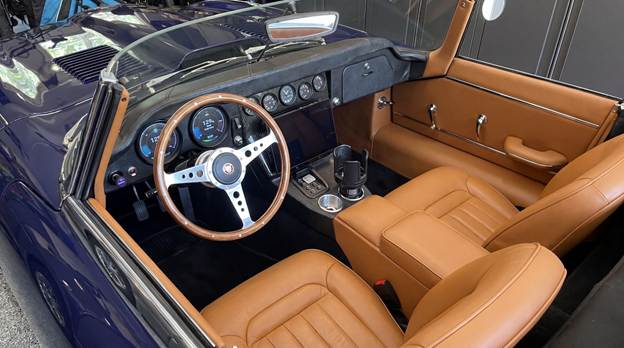
Status and Aesthetic Appeal
Status is highly subjective, but automotive history is decidedly not. When Enzo Ferrari debuted his own legendary sports cars, he famously referred to the Jaguar E-Type as the most beautiful car ever made. Its infinitely long hood, sweeping curves, and undeniable physical presence make it a certified masterpiece of 20th-century industrial design. Arriving anywhere in an E-Type—whether powered by gasoline or electrons—commands universal respect, admiration, and a barrage of enthusiastic questions from onlookers. It is a rolling piece of art that easily transcends automotive tribalism.
The Jaguar Type 01 represents a massive, bet-the-farm aesthetic gamble for the brand. Jaguar’s new design philosophy is intentionally polarizing, aiming to attract a new generation of ultra-wealthy buyers while deliberately alienating its traditional, older customer base. While it will undoubtedly turn heads upon its release due to its sheer novelty and aggressive proportions, it will also draw inevitable, grueling comparisons to other modern luxury EVs. Its status is intrinsically tied to its steep price tag and its raw performance metrics, both of which will eventually, inevitably be surpassed by the next iteration of electric hypercars. The E-Type's status, however, is permanently secured in the global pantheon of design.
Practicality and Daily Usability
If there is a category where the Type 01 secures a definitive, unquestionable victory, it is in practicality and modern safety. The Type 01 will feature the absolute latest in rapid DC fast charging infrastructure, likely capable of adding hundreds of miles of range in under 20 minutes thanks to its advanced battery chemistry. It will possess modern, energy-absorbing crumple zones, multiple airbags, advanced driver-assistance systems (ADAS), and a sophisticated, multi-screen infotainment suite seamlessly integrated into the cabin. It is a highly capable vehicle you can comfortably and safely drive across the country in pouring rain or freezing snow.
An E-Type restomod, conversely, remains a fair-weather friend. Most classic EV conversions rightly prioritize vehicle weight and handling balance over massive battery capacity, resulting in real-world driving ranges of roughly 150 to 200 miles. Furthermore, physical packaging constraints usually limit high-speed DC fast-charging capabilities, meaning a long road trip requires incredibly careful logistical planning and significant patience at Level 2 chargers.
Safety is another critical, unavoidable factor; the E-Type was fundamentally designed in the late 1950s. It lacks crumple zones, side-curtain airbags, and modern rollover protection. It requires an engaged, hyper-aware, defensive driver. You do not realistically commute in an E-Type restomod; you take it out for curated weekend drives, scenic coastal runs, dinner dates, and elite cars-and-coffee events. It is an occasion vehicle, not a daily appliance.
The Buyer Profiles
The target buyer for the Jaguar Type 01 is a wealthy early adopter with substantial disposable income who desires the absolute pinnacle of contemporary automotive technology. They want the 1,000 horsepower to casually impress their peers, the striking, brutalist design to stand out in a valet line currently dominated by Audi E-Tron GTs, Porsche Taycans, and Tesla Model S Plaids, and the effortless comfort of a modern luxury cruiser. They view their cars as high-tech, luxurious appliances that directly reflect their forward-thinking, bleeding-edge personal brand.
The buyer for the classic E-Type EV conversion is fundamentally driven by nostalgia, timeless aesthetics, and a deep desire for a tactile, analog experience. They have likely owned classics before and are thoroughly exhausted by the constant mechanical maintenance, or they are affluent enthusiasts who have always loved the unmistakable E-Type silhouette but refused to deal with flooded carburetors and persistent oil leaks on their garage floor. They value automotive heritage over top speed and are perfectly happy sacrificing modern digital conveniences for the visceral, unadulterated joy of piloting a mid-century icon that starts silently and flawlessly on the first turn of the key.
Wrapping Up
As Jaguar aggressively, and somewhat perilously, reinvents itself with the breathtaking, 1,000-hp Type 01, it is asking premium buyers to buy into an entirely new, unproven vision of what a British luxury vehicle can be. For those seeking the ultimate in modern speed, comprehensive safety, and ultra-fast 800-volt charging infrastructure, the Type 01 will likely be a formidable - albeit rapidly depreciating—machine.
However, for the exact same financial outlay, the classic E-Type restomod offers an emotional experience that modern software and engineering simply cannot replicate. By meticulously dropping a reliable, low-maintenance electric powertrain into an indisputably beautiful vintage chassis, you completely strip away the frustrations of classic car ownership while perfectly preserving its soul. The restomod market has matured into a brilliant engineering sector, producing balanced, lightweight, and incredibly satisfying vehicles that securely hold their financial value while turning every single drive into a momentous occasion. While the Type 01 aims to be the high-tech car of tomorrow, an electrified E-Type successfully achieves something far more difficult: it perfects the absolute best of yesterday.
Disclosure: Images rendered by Artlist.io
Rob Enderle is a technology analyst at Torque News who covers automotive technology and battery developments. You can learn more about Rob on Wikipedia and follow his articles on TechNewsWord, TGDaily, and TechSpective.
Set Torque News as Preferred Source on Google
Follow us today...