
Toyota is often synonymous with reliability, but even their models are prone to having issues every now and then. While the Japanese company's more recent models leave something to be desired in the quality department, things seem to be a lot smoother with the older models. Still, one forum member started an interesting and somewhat amusing discussion on Toyota Nation, regarding what may or may not be a well-known issue. Here's what he says:
“My son-in-law is driving a 2007 Camry that I purchased because he was unemployed, but tonight he said that it's blowing blue smoke from the exhaust, and he needs to get it in and checked. He's still unemployed, so I will be paying for whatever it is that's causing it to be repaired. Can you give me some idea of what it's most likely to be?”
One forum member has chimed in with, as he speaks of a well-known issue of the sixth-generation Toyota Camry.
A forum member who goes by 1996ClaretCamry says, “If it's a four cylinder, it probably has the classic problem. On the Gen Six four-cylinders, they made the oil drain back holes in the pistons too small, and they quickly plugged up.
The oil can't escape the combustion chambers and is burned instead. Some engines ran dry of oil while still under warranty. Toyota barely avoided a total recall of these engines by offering to rebuild them if they burned too much oil during a test period (set at an indefensibly high burn rate, but it was something).
But that was if the car was less than ten years old and less than 100k miles, IIRC. It can be fixed by replacing the pistons and rings (I think without pulling the engine?), assuming the bores are still good. There may be other reasons for oil burning, like the PVC system. But I doubt it. Regardless, he HAS to check the oil WEEKLY or say, every hundred miles and keep the level right. Now what it's doing to the cats is another problem...”
Everything points to a well-known issue that may lead to more problems
The 2007 Toyota Camry had two engine options – a 2.4-liter, 2AZ-FE, inline-four and a 3.5-liter, 2GR-FE V-6. Both are normally aspirated. While both units are known to last long when properly maintained, it is the base four-cylinder engine that can give you more trouble.
Aside from his son-in-law's employment status, which the Toyota forum member was very keen on pointing out, the description fits a well-known problem with Toyota's 2AZ-FE engine.
The unusually high oil consumption this unit suffers from is due to a faulty piston-ring design. As another forum member explained it, the drain holes on the piston rings are too small and can clog easily. This is especially true if the oil-change intervals aren't kept up with. If left unattended, this can lead to bore scoring.
You would not be entirely wrong thinking this could be a clogged PCV valve. The symptoms are very similar. Moreover, bad piston rings can also contribute to problems with the PCV as this forces more oil into the combustion chamber. Granted, issues with the positive crankcase ventilation aren't always accompanied by blue smoke, depending on the severity of the issue.
Regardless, unusually high oil consumption can also lead to the catalytic converter getting clogged much sooner than anticipated. That's because oil residue and carbon deposits now join the exhaust gasses as they attempt to pass through the catalytic converter's honeycomb inner structure, reducing the filtering capabilities.
2000s Toyota build quality doesn't represent the brand's finest hour
While there are plenty of high-mileage Toyota vehicles, produced in the 2000s, that are still on the road, this era of the Japanese brand is filled with various quality issues as well as reliability concerns like the above-mentioned. Unlike the everlasting, second-generation Toyota Tundra, the mid-2000s Camry is one of those less-fortunate models. There is a popular Reddit discussion on 2000s Toyota build quality, and people have a lot to say.
Here are some of the common problems reported on the earlier sixth-generation (2006-2009/ pre-facelift) Toyota Camry.
-
Advertising
High oil consumption – by far, the most concerning and widely-discussed issue, corresponding to the above-mentioned issue. The Camry's four-cylinder engine suffers heavily by the bad piston-ring design, causing severe oil consumption – reports indicate a consumption of 1 quart per 500 to 1,000 miles.
-
Transmission jerking and slippage – some examples of the sixth-generation Camry can suffer from unusually high RPM climb that does not correspond to the increase in speed – slippage – there are also reports of hesitant acceleration, particularly on third and fourth gear. The cause is low or contaminated transmission fluid, worn-out torque converter or lock-up clutch, or solenoid failure.
-
Melting dashboards – the dash material can degrade with time (and due to heat), causing it to become sticky.
Final thoughts
There are many who choose Toyota vehicles for their reliability, and this goes double for older vehicles. That said, this owner's ownership experience is plagued by a well-known issue. In this case, the issue manifested itself post-purchase, leaving the Camry owner with a hard choice to make – sell for cheap or repair. Toyota quickly improved things after 2009, and to this day, the Toyota Camry continues to be one of the most popular sedans in America, despite some minor glitches.
Replacing the piston rings on a 2007 Toyota Camry can cost anywhere from $1,000 to $5,000, depending on whether or not you need to overhaul the entire engine. The issue had manifested recently, so it may be possible to sort it out within the lower end of the price bracket.
What's your experience with 2000s Toyota models? What would you do in a similar situation? Let us know in the comments section below.
Dimitar Angelov's automotive interests made him an expert in a wide variety of vehicles. Japanese brands like Toyota are closest to his heart, although performance cars in general are his favorite segment, which is why he is constantly on the lookout for the best deals on the market. Dimitar Angelov's car passion and knack for the written word led him to complete a Master of Arts in Media and Communications, and classic car restoration. Dim is happy to get behind the wheel of any car and share his impressions. You can follow Dimitar on X, Linked-in, Instagram, and Facebook.
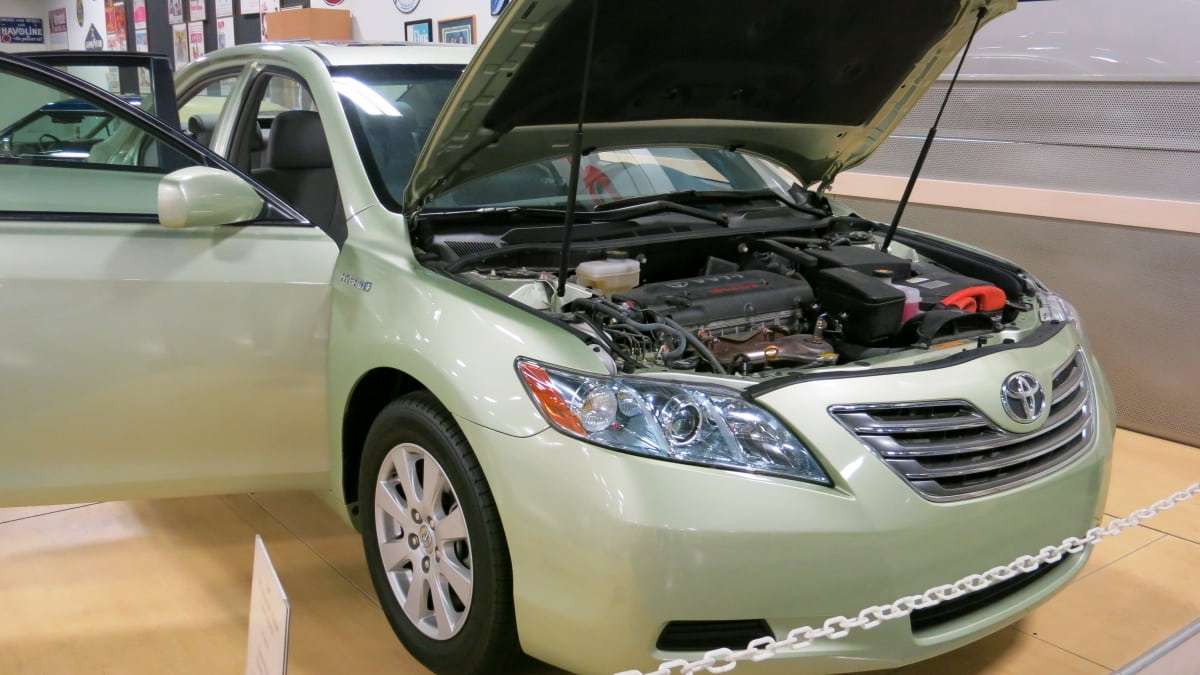
Image source: CapCase via commons. wikimedia.org
Set Torque News as Preferred Source on Google
Follow us today...