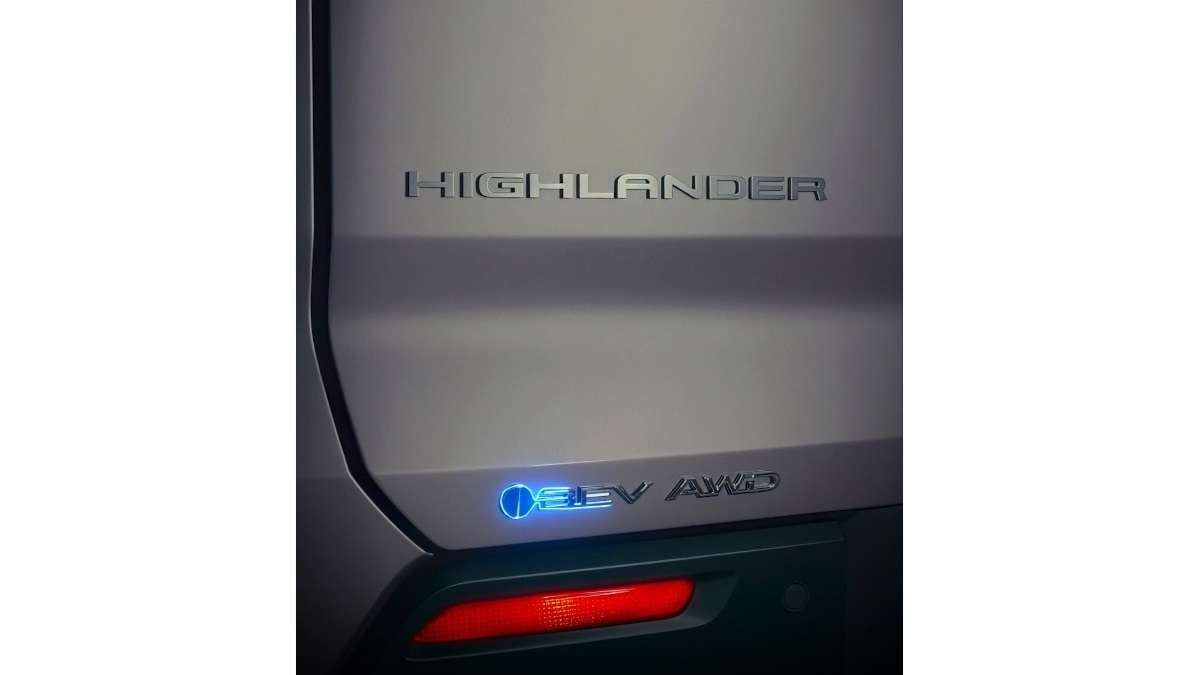

Toyota today confirmed speculation that its next-generation top-selling three-row Highlander SUV will be all-electric. The confirmation arrived as a short video clip. In the clip, a light scans across the Highlander’s model designator, which is “BEV.” BEV stands for battery-electric vehicle. Think of it as meaning battery-only, not hybrid.
Setting aside my two decades of new vehicle reviews, this is a personal story for me to write. My family owned a first-generation 2007 Toyota Highlander for sixteen years. It served three generations of family members, both my kids learned to drive in it, and it was eventually gifted to a new family in need.

The Highlander has been electrified since its first generation, which had a V6 assisted by electric propulsion as an optional trim. It carried on this way, and later shifted to Toyota’s more modern four-cylinder hybrid system, complete with a rear electric drive unit that eliminated the need for a drive shaft. The electrified Highlander Hybrid has proven very popular among buyers. In 2025, half of shoppers opted for the hybrid.
Toyota added a larger model called Grand Highlander during the last generation, which has expanded overall sales of the Highlander nameplate, and the traditionally-sized (smaller) Highlander has lost some buyers as many families opted for the larger Grand Highlander.
It would seem as if the new Highlander moving to all-electric will carve out the Highlander name for that powertrain. It could also be offered as a hybrid, but more likely, Toyota has developed a new all-electric platform that won't lend itself well to also being powered by a hybrid powertrain. Though possible, it’s trickier to manufacture the dual-powertrain setup. We assume the Grand Highlander will be sold as a hybrid, capturing the family buyer who wants both size and the ease of a battery-only powertrain.
For drivers, the primary benefit of going BEV is the instant torque from an EV powertrain, which means confident merges, easy passes, and better pickup when you’re trying to thread into traffic headed to the school or daycare drop-off with a car full of sleepy kids. Around town, an EV Highlander will also be calmer with no engine drone to disrupt your sixth-grader finishing some last-minute math homework in the carpool line. There will be no rumble when a toddler finally falls asleep. Just a steady hush, punctuated by the sound of the mandatory EV hum of a spaceship at low speeds.
Then there’s home charging, which is reserved for wealthier Americans who own their own home. For the better-off, plugging in overnight means waking up to a full charge in the morning and no more need to head to the gas station. The flip side to this coin is that for those families who don’t have a home charger, public charging requires adapting one’s life to the car, which becomes another needy entity in the family.
We’d peg the range at around 300 miles, typical for EVs launching in 2026 and 2027. DC charging will, of course, be available, and if Toyota has any sense, the Highlander BEV will have an NACS-style, Tesla-style charge port, which will allow for Supercharger use. For those with an at-home level 2 charger already, adapters or a new wall-mounted charger will be needed.

Moving the Highlander to all-electric is a bold step for Toyota. The Highlander has long been loved by families for its utility and flexibility. Being reliant on public charging will quickly earn the Highlander a bad name as a family vehicle for those whose affluence has not yet afforded them a home with a dedicated charger of their own.
Kia and Hyundai both offer 3-row BEV SUVs in the Highlander's class. Both have sold at minuscule numbers. More concerning is that the EV9, which has been on the market longer, saw its deliveries drop by half in January to just 674 units. The Hyundai Ioniq 9 sells at an even lower rate, with just 580 units delivered in January. By contrast, Toyota delivered 4,488 Highlanders overall in January, and 2,823 of them were hybrids.
It will be interesting to see how the Toyota 3-row SUV lineup shakes out. There is certainly room above the two-row RAV4 for a smaller than Grand Highlander SUV that is not battery-only. Toyota’s Sienna is all hybrid now, and will suffice for those who don’t want the lifestyle limitations BEV comes with.
Watch for more updates on the all-important Highlander here at Torque News. Once the full line has been revealed, we will do an updated look at this beloved model.
Please tell us in the comments section below if you are excited about a battery-only Highlander, or if you would prefer hybrid and gas options.
John Goreham is the Vice President of the New England Motor Press Association and an expert vehicle tester. John completed an engineering program with a focus on electric vehicles, followed by two decades of work in high-tech, biopharma, and the automotive supply chain before becoming a news contributor. He is a member of the Society of Automotive Engineers (SAE int). In addition to his fourteen years of work at Torque News, John has published thousands of articles and reviews at American news outlets. He is known for offering unfiltered opinions on vehicle topics. You can connect with John on LinkedIn and follow his work on his personal X channel or on our X channel. John employs grammar and punctuation software when proofreading, and he sometimes uses image generation tools.
Top of page image courtesy of Toyota. Second image of a family in a loaded-up Toyota on vacation by John Goreham.
Set Torque News as Preferred Source on Google
Follow us today...