
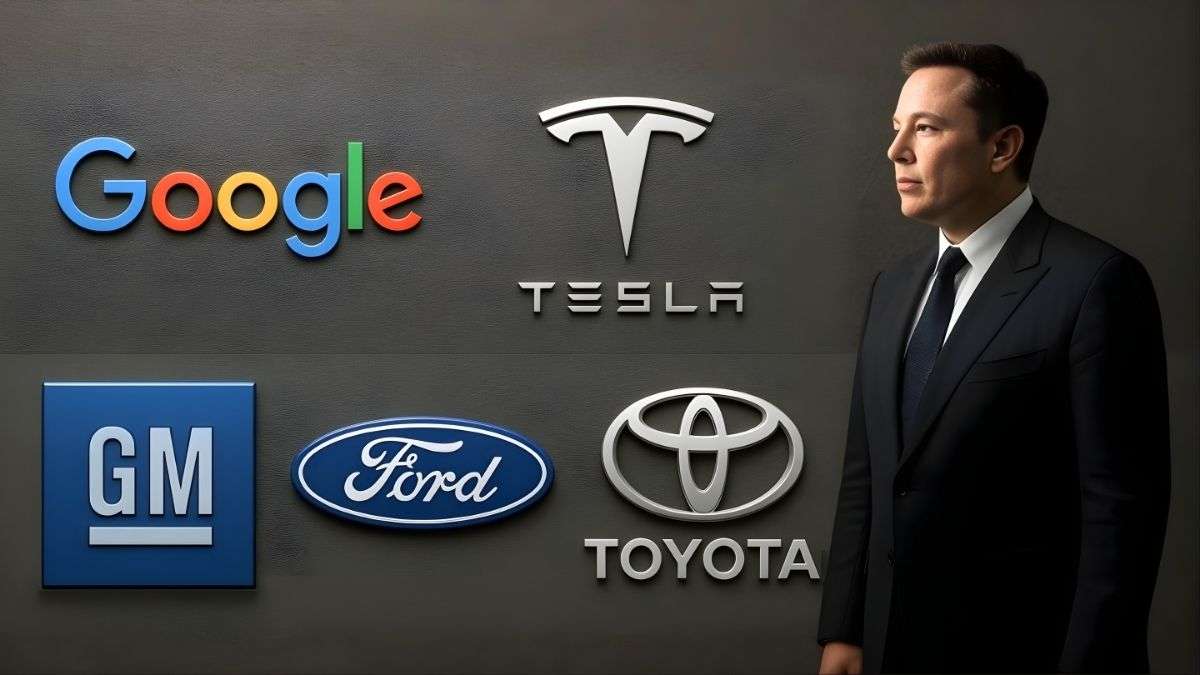

Elon Musk has shared what he believes is Tesla's competitive advantage in the tech and EV markets.
Musk states that the future of cars is autonomous and that tech giants like Google can create a fully self-driving vehicle, but struggle with mass production.
Conversely, traditional automakers like General Motors, Ford, and Toyota excel at mass-producing cars but lack the technological expertise to develop fully autonomous vehicles.
Musk believes this unique blend of vehicle mass production and advanced AI gives Tesla the edge to win the robotaxi race.
Musk shared this insight in response to Tesla investor Sawyer Merritt, who first outlined Tesla’s advantage.
Sawyer started the discussion by writing...
“Legacy automakers like Ford and GM know how to mass produce cars — but not how to develop self-driving technology.
Tech companies like Google (which owns Waymo) will likely figure out self-driving technology — but they don’t know how to mass-produce cars.
Tesla is the only company in the Western world capable of both mass manufacturing cars and developing self-driving technology.
Thanks to their vertical integration, Tesla can design a fully optimized, scalable robotaxi — and do so at a lower cost than anyone else.
Waymo has to source cars from third parties (their 6th-gen hardware is on Zeekr vehicles). Ford and GM will probably have to license self-driving tech from other companies.”
Sawyer believes Tesla has the unique combination of capabilities to dominate the robotaxi market, and Elon Musk strongly agrees, replying to Sawyer with an emphatic “Exactly.”

Robotaxi Business
Musk considers Tesla the leader in the robotaxi race, and on paper, it appears Tesla has all the elements necessary for success.
Unlike most self-driving startups, Elon Musk has decided to focus Tesla’s efforts on a pure vision-based system.
By using affordable cameras to achieve level 5 autonomy, combined with Tesla’s mass-manufacturing strength, the EV maker is well-positioned to produce the most affordable robotaxi vehicle.
However, the biggest challenge is that, after a decade of promises, Tesla still hasn't launched a fully autonomous robotaxi service.
Tesla has officially launched its robotaxi service in Austin, Texas, and the Bay Area, California; however, both programs involve a Tesla employee in the vehicle to oversee the autonomous operation.
In contrast, Google’s Waymo division has already logged millions of miles of robotaxi service without a driver at the wheel.
Car Business
In the automotive industry, Tesla has faced setbacks in recent years. From 2013 to 2023, Tesla’s growth was impressive, with vehicle deliveries increasing by about 50% annually.
But since 2023, sales have plateaued. In 2024, Tesla delivered fewer vehicles than in the previous year.
Tesla's vehicle deliveries seem flat this year, and even for 2026, Tesla has indicated that sales won’t increase significantly.
Tesla has also canceled entire factories, such as Giga Mexico, and planned expansions at Giga Berlin, Giga Texas, and Giga Nevada have been delayed due to falling demand.
While Tesla’s current vehicle production capacity is about 3 million vehicles per year, actual demand appears to be under 2 million.
Along with falling demand, Tesla’s profits have declined. Once the most profitable automaker based on margins, Tesla’s earnings are now in line with those of legacy automakers.
The Cybertruck, expected to be Tesla’s next major product, has also faced difficulties with sales of approximately 25,000 units annually—only about 10% of Tesla’s goal of 250,000 units.
Overall, Elon Musk's assessment that Tesla is uniquely positioned to succeed in the robotaxi market is correct; Tesla has all the necessary prerequisites to win the robotaxi race, but the EV maker doesn’t appear to be performing at its full potential.
However, please let me know what you think in the comments. Share your ideas by clicking the red “Add new comment” button below. Also, be sure to visit our site, torquenews.com/Tesla, regularly for the latest updates.
For more information, check out: Elon Musk Says, “I Initiated The Dozen Or So Startups That Constitute Tesla With An X Post. Tesla has Made Very Few Acquisitions. Our Growth is ~90% Organic”
Tinsae Aregay has been following Tesla and the evolution of the EV space daily for several years. He covers everything about Tesla, from the cars to Elon Musk, the energy business, and autonomy. Follow Tinsae on Twitter at @TinsaeAregay for daily Tesla news.
Set Torque News as Preferred Source on Google
Follow us today...


Comments
No robo-taxi will stand a…
Permalink
No robo-taxi will stand a chance against my ridiculously affordable cars. No one would choose to be a passenger in a boring cyber-pod when they can buy a feisty little hatchback or sedan for $8k.