
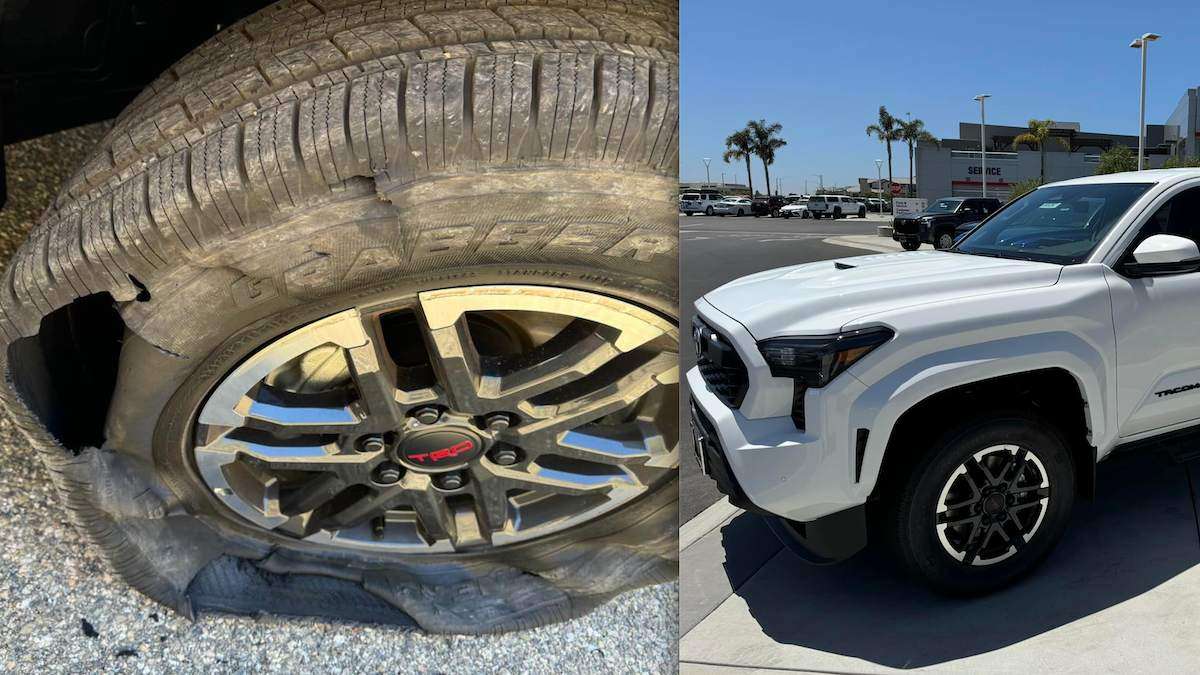

Why would a brand-new Toyota Tacoma tire blow with only 148 miles on it?
Emerito Cabreros shared his unfortunate experience with a tire blowout on his new 2024 Toyota Tacoma pickup on the Toyota Tacoma Owners' Facebook page.
This is what I see going down.
Imagine Emerito's 2024 Toyota Tacoma pickup sitting in his driveway, and he can’t wait to take it on a road trip. Fresh off the lot, its metallic white paint shimmered under the California sun, promising adventures and reliable service.
He'd barely had it a week, and the odometer still whispered a mere 10 miles. Today was the day to truly break it in, with a planned 250-mile trip out of town.
His bags were packed, the cooler was stocked, and a sense of eager anticipation hummed in the air.
He merged onto the freeway, the Tacoma's engine a smooth purr beneath him.
The pickup handled like a dream, a stark contrast to his old, trusty, but undeniably tired sedan. He was settling into the rhythm of the open road, enjoying the quiet hum of the tires on the asphalt when it happened.
A sudden, violent WHUMP-BANG! jolted the truck. The steering wheel wrenched sharply to the left, and a terrifying flapping sound erupted from the front driver's side.
Emerito's heart leaped into his throat. He gripped the wheel, his knuckles white, and fought to maintain control. He could feel the vehicle pulling, struggling against the sudden imbalance.
"A blowout!" he muttered, a cold dread creeping in. He eased off the gas, signaling, and carefully guided the truck to the shoulder. The flapping continued a grim soundtrack to his misfortune.
Once safely stopped, he got out, his legs a little shaky. The sight confirmed his fear: the right front tire was shredded, a mangled mess of rubber and cords. He sighed, running a hand over his face.
One hundred and forty-eight miles. One hundred and forty-eight miles! On a brand-new truck!
He knelt, inspecting the wheel. A minor miracle, it seemed. Despite the catastrophic blowout, the rim itself appeared unscathed. No dents, no bends, just a naked wheel waiting for new rubber. That was a small victory in a rather large defeat.
After a call to Toyota roadside assistance and a bit of a wait, a tow truck arrived to take him to the nearest tire shop. The whole process felt like an absurd initiation. He watched as the mechanic effortlessly swapped out the destroyed tire for the spare tire.
With a fresh tire mounted and the blown tire in the pickup bed, Emerito was back on the road, albeit with a slightly deflated spirit. He drove the remaining 250 miles to his destination, the initial excitement replaced by a lingering sense of bewilderment
How could my tire blow with only 148 miles on it?
It wasn't until later, when he recounted the tale to a friend who happened to be a retired mechanic, that the true culprit was revealed. His friend, after hearing the details, nodded sagely. "Sounds like overinflation, Emerito. This happens frequently when they are loaded onto the transport trucks. Dealers are supposed to check the pressure, but sometimes they miss it."
This kind of unexpected surprise at the dealership isn’t just limited to trucks. Look at this fresh story involving a 2025 Hyundai Ioniq 6, where the driver stopped by a dealership just to charge up and was hit with an unusual cost that turned into a detour and a deeper look into dealer charging practices. It’s a good reminder that when it comes to new vehicle ownership, surprises - whether they come from a tire or a charger - often show up where you least expect them.
A wave of annoyance hit Emerito like a ton of bricks.
The dealer hadn't checked the air pressure. The tire, pumped up beyond its safe limits, had simply given up under the strain of the road, a ticking time bomb waiting for its moment.
The brand-new pickup, his symbol of adventure, had started its journey with a literal bang, all because of a simple oversight. He shook his head, "Well, at least I have a story to tell.
And tell his story he did.
He went on the Toyota Tacoma Owner's Facebook page and said,
"Driving out of town with only 148 miles on the odometer, the right front tire blew out while driving on the freeway. Luckily, it didn't mess up the wheel. Got a new tire and drove 250 more miles to our destination."
"What I found out later was the dealer didn't check the air pressure when the pickup came off the transport truck. The tire was overinflated, and that's why it blew out only 148 miles later."
What do other Tacoma owners say?
Darin Anderson says, "My Tacoma was fifty psi, and I thought the ride was a bit harsh during the test drive. The salesman didn't think anything was wrong; we both brushed it off because I was coming from a second-generation background. After driving it for a week, I knew something was not right, especially since it was not equipped with off-road tires. I confronted the dealer after I corrected it, and their excuse was, "Oh, we were rushing to get you your truck and must have missed it."
Joey Ahrens says, "My Tacoma tires were 40-45 off the lot and the WORST ride home EVER... 3 hours!!! I checked them when I arrived and adjusted them to around 30-35 degrees all around. Luckily, this was back in March, and it was a nice, cold day."
After reading some reports about overinflated tires from the dealer, Emerito checked the other three tires.
"Mine were all over 40 psi when I got in it, cold. They should have been 30 psi."
So, why are new car tires overinflated for transport?
- Preventing Flat Spotting: When cars are stored or transported for extended periods, especially on car carriers or in storage lots, the tires can develop flat spots where they contact the ground. Inflating the tires to a higher pressure helps to minimize or prevent this phenomenon. Flat spotting can cause a "thump-thump" sound when driving and, in severe cases, can damage the tires.
- Seating the Bead: Overinflation can help ensure the tire's bead (the edge that seals against the wheel rim) is seated adequately during the manufacturing and mounting process.
- Transportation Rigging: When vehicles are secured on transporters, they are often chained or strapped down to prevent movement. Higher tire pressure can provide additional stability and help avoid deformed tires under the tension of the rigging.
Important Notes:
- Dealers should adjust the tire pressure to the manufacturer's recommended level during the pre-delivery inspection (PDI) before delivering the car to the customer.
- The recommended tire pressure is usually listed on a sticker inside the driver's side door jamb or in the owner's manual.
- Driving with overinflated tires can negatively impact ride comfort, handling, and tire wear, according to The Autopian. And a tire blowout on the highway like Emerito experienced.
- Check the tire pressure of a new car soon after taking delivery and adjust it to the manufacturer's recommended level for optimal performance and safety.
In The End
It could have been a dangerous situation with a tire blowout in Ererito's 2024 Toyota Tacoma pickup, traveling at 70-75 mph on the highway. Luckily, no one was hurt, and the truck wheel was not damaged.
Toyota dealers are supposed to check tire pressure during the Pre-Delivery Process. This time, the dealer was sleeping and made a mistake.
How About You?
Did you know that new cars' tires are overinflated when they roll off the transport truck? You can click the red Add New Comment link below and let us know if you've had a tire blowout.
Check out my Toyota Tacoma story: I Hate My 2023 Toyota Tacoma, It’s Underpowered, Uncomfortable, the Transmission is Awful, and the AC Isn’t Cold Above 80, I’m Buying A Tundra
I am Denis Flierl, a Senior Torque News Reporter since 2012. My 30+ year tenure in the automotive industry, initially in a consulting role with every major car brand and later as a freelance journalist test-driving new vehicles, has equipped me with a wealth of knowledge. I specialize in reporting the latest automotive news and providing expert analysis on Subaru, which you'll find here, ensuring that you, as a reader, are always well-informed and up-to-date. Follow me on my X SubaruReport, All Subaru, WRXSTI, @DenisFlierl, Facebook, and Instagram.
Photo credit: Denis Flierl Emerito Cabreros
Set Torque News as Preferred Source on Google
Follow us today...




Comments
Fake news. Tires are…
Permalink
Tires are inflated to the maximum pressure to avoid flat spots from sitting on the dealer's lot. Not over-inflated above the maximum PSI rated.
And all new cars have tire pressure sensors also which would have alerted the driver.
Well I believe the new owner…
Permalink
Well I believe the new owner should have checked all his tires to begin with because even when I take my truck to the tire shop I have to check them because I've never got a vehicle from any tire shop with tires aired up to the recommended air pressure they air them up till they blow up most of them just throw them on
50 lbs would not cause a…
Permalink
50 lbs would not cause a tire to explode. 100 pounds maybe, but most of the time under inflation can cause a zipper break. Another thing radial tires don't get flat spots from setting just the few days they are transported. Back in the day old bias tire could get flat spots , but once they heat up it smooths out.Just looking at tire from what I can see it was an impact break. 30 years in the tire business.
How long was the tpms…
Permalink
How long was the tpms warning on ?
Does the Tacoma not have…
Permalink
Does the Tacoma not have tire pressure read out monitor in dash, if so he could have checked the pressure before trip.
Always check your tire…
Permalink
Always check your tire pressures after a dealer service. Techs always seem to air up pressures to tire maximum pressure, not the manufacturers recommended pressure on the door sticker.
As a driver. How do you not…
Permalink
As a driver. How do you not know your tire pressure? Trucks these days have a digital read out of the tire pressure. If it was at 50 psi. He should have known something was wrong. I'm a girl and even i know that.
Dude could not even change…
Permalink
Dude could not even change his own tire. No man card, why have a truck?
Just another example of why…
Permalink
Just another example of why you should never trust that anyone has done their job. Checking tire pressure is a basic thing you can do yourself and should. Yes, people should do their job, but it's your butt on the line.
Tires at 40psi would not…
Permalink
Tires at 40psi would not have caused a blowout. A grossly under inflated tire could fail but the tire pressure monitor should have warned him.
I've seen person drove around with tires over 100psi without a failure.
Either some object cut the sidewall or the tire was a factory defect (rare but can happen)
What new truck doesn't have…
Permalink
What new truck doesn't have TPMS ? You're too lazy to fill up your tires this is fake news
If you've ever worked in a…
Permalink
If you've ever worked in a shop before you've had cars come in with tires 60-80psi or more on a pretty regular basis, 50 psi isn't going to blow up a tire. My guess is he hit something. Nice write up though.
Your dash gauge cluster has…
Permalink
Your dash gauge cluster has your inflation displayed right in front of you. You might want to check that yourself.
So no one commenting in the…
Permalink
So no one commenting in the article thought to check their air pressure readout on the dash, whether the TPMS was lit up or not, and compare it to the manufacturer door sticker for recommendations on air pressure?
I am not familiar with the…
Permalink
I am not familiar with the Toyota brand but most vehicles have TPMS or tire pressure monitor systems in them so most people can check that pressure of the tires on the dash before ever moving a vehicle. Yes, if the tire is low, you get a warning light but if they have too much pressure, you would see that also. Because it is an early hour/mile failure and the truck was not loaded, it might have had a belt separation issue or defect. Hard to say but a good tire guy should be able to tell you what failed and why.
This is the most nothing…
Permalink
This is the most nothing-burger article I've ever read.
That said, if you don't check your tires before going off on 250 mile trip, that's your own damn fault. Typical Californian "it's not my responsibility" mentality.
I bought a new Chevy Monty…
Permalink
I bought a new Chevy Monty Carlo back in the 1970's and all the Firestone tires steel belts had separated due to being overinflated on the transport truck. They had to replace the tires under warranty.
Dip shit ran over something …
Permalink
Dip shit ran over something ,he didn't leave the dealer with a low tire,He's just another dumb ass behind the wheel
It's always been standard…
Permalink
It's always been standard procedure for me to go over the usual things before a trip: oil, water, air, gas, washer fluid, spare tire. Make sure you have registration, insurance card. Check for kids and pets. And give the car a mini-inspection.
The dash didn't show the…
Permalink
The dash didn't show the tire pressures? Driver gotta take some responsibility here
My car only shows the…
Permalink
In reply to The dash didn't show the… by Al (not verified)
My car only shows the pressure if it's low. I mean,I can see the pressure any time if I pull up that screen, but the warning is only for low pressure, not high.
My question is this: why…
Permalink
My question is this: why didn't he check before he left for the road trip? I understand it's new, but I was always taught to check everything (oil, tires, etc etc) out of caution.
Glad it was something minor, as opposed to what could have happened.
New Tacoma's are 35 psi, 40…
Permalink
New Tacoma's are 35 psi, 40 isn't going to do that. Maybe your looking for a free tire. I'm a Toyota tech for 30 yrs. Your story is a weak excuse to pass the buck. I call B.S. on your version
Me too. I’ll bet he hit…
Permalink
In reply to New Tacoma's are 35 psi, 40… by Jeremy (not verified)
Me too. I’ll bet he hit something like the other 99.9999999% of people who have a blowout and try to blame someone else.
Unfortunately for Mr…
Permalink
Unfortunately for Mr. Cabreros, he accepted the vehicle without doing his own inspection. Checking tire pressure is quick and inexpensive...and a very basic "check off" during a prospective owner's pre-acceptance of the vehicle--you know, so the owner can discuss defects or damage found BEFORE taking the vehicle. Of course, there also could've been unseen road debris responsible for that blowout, too. Nevertheless, check your own tire pressures, folks; it's very easy...
We used to let out the …
Permalink
We used to let out the excess air out of the new Toyota vehicle tires. This was part of the dealer prep 20 years ago. It cannot be skipped.
So your telling me that you…
Permalink
So your telling me that you had the truck a week and it's the dealers fault. At what point do you take responsibility. Could have run over something in the road. Tire explodes from low pressure heat build up. The tire light comes on if the pressure is low or to much. My father taught me to check my vehicle myself. Especially before a trip.
The stealership left my…
Permalink
The stealership left my tires at 50 psi on my brand new 4runner. The parking brake cable was also slightly hung up causing a burning brake smell all the way home. They also did a shoddy job detailing the vehicle and never finished the job before i picked it up.
Yeah i bet. Folks like you…
Permalink
In reply to The stealership left my… by TJ (not verified)
Yeah i bet. Folks like you love blaming other people for issues that you should have checked for yourself. It’s always after y’all take it home that suddenly something is going on… I’m pretty sure this is why test drives are a thing. To know what you’re getting before taking it home. But you’re telling us that even after test driving it, it wasn’t until you were going home that you had an issue?yeah ok
It's your responsibility to…
Permalink
It's your responsibility to check everything on any vehicle, especially prior to a road trip.