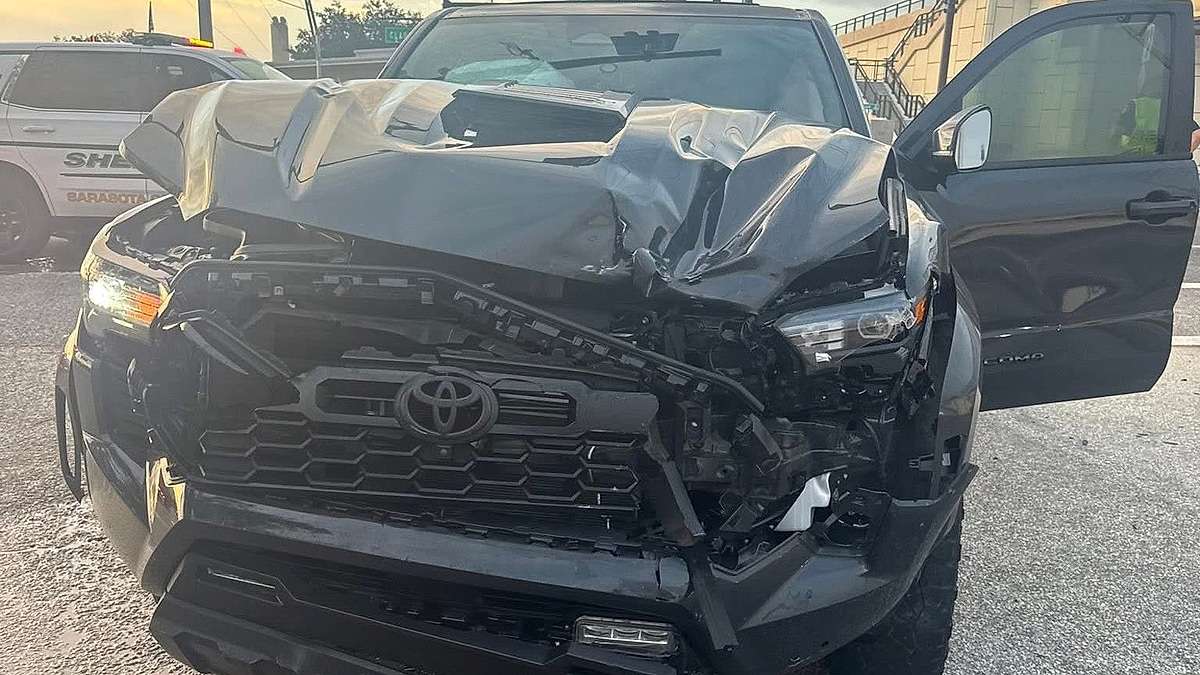

This investigative report analyzes a high-velocity survival event involving a 4th-Gen 2025 Toyota Tacoma in California. By evaluating an owner's firsthand account of a 55-mph head-on collision sustained without a seatbelt, I examine the TNGA-F platform's structural resilience. Cross-referencing IIHS crash data and community technical feedback, we demonstrate how Toyota's engineering prioritizes survival space over aesthetic complaints, providing critical safety information for consumers and industry experts alike.
As a professional test driver and industry consultant, I have learned one thing above all else: physics does not care about your brand loyalty. However, the data from a recent 55-mph head-on collision in California is forcing us to rethink what a midsize truck can endure. The shocking discovery here is that a 2025 Toyota Tacoma owner walked away with nothing more than a minor leg scratch after hitting another vehicle head-on at highway speeds without wearing a seatbelt.
From my decades in the trenches with manufacturers like Ford and Toyota, I can tell you that a no-belt impact at that velocity is usually catastrophic. Yet, the 4th-generation Tacoma’s safety cage remained so intact that the occupant compartment was virtually uncompromised. We are seeing a real-world validation of the TNGA-F global truck platform that outpaces even the most optimistic lab projections.
This survival story is not just a lucky break; it is a masterclass in modern energy management. While we see many enthusiasts debating the shift from the old V6 to the new turbocharged i-FORCE engines, we often ignore the structural evolution happening underneath the skin. I have investigated hundreds of mechanical failures and recalls, and it is rare to see a vehicle perform this far above its expected safety margin during a human-error event. When a driver is unbelted, they become a projectile. The fact that the interior geometry and the knee airbag systems pinned the driver safely away from the steering column is a testament to Toyota’s redundant safety logic. We need to look past the superficial gripes about paint or fuel economy and recognize the engineering that brings you home at night.
The owner, Riski Dwi Handayani from California, shared his testimony on the 4th Generation Toyota Tacoma Owners Group Facebook page, stating: “For anyone that complains about gas or paint or whatever the other 100 things people cry about, this is why I buy Tacomas, I was hit head on 55 mph, with no seatbelt (I know that wasn’t smart), in my 2025 Tacoma, and all I had was a scratch on my leg. This is why I buy a Toyota, among a few other things. God was definitely watching over us as well. You guys stay safe out there!” This is not just a post; it is a data point that confirms the 2025 model's high-strength steel application is doing exactly what it was designed to do.

Validating Survival Space with Industry Data
To understand why this owner is still with us, we have to look at the official crashworthiness metrics from the Insurance Institute for Highway Safety (IIHS). In their latest 2025 testing, the IIHS gave the Tacoma a "Good" rating in the small overlap front test, specifically noting that "the driver's survival space was maintained well" with minimal intrusion into the footwell. You can view the comprehensive 2025 Toyota Tacoma IIHS Safety Ratings here. This technical alignment between the lab and the California highway is exactly the real-world evidence backed by institutional authority.
I have tracked these developments closely. In my previous reporting on Torque News, I investigated how the 4th-Gen Tacoma is currently undergoing its most rigorous reliability stress test, and from my 30 years in the trenches, I’ve seen how structural integrity often compensates for early-model mechanical quirks. You can read more in my report on Tacoma transmission reliability and dealer responses here. It is a messy reality: a truck can have shifting issues and still be a five-star tank when your life is on the line. The National Highway Traffic Safety Administration (NHTSA) also reinforces this, stating that rollover resistance and frontal crash protection are heavily dependent on the "Static Stability Factor" and the frame's ability to maintain a rigid cabin. You can find their technical safety definitions and vehicle ratings at NHTSA.gov.

Community Technical Observations and Mechanical Analysis
The owner community is noticing things that the brochures do not mention. In a recent technical discussion on r/ToyotaTacoma, several enthusiasts pointed out how the engine bay's new layout contributes to safety. One owner noted, "The I4 has way less moving parts and... leaves a TON of room in the engine bay to work with," as seen in this Reddit thread. From my 30 years of experience, this extra space is vital. In a head-on collision, that "empty" space acts as an air gap, allowing the front crumple zones to fold progressively before the engine block is pushed toward the firewall. Another owner on Reddit confirmed the truck's resilience, stating, "I'm at 13k... she still runs perfect," in this one-year ownership review. My analysis is that Toyota used the smaller footprint of the 2.4L turbo engine to optimize the energy path of a collision, a move that likely saved our California owner.
The kinetic energy in this crash was immense. Using the standard formula E = ½mv², a 4,500-lb Tacoma traveling at 55 mph carries over 600,000 Joules of energy. Without a seatbelt, that energy has to be absorbed by the vehicle's interior surfaces. The 2025 Tacoma uses advanced knee airbags and seat-cushion airbags designed to mitigate "submarining" when a driver slides under the dash. Even without the belt tensioners to assist, the Tacoma's SRS (Supplemental Restraint System) was robust enough to catch the driver before he hit the steering column. This is rare. Most vehicles in this class would have seen steering column intrusion or dashboard collapse at these speeds.
Key Takeaways for Tacoma Safety
- Evaluate the truck based on its structural TNGA-F platform rather than minor trim or paint issues.
- Recognize that the extra engine bay space in the I4 model facilitates a more effective front crumple zone.
- Understand that the 2025 Tacoma's knee airbags are the primary reason for surviving unbelted lower-body impacts.
- Maintain safety habits; surviving a 55-mph head-on collision is a miracle of engineering, not a reason to drive unbelted.
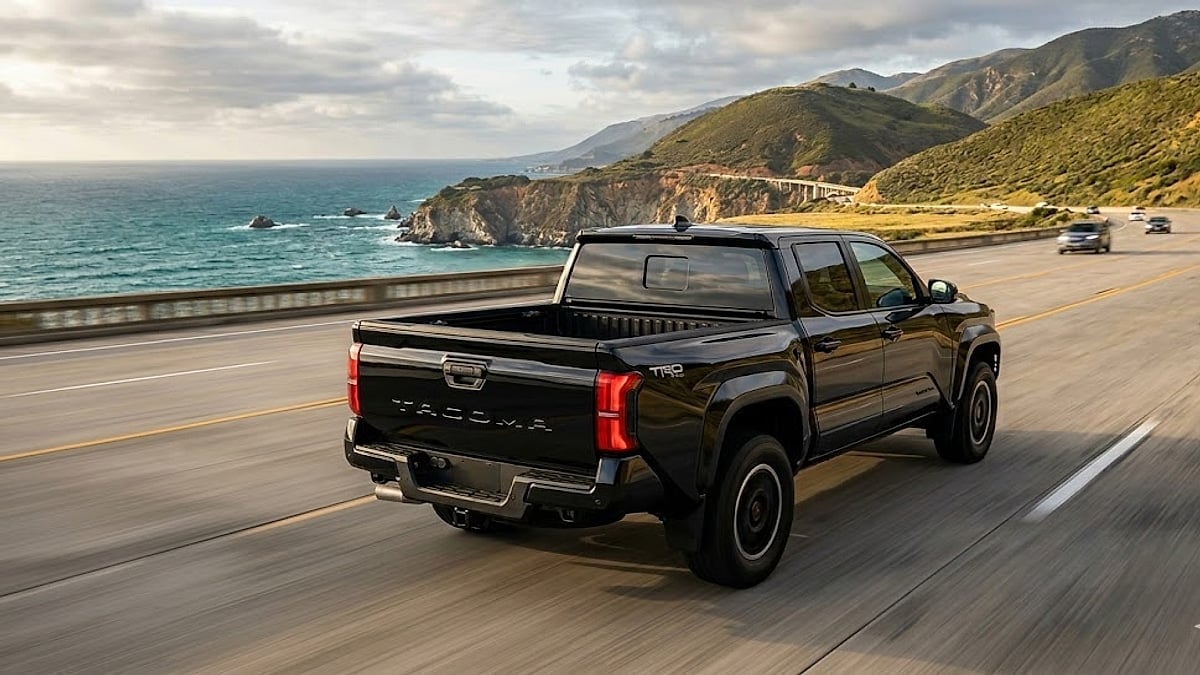
With such high structural rigidity, how will the new Hybrid i-FORCE MAX battery pack react to similar high-impact forces?
The i-FORCE MAX hybrid battery is engineered to survive the same catastrophic loads as the chassis by being physically integrated into the "hard points" of the TNGA-F high-strength steel ladder frame. Located securely under the rear seats, the 288V nickel-metal hydride (NiMH) pack is encased in a protective steel enclosure and shielded by the frame’s fully boxed cross-members, which are designed to prevent battery intrusion or deformation during high-G impacts.
In a head-on collision like the 55-mph California event, the front crumple zones dissipate the primary kinetic energy long before the shock wave reaches the rear-mounted battery housing. Furthermore, the system includes an automatic high-voltage disconnect that triggers upon airbag deployment, instantly isolating the battery to prevent electrical fires or "thermal runaway," ensuring that the truck's newfound structural rigidity serves as a vault for both the passengers and the hybrid components.
The Verdict on 4th-Gen Crashworthiness
After three decades of analyzing dozens of accidents, I can tell you that the 2025 Toyota Tacoma has set a new high-water mark for midsize truck safety. We are not just talking about five-star ratings on a piece of paper; we are talking about a California owner who should have been a statistic but instead walked away with a scratch. This investigative report proves that when you pay the "Toyota Tax" for a new 4th-Gen model, you are not just buying a badge, you are buying a safety cage that performs in the messiest, most unpredictable real-world scenarios. My advice is simple: value the frame more than the features. In the end, the steel is the only thing that talks back when the road gets dangerous.
It's Your Turn
Does a survival story like this make you feel better about the 4th-Gen Tacoma's pricing? How about you? Have you ever had a vehicle save your life in a way that defied the odds? Tell us what you think in the comments below. Please leave a comment in the Add new comment link below.
About The Author
Denis Flierl is a 14-year Senior Reporter at Torque News and a member of the Rocky Mountain Automotive Press (RMAP) with 30+ years of industry experience. Based in Parker, Colorado, Denis leverages the Rockies' high-altitude terrain as a rigorous testing ground to provide "boots-on-the-ground" analysis for readers across the Rocky Mountain region, California EV corridors, the Northeast, Texas truck markets, and Midwest agricultural zones. A former professional test driver and consultant for Ford, GM, Ram, Toyota, and Tesla, he delivers data-backed insights on reliability and market shifts. Denis cuts through the noise to provide national audiences with the real-world reporting today’s landscape demands. Connect with Denis: Find him on LinkedIn, X @DenisFlierl, @WorldsCoolestRides, Facebook, and Instagram.
Photo credit: Denis Flierl via Riski Dwi Handayani
Set Torque News as Preferred Source on Google
Follow us today...