

Battery-electric pickup trucks are failing miserably in the U.S. market. Since our last story explaining the dire situation for EV trucks, dated November 3rd, three new bits of info have emerged showing how grave the situation is for EV trucks.

According to the Wall Street Journal, citing people within Ford, the company is considering canceling the F-150 Lightning altogether.
Ram has canceled its plans to produce the Ram REV EV pickup, and instead will move ahead with hybrid versions.
Bollinger, an EV startup once planning to build EV pickups, is “no longer paying its bills,” according to The Drive
However, EV truck owners love their vehicles. Case in point, Torque News reader and commenter, Rodney, who posted this excellent comment under our previous report:
It’s sad to see EV truck sales slowing down, especially when so many people still aren’t aware of the long-term benefits. I was hesitant at first, too - jumping into a pricey truck without knowing if I’d like it. But now, I’m saving around $4,000 a year just on energy costs for my work-related driving. That doesn’t even include the savings from no oil changes, reduced brake wear, and fewer mechanical issues compared to gas engines. People need to look beyond the sticker price and understand the true cost per mile of ownership. Once you do the math, EV trucks make a lot of sense. My coworkers are now seriously considering one after seeing my experience. For me, there’s no going back to gas.
Rodney added that “Charging at home is incredibly convenient—no more detours to gas stations. And the F-150 Lightning has been a game-changer for me: it’s comfortable, fun to drive, and still has the payload capacity to haul building materials when I need it. It’s the perfect blend of utility and tech.”
This is a very strong argument for why EV trucks should survive and actually thrive. Let’s break down Rodney’s strong arguments. We will add our own comments based on our many EV truck tests and our own experience owning a 2023 Ford vehicle.
Energy Cost Savings From EV Trucks
Rodney states that he is saving $4K per year on energy costs by switching to an EV truck. In many markets, EVs offer a distinct energy cost advantage because electricity is inexpensive and liquid fuels are expensive. However, that has not been our experience. When we tested both the Ford F-150 Lighting and the Ford F-150 Hybrid and ran the numbers, we found the hybrid had a lower cost per mile of energy. Here in Metro West Boston, electricity is very expensive, and we have no discounted evening rates from Eversource. With gas under $3 per gallon, and steadily becoming more affordable when the value of the dollar is considered, EVs are not the best bang for the buck when it comes to energy. Your local prices are all that matter. It is not universally true that EVs offer the lowest energy costs.

EV Trucks Offer a Lower Cost of Maintenance and Repair
Rodney’s next point is that with no oil to change and less brake wear from regenerative braking, his total cost of ownership is lowered against other options. He may be right if scheduled maintenance costs, compared to those of traditional trucks, are the only metrics. However, the Lightning is not Ford’s only green(ish) truck. The F-150 Hybrid also has regenerative braking, and thus will have less brake wear. Not having to change oil is a definite plus, but overall tire costs are the highest single part of vehicle maintenance and repair costs, and EV trucks are heavier and wear out tires faster than other lighter models. We think the jury is out on this particular aspect of EV truck advantages.
EV Trucks - Charging vs. Putting in Liquid Fuel
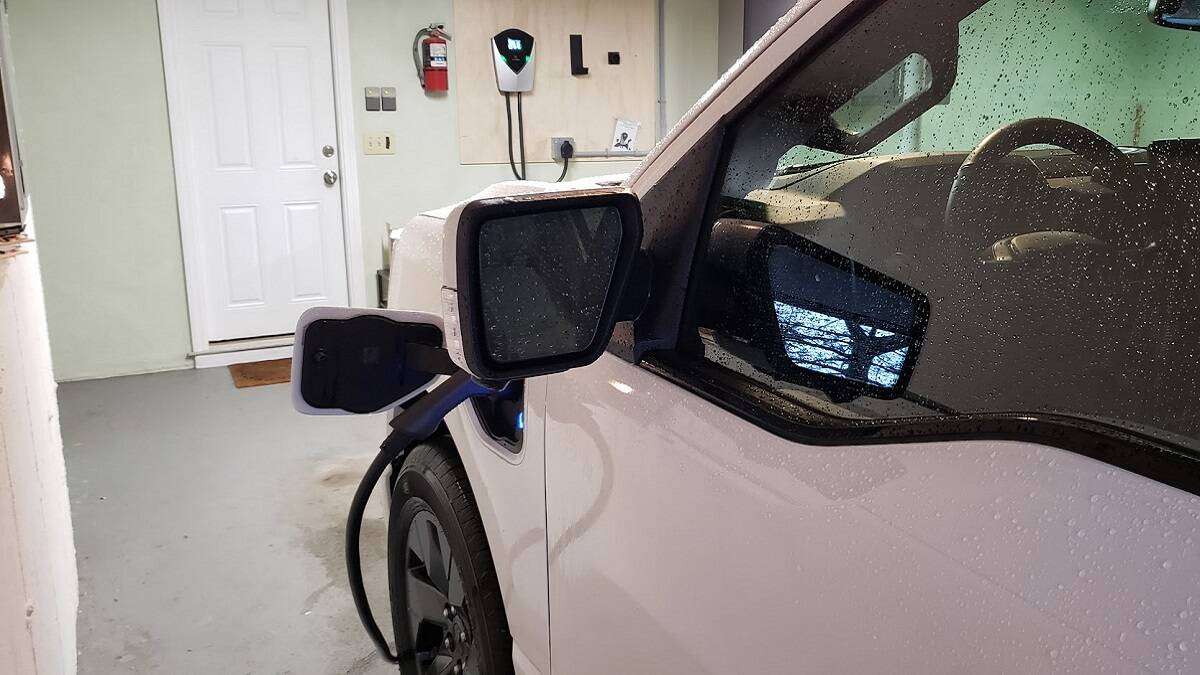
Rodney can charge at home, which is great. It’s a definite plus. However, only about half of all American drivers could ever have that feature. If they reside in a condo or an apartment, charging at home may never be possible. If they live in a city without a dedicated parking spot, it simply won’t ever be possible. I can charge at home. The F-150 Lightning would not fit in my garage, but I made it work.
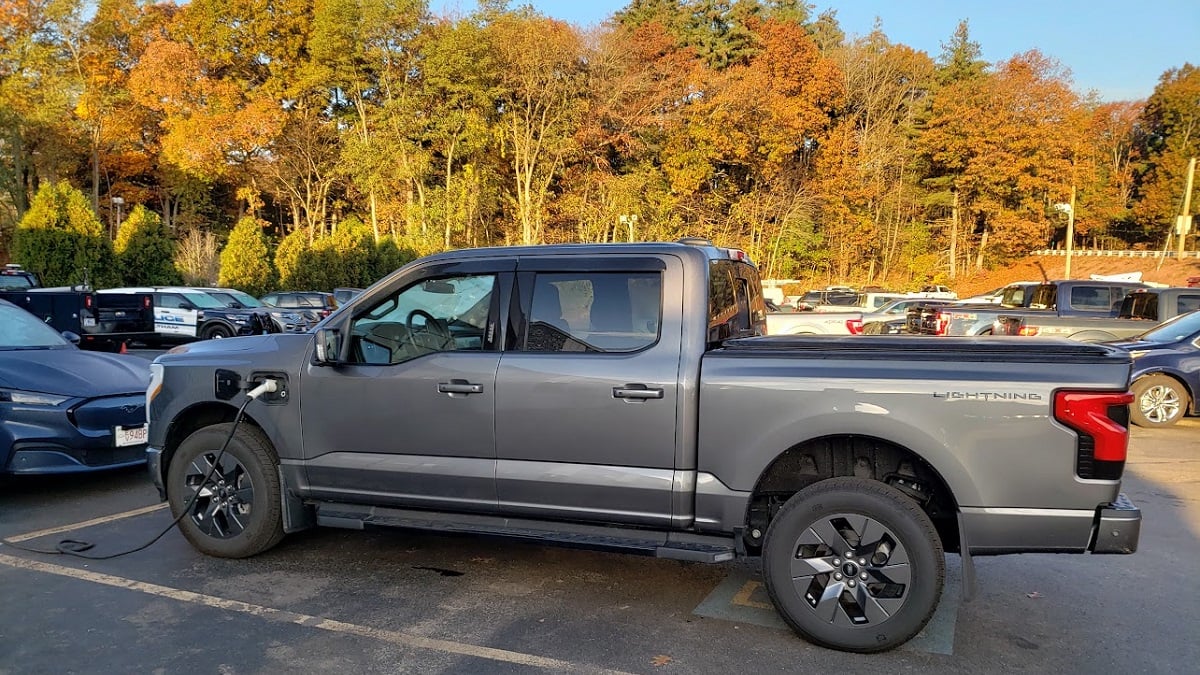
Rodney repeats one aspect of this discussion we often see in print. “No more detours to gas stations.” I’ve driven in America for over 40 years, and I can’t say I’ve ever made a detour for gas. It is literally everywhere one drives. Public DC chargers, by contrast, are decidedly scarce. A Ford F-150 Hybrid can add 700 miles of range in under three minutes. Charging a Ford F-150 Lightning to add that much range takes about 24 hours on a Level 2 charger, or it takes multiple stops and multiple hours at a DC charger.
EV Trucks - Comfortable and Fun to Drive
Here, Rodney is 110% correct. EVs of all types drive great. The endless instant torque is addictive. EV trucks, like EVs in general, are also downright fast. They offer outstanding performance bang for the buck. Because EV trucks have a long wheelbase and a flat floor, making them comfortable is easy. We have found the Lightning to be quite comfortable when driven. If we can be a bit picky, shouldn’t a $55K to $90K vehicle be comfy?
EV Trucks - Upfront Cost and Depreciation
EV trucks have one big problem. Even base model EV trucks cost more than the average of trucks overall. Base model Gas trucks undercut base model EV trucks by tens of thousands of dollars. According to Cox Automotive, the average transaction price for all pickups in America is $66,462. That includes a lot of luxury models. The starting price of an F-150 Lighting XLT (the base trim for non-commercial customers) is $66,330. Top trims top out at around $88K. When comparably compared, the F-150 Lightning is more expensive than gas-powered F-150 trucks. Then there is depreciation. EVs are notorious for having steep depreciation, and EV trucks too new to really gauge their long-term value in the used market. Used Ford gas-powered trucks have a century of data available and a LOT of used inventory from which to choose.
Conclusion - The EV Truck Movement May Be Ending, but There Are Many Happy Customers
Our take is that EV trucks are less convenient than conventional trucks for many owners who cannot charge at home. The “simple math” that leads many owners to think EV trucks have a lower cost of ownership isn't so simple when you start with a place like Metro Boston, with normal gas prices and high electricity costs. While maintenance and repair costs may be lower for EVs in theory, are they when the trucks have reached the end of their lives and the total is known? Nobody really has that data yet. One thing is for sure. In many cases, EV trucks do make sense, and they are much loved by their owners.
We thank Rodney for taking the time to comment, and we hope you will comment too.
Images by John Goreham
John Goreham is the Vice President of the New England Motor Press Association and an expert vehicle tester. John completed an engineering program with a focus on electric vehicles, followed by two decades of work in high-tech, biopharma, and the automotive supply chain before becoming a news contributor. He is a member of the Society of Automotive Engineers (SAE int). In addition to his fourteen years of work at Torque News, John has published thousands of articles and reviews at American news outlets. He is known for offering unfiltered opinions on vehicle topics. You can connect with John on LinkedIn and follow his work on his personal X channel or on our X channel. John employs grammar and punctuation software when proofreading, and he sometimes uses image generation tools.
Set Torque News as Preferred Source on Google
Follow us today...






Comments
Good Article of Pros and…
Permalink
Good Article of Pros and Cons and a good balance between The F-150 Lightning and Hybrid.
I just wanted to add that like all tools, one tool doesn't do it all or one size doesn't fit all. I do not tow, am a weekend warrior ... at Home Depot or Lowe's so I would consider myself an urbaninite using my Lightning more as a daily driver (up here in NH). I find myself using it more than my S or X. The torque is addictive but watch those tires ... although still on my originals at 43k miles.
My thirsty M6 takes 9 quarts of synthetic oil and 10 spark plugs...nope don't miss the maintenance cost associated with that.
The ease and convenience of plugging in at home outweighs getting gas and yes, charging stations while becoming more ubiquitous, are still in obscure locations.
Thank you for your very…
Permalink
In reply to Good Article of Pros and… by Leslie Tan (not verified)
Thank you for your very thoughtful comments, Leslie. My BEV travels in NH have been significantly expanded by Hillsboro Ford's DC chargers and the ones in Townsend, Mass, at the Ford dealer there. I also grab twenty miles here and there on the (terrible) L2 chargers in Peterboro when I stop for a movie or a long dinner. I'll watch for your Lightning on the road!
The electric truck concept…
Permalink
The electric truck concept just never caught on. This is what happens when manufacturers build without first asking the market if the product is even wanted. Jim Farley admitted as much.
Indeed, although the few EV…
Permalink
In reply to The electric truck concept… by Buzz Wired (not verified)
Indeed, although the few EV truck owners we know love their trucks, the vast majority of truck owners I know, even ones who own EVs, do not want an EV truck. Many truck owners are dead-set against them.
Maybe if Ford added the NACS…
Permalink
Maybe if Ford added the NACS to it sales would have went up. I know I would have bought one.