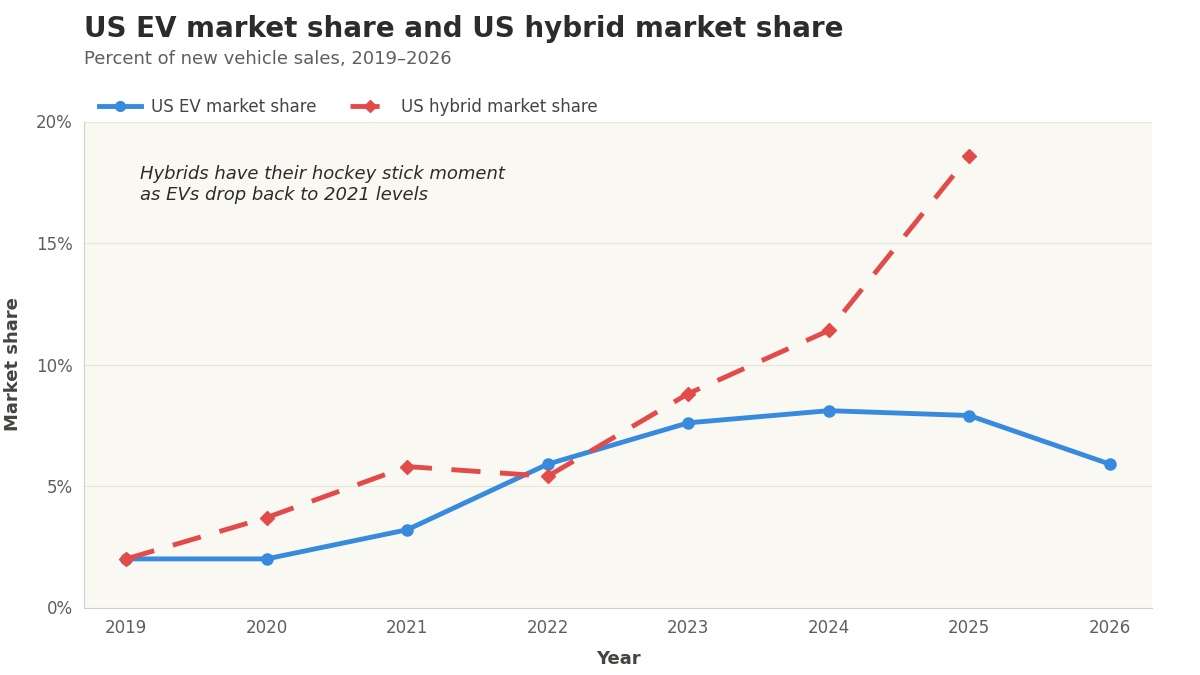

Hybrid vehicles now command roughly triple the U.S. market share of battery-electric vehicles, according to Cox Automotive data, while EV share has fallen back to levels last seen in 2021. The reversal happened during, not after, the peak of federal EV subsidies, suggesting consumer preferences, not policy, are the clear market movers.
In 2017, Green Car Reports stated that “the industry” expected EVs to demonstrate a “hockey-stick-shaped” market-share curve by 2025. Instead, EVs in America show a curve that has peaked and is now headed back to the low single digits. By contrast, hybrids took off in 2024, have double-digit share right now, and it's hard to find many news stories reporting this.
Why Hybrids Went Up, and EVs Went Down
EVs have always cost more up front than hybrids, and they have missed the meat of the affordable market. For example, in 2026, there is still no all-wheel drive battery-electric crossover on sale for $35K. But Subaru, Kia, Hyundai, and Toyota all make and sell AWD hybrid crossovers at that price. I'm driving one this week, the Subaru Crosstrek Hybrid.
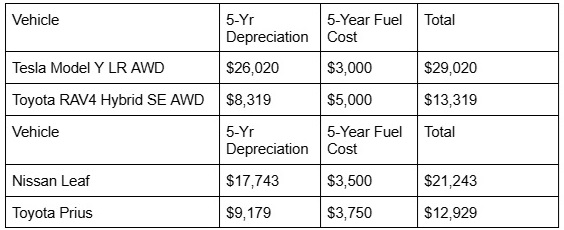
Another problem is that EV depreciation is significantly higher than that of hybrids. So much so that it negates the gas savings EVs may offer to some drivers in some areas. A recent report by iSeeCars.com highlighted how EVs have the steepest depreciation of any vehicle type, and hybrids hold their value the best. We pulled together this chart based on that study.
Adding to the growing trust gap between the EV narrative and reality is that EV advocates have somehow settled on 300 miles of range and told themselves that it is all anyone needs or wants. The Prius hybrid offers 600 miles of range and replenishes it from empty to 100% in 87 seconds at any corner pump. The top-selling RAV4 can add 500 miles of range in that time.

Perhaps the worst news for EV purists is that hybrids have stolen EVs' best qualities. That smooth-driving, high-torque feeling that EVs once uniquely offered is available from cars like Honda’s Civic hybrid, Prelude, and CR-V hybrid. Look closely at their powertrains, and you will see that these vehicles run on electric power nearly 100% of the time.
Finally, EV advocates, fans, and owners continue to pretend that most drivers can “charge at home.” This is factually false, and it undermines the narrative that charging is improving. Making matters worse, many stories are now highlighting how expensive public DC charging is, and shoppers without home charging options are taking note.
EVs and Hybrids Started Out Equal In Market Share - But Hybrids Overtook EVs
Looking to the far left of the graph, you can see that both hybrids and EVs each had about 2% U.S. powertrain market share back in early 2019. They also had their modern-era births in the same time frame of 1996 to 1997, when the GM EV-1, RAV4 EV (Gen 1), and the Prius and Honda Insight hybrids all debuted over roughly 18 months. Everyone knows that EVs emerged in the 1800s in America, but the modern era of green vehicles was born again thirty years ago. As the chart shows, EVs had the edge from about 2019 to early 2022. Then, hybrids passed EVs in market share. Since then, hybrids have only widened the gap.
Notably, hybrids began to outpace EVs well before the end of battery electric subsidies. In fact, hybrids began to lap EVs right in the middle of peak EV subsidy mania. This was back when the federal government was subsidizing EVs on the consumer-facing side by around $7,500 and on the back end with ZEV credits worth $10K. Meanwhile, states like Massachusetts and California had programs to throw thousands more at EV shoppers. And despite the money being thrown at EVs, hybrids went up, and EVs floundered.
Hybrids Are Expanding Quicker Than Analysts Can Follow
One data analyst we spoke to told us that collecting hybrid powertrain data is getting trickier. The reason is that Toyota has been hybridizing its lineup so rapidly that it’s hard for the analysts to keep up. For example, in the past six months, the top-selling SUV in North America, the Toyota RAV4, transitioned from about a 50-50 hybrid mix vs. a conventional powertrain and is now only hybrid. In addition, a small percentage are plug-in hybrid-electric vehicles (PHEVs). We didn’t add the PHEVs to the hybrid or EV grouping. Some outlets count them as hybrids, others as EVs. Some swing back and forth. Overall, PHEVs are less than 1% of the mix now and are declining as Jeep, Chrysler, Dodge, Ford, and Honda have all stopped making them.
About the Graph, Data, and Hockey Stick Growth Curves
Our line graph at the top of the page is populated with data provided to Torque News by Cox Automotive’s Insights & Corporate Communications team. There is no better, more accessible, and consistent source of data than Cox. You may know Cox as the parent company behind KBB. Torque News made a special request of Cox today, and the group was kind enough to supply us with U.S.-market market share data broken down by powertrain type.
For those wondering what a hockey stick curve is, it refers to when the curve is flat for a while during a period of stability and then heads steeply upward. Other phrases to describe this are "tipping point" and "inflection point." The hockey-stick tipping point began with hybrids in 2024 and 2025. It never happened for EVs.
If you look at the right end of the graph, you will see that the hybrid line is not as far over as the EV line is. This is not a glitch. Cox didn't have any Q1 2026 data for hybrids, but they did have it for EVs, so we showed only the data provided. No fake data cells. We can tell you that NADA, which does its own data collection and sorting, showed that EVs dropped down to 5.1% share in April, and hybrids added market share in Q1 and in the month of April. Had we mixed and mingled the data sets, the graph would look even more favorable to hybrids. But we don't fudge the numbers or exaggerate. We keep the data sets “clean.”
Hybrids now outsell battery-electric vehicles by roughly three to one in the U.S. market, and that ratio has grown every quarter since 2024. Whatever the reason, be it price, range, charging access, or resale value, American shoppers are answering the green-vehicle question with a hybrid badge, not a plug.
John Goreham is a 14-year veteran of Torque News. An accomplished writer and a long-time expert in vehicle testing, Goreham also serves as the Vice President of the New England Motor Press Association and has a growing social media presence. He’s also a 10-year staff writer and community moderator for Car Talk. Goreham holds a B.S. in Mechanical Engineering and an undergraduate Certificate in Marketing. In addition to vehicle and tire content, he offers deep dives into market trends and opinion pieces. You can follow John Goreham on X and TikTok, and connect with him on LinkedIn.
Set Torque News as Preferred Source on Google
Follow us today...