
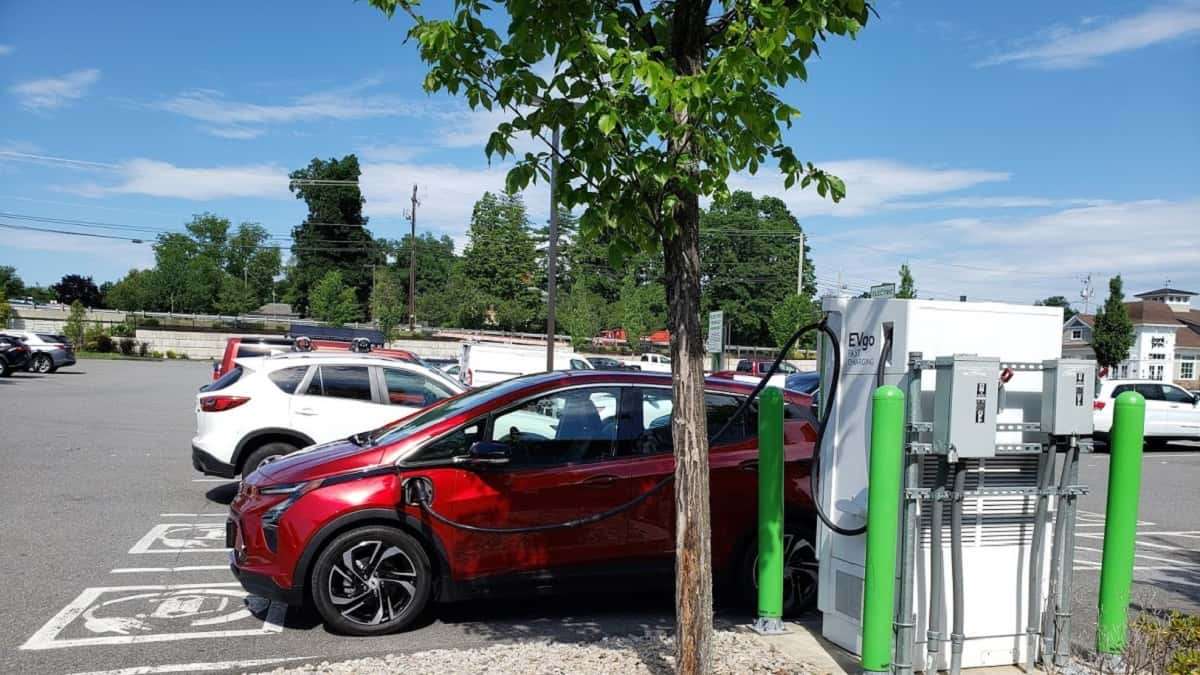

Charging an electric vehicle in public can range in price from free to very expensive. When we recently charged a new 2022 Chevrolet Bolt at an EVgo DC fast charger (DCFC) in Bedford, NH, we discover the pricey end of the spectrum can be more than it would cost to fuel a "gas-guzzling" V8-powered muscle car.
Related Stories:
Big Mistakes To Avoid When Charging an EV In Public
Many Public DC Fast Chargers For Electric Vehicles Are Slower Than You’d Think
Quick Stops At Level 2 Public Electric Vehicle Chargers Are Worthless
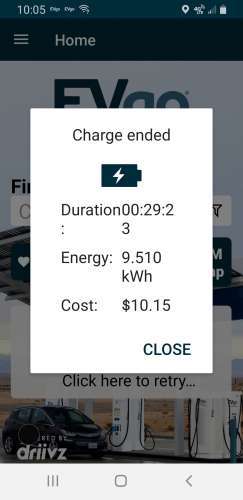
$10.15 To Add 34 Miles of EV Range
We charged up a Chevy Bolt using the EVgo DC fast charger, and the bill was $10.15. That amount of money added 34 miles of range to the Bolt. So, the cost per mile of energy was 30 cents per mile. Let’s compare that to a 2021 Dodge performance car we tested the prior week.
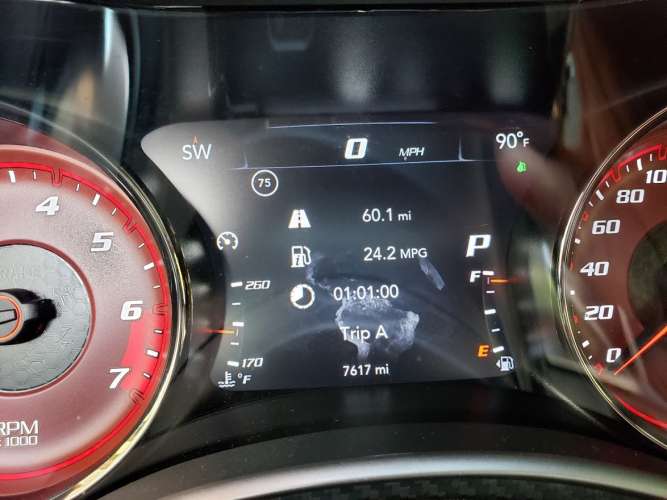
The Dodge had 797 hp, and it returned a combined fuel mileage of 24 MPG in our use on the same route we tested the Bolt. We paid $2.90 per gallon for the gasoline it uses. Doing some “goes in’tahs,” the cost per mile for energy in the muscle car turns out to be 12 cents. Thus, the cost per mile to energize the Bolt was roughly triple what the V8 gas-powered car cost us.
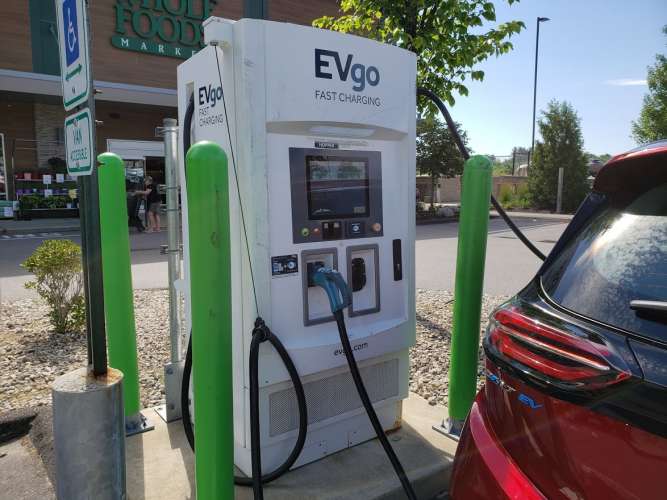
Charging Etiquette
When charging in public one is supposed to quit charging when one’s EV reaches 80% state of charge. The reasons for this are two-fold. First, the rate at which charge can be added to an EV battery is more rapid below 80% and much more time-consuming as the battery reaches full. Second, EV chargers are in very short supply. We need to ration them.
On my route from the metro Boston area to the lakes region of New Hampshire, there are exactly zero public DC fast chargers. In order to charge at a DCFC, I took a slightly longer by time route to swing by one of only two DCFC charging spots in that area. Google “Henniker NH DC Fast Chargers” if you want to see what I mean about no chargers. I needed to top-off in order to complete the 200+-mile route I was making. So, I broke charger etiquette, and I charged to full.
I also charged at the DCFC because I wanted to test my EVgo membership RFID card and account and see how long the DCFC took to add back miles. Both were successful tests.
Charging For Free
Coincidental to my test, GM was running a free-to-charge promotion day during the week I had the Bolt. I think free anything is great, but I always wonder, what’s the hidden agenda? If charging up an EV is very affordable anyway, why does there need to be a promotion to make it “free?” If Dodge offered free gas to muscle car owners, I suppose folks would jump at the chance for a free fillup. But why make EV charging free?
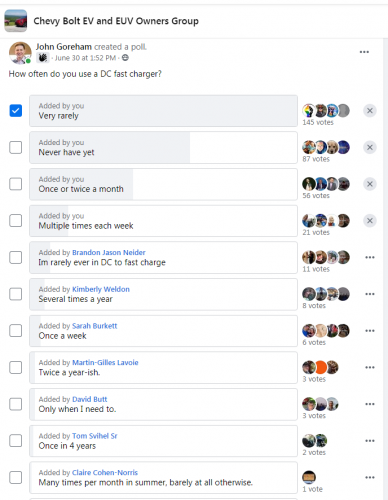
The answer is to get EV owners to the chargers and have them try out the experience. You see, when we poll owners of EVs, most report that they only charge at home, and almost none report using DC fast chargers.
When I plugged into the EVgo DC fast charger, I hadn’t thought about the cost. After all, we constantly hear how affordable EVs are to power up. I have done the math at my own home, and I know that the cost is typically about five to seven cents per mile of range I add back on my home charger using my relatively pricey Boston-area electricity. $10.15 for just 34 miles was a “shock.” Get it, shock. Bet you never heard that in an EV story before.
Related Story: New Hampshire Innkeepers Demonstrate EV-Driving Guest Best Practices
Feel free to tell us in the comments below what you typically pay to charge in public at a DC fast charger and how that cost compares to your cost at home.
John Goreham is a long-time New England Motor Press Association member and recovering engineer. John's interest in EVs goes back to 1990 when he designed the thermal control system for an EV battery as part of an academic team. After earning his mechanical engineering degree, John completed a marketing program at Northeastern University and worked with automotive component manufacturers, in the semiconductor industry, and in biotech. In addition to Torque News, John's work has appeared in print in dozens of American newspapers and he provides reviews to many vehicle shopping sites. You can follow John on TikTok @ToknCars, on Twitter, and view his credentials at Linkedin
Set Torque News as Preferred Source on Google
Follow us today...





Comments
I charged for 2 hours at a
Permalink
I charged for 2 hours at a Chargepoint and added about 20 miles and the display said $1.63 but when I got my credit card bill I see a $10 charge. What's up with that. Does anybody know why Chargepoint does that?
No doubt that we EV drivers
Permalink
No doubt that we EV drivers pay far more on the road for equivalent energy than petrol users, but it doesn't really matter much because electric motors are far more efficient. It evens out at the end, especially when noting that most of the time we get are juice from home were it's cheaper.
This is one of the reasons
Permalink
This is one of the reasons Tesla is leading in sales. Super charging does not cost that much. 5 to 7 dollars for 80 percent charge. 50 to 70 dollars or more to fill-up a f150 or Taurus. EV go may charge a lot but supercharger do not. There may be other level 3 charging that is free. Report on that
Our family has owned two
Permalink
Our family has owned two Tesla’s for the past five years. To all the people using EV cars, the idea of CHARGING BY THE MINUTE REALLY DOES NOT MAKE SENSE. EV’s charge at different rates. Some charge quickly to 80% and other take twice as long. Why would a charging station charge by the minute when we are buying energy in the form of Kilowatt. It should not matter how long it take to secure that Kilowatt. The charging station should charge by how much energy you take onboard.
Think about it, does your electric company charge you for power at home by the minute,, NO! It would not make sense and would not represent your actual energy usage. Do we buy gas by the minute NO! We buy gas by the gallon and the gallon represents a measure of energy that we can see as miles per gallon.
Has no one else thought about this?? Many states mandate EV charging by the minute, that’s highway robbery.
I bought a 2021 Hyundai Ioniq
Permalink
I bought a 2021 Hyundai Ioniq electric. I live on the East Coast in Maryland about 20 mi south of DC and after owning the car for about 6 months I have to say it's been really good. I read all these stories online about how expensive EV 's are to charge but so far I've had no trouble finding free charging stations ready available all over my area. The electric company I get my power from in my home only cost $0.07 a kilowatt hour so it would cost me about $2.70 to charge my car from 0% to 100. I do charge it from home but I would say it is probably a 50-50 mix between public charging stations and home charging. All the public stations I use are free .The majority are level II so those stations do take a bit longer to get decent range. But I have found several free fast charging stations near me. If I'm running low on battery I typically stop at a public station as I currently only have 120 volt level I charging available for me at home but if I'm going to be in for the night and I have at least 40% battery level 1 charging works fine by the time I leave the next day I have plenty of range. I have taken several 100 mile one-way trips into Virginia to see family and friends and have had no issues finding free public charging stations somewhere on the route. So it is shocking to me when people talk about how expensive these cars are to charge I can legitimately run this car off of free power from public charging stations or charge it at home for a very affordable price. I am about to install a level II charger in my garage so that will make charging that much faster and allow me the option of almost charging strictly at home. But if you download several apps on your phone such as plug share, EVgo or charge point you can find plenty of free stations to charge your vehicle. I charged my car one time at a Tesla Super station where I had to pay for charging time it was rather expensive for 50 minutes of charging it ran me about $21 so yes that would have been more expensive than a gas equivalent for the 160 mi of range I got but now owning the car and being plugged in lpun intended to what's available out there with free charging public stations, I no longer pay to charge my car outside of my home. I am going to take a 300 mile road trip this week and using the apps I've found many free charging stations directly along my route that I will stop to charge my battery. I really do think you have to find out what type of charging is available to you how many free stations are in your area and where you'll be driving the car to be sure that it will work for you and the type of driving and mileage you do. But I got to say so far I don't regret switching from gas to all electric it's been great and the savings is better than I imagined. I don't know about everyone's area but a helpful tip I have found is almost any brand car dealership that sells EVs has free charging most hospitals that have parking garages also have charging stations, malls and newer condo and townhouse communities have public charging stations I do think the network still has a lot of room to grow but the area I live in is pretty rural and I have nine charging stations in my county so they are out there. So I find it hard to believe these large metropolitan areas such as Boston New York and other places are so expensive to charge one of these vehicles. But I can only speak for my experience. So if anyone is looking to take the leap to an electric car do your research before you buy one and if you have the charging stations and the company you get your electric from is affordable I say do it and don't look back. Also I do think Teslas are wonderful cars but they are expensive now that they EV market is heating up there is a lot more great affordable EV alternatives Tesla might be the king with range and electric car performance but if you're looking at it from a saving standpoint I feel like the less expensive models are great alternatives to Teslas.
Tommy, thank you for this
Permalink
In reply to I bought a 2021 Hyundai Ioniq by Tommy (not verified)
Tommy, thank you for this thoughtful comment. Your advice here is very good. In fact, my trip to the EVgo station was in part to ensure my account and RFID card worked (so I could trust them when I might later be pressed for time or short of range). Here in Metro Boston the charging situation is good. Particularly by contrast to rural New Hampshire (Which in this region can be as close as 30 miles from point to point). Indeed, during my time with this particular test vehicle, the GM folks were offering free charging. Just not on the day I needed it, or on the route I traveled. I particularly liked your closing statement. With the least expensive Tesla now over $45K (and out of stock for most of the coming year), many shoppers may not be able to afford or find a model that works for them from that brand. Cheers,
It's not like DC fast
Permalink
It's not like DC fast chargers are the only option. They are actually more rare than any other kind. I never use pay chargers anyways, because I charge up my car at work for free, that gives me 250+ miles per charge. I never need to charge at home. (If I do charge at home, I use the portable 110v charger that comes with every EV so I didn't spend a couple thousand or more to add a charger to my house.) I've had my Bolt since the end of June. I never had to go to a charger where I had to pay. I also have only had to fill up my SUV once. (My wife uses it to drop the kids off and pick them up from school, which is about 1.5 miles from our house, and they were homeschooling last year, and didn't go to school all summer.) However that 1 fill up cost me more than what I have spent using the Bolt every day for months. Gas is around $5/gallon here in the bay area. When I filled up my SUV, it was over $60 for 1 time. When I was driving my Accord, it was costing over $120 a week to fillup and go to work 5 days a week.
Face it, EV cars can be much more cost effective. No, they aren't for everyone. Especially those who say they like to take long trips across the country. But if you have a daily commute of 120mi. I would say it's a good cost saver. All you have to do is know your range, (Like you do with gas cars, so you don't get stuck on the freeway)
I pay about $10 Canadian for
Permalink
I pay about $10 Canadian for 300 miles.
Not sure why you picked the most expensive place to charge, and paying per minute after 80% charge is your own fault.
Click bait?
As the story details, there
Permalink
In reply to I pay about $10 Canadian for by Keith Fredland (not verified)
As the story details, there was no choice. The DC FC options in the Metro Boston to lakes region corridor are 2. I picked the one that was open. Even that required a detour. The very first line of the story makes your point to ensure readers understand that the prices of charging range from free to very expensive. When you are visiting Southern-Central New Hampshire from Canada, which DC FC do you frequent?
That wasn't actually the
Permalink
In reply to As the story details, there by John Goreham
That wasn't actually the first line of your 'story'.
But what you're quoting should be the title of your article.
Instead, you chose to use clickbait to justify a few extra views.
A little pre-planning and I'm sure you could have got away with a little two charger.
First line of the story reads
Permalink
In reply to That wasn't actually the by Keith Fredland (not verified)
First line of the story reads, "Charging an electric vehicle in public can range in price from free to very expensive."
This is actually the first
Permalink
This is actually the first sentence.after to he Head line.
Public EV charging can be ridiculously expensive. Here is what we paid to add 34 miles to a new 2022 model year EV at an EVgo charger..
What your headline should read is
'if you don't know what your doing, do some research or you'll pay too much to charge your EV."
As you stated, you didn't think about the cost .
I pay a tenth what you did at a level three charger.
For only 34 miles you could have used a level 2 charger for free.
Use the plug share app..
Title: Teaser: Story's first
Permalink
In reply to This is actually the first by Keith Fredland (not verified)
Title: Teaser: Story's first sentence. I do use Plugshare. How would Plugshare have helped me? I already know where the two DCFCs on my route are. What part of the story do you find so upsetting? That charging can be expensive?
EVGO is transitioning from
Permalink
EVGO is transitioning from per min to per KHw
30 states now approve charging by KHw after bipartisan legislation said it should be that way.
Just give the industry time. EV will eventually be cheaper than ICE to ‘fill up’
Looks like someone is
Permalink
Looks like someone is sticking it to the wrong man. I would like to see the details of the charging session because the lack of details makes me suspect that the charging session depicted may be out of the norm for price, and may have incured some type of penalty for idle time or something like that. Seeing all the details will allow us to see the process and results through the lens of truth. If you don't supply complete details about the session reported then you may be practicing deception.
Aside from the screenshot of
Permalink
In reply to Looks like someone is by Buddy K Reynolds (not verified)
Aside from the screenshot of the EVgo receipt, the location of the charger, the miles added, time on the charger, cost incurred, state of charge start and end, and the circumstances of the charging, images of the vehicle at the charger and of the charger, what added details can I provide to help you feel the charging done in the story was real? Other commenters in this string have already validated that their experiences were similar or the same.
I only charge my leaf at home
Permalink
I only charge my leaf at home. I have plenty of range for all my trips within a 65 mile radius. A long trip I use my hybrid Volt. No reason to force a square peg into a round circle. Solid state batteries are not here yet. Thus EV is an predominantly still more for local use.
Well said, Marc. I'm glad you
Permalink
In reply to I only charge my leaf at home by Marc Baker (not verified)
Well said, Marc. I'm glad you used the "Radius" term. For most of my time with test EVs, that is how I think of their operational range. My home charger does the job (well) almost every week I test a new EV. Many PHEV and EREV owners say just what you did here - Plug-in hybrids are the ideal green vehicle solution (today) for those that want long-distance convenience. Cheers
Per minute charging really is
Permalink
In reply to Well said, Marc. I'm glad you by John Goreham
Per minute charging really is a scam most places since most charging stations don't take into account the charging speed of the vehicle. I would be interested in seeing a new version with different EVs once the Tesla network has opened.
I feel like I can take my Model 3 anywhere without an issue because of the network, I'm hoping the opening of the network will help others as well.
Based on Elon's comment though, I don't think it will be wise to charge a slower charging vehicle there, but having the option is always a plus.
I recently drove over 1800
Permalink
I recently drove over 1800 miles for a road trip in my Chevy Bolt EV. I'm not going to say it was convenient to stop for 45 to 60 minutes to charge. But it was CHEAP. I spent less than $100, total, on charging. That's about 18 miles per dollar spent. An equivalent of 54 mi/gal at $3/gal, which were around most of the gas prices I saw. Not many cars can get that kind of mileage.
Like I said, it wasn't convenient, and I would NEVER do that with my family while traveling. But driving alone, it wasn't bad and it WAS inexpensive.
You could have driven 5 miles
Permalink
You could have driven 5 miles an hour slower on that leg of trip and it would have cost nothing as you would not need to charge that top twenty percent.
Or at the rate you were charging you could have used a stage two which are free all over the place.
Thanks, Brian. Now I have
Permalink
In reply to You could have driven 5 miles by Brian Simpson (not verified)
Thanks, Brian. Now I have comments telling me I drive too slowly (and thus get unrealistic fuel economy) and a comment telling me I drive too fast (and thus have poor energy economy) under the same post. Like I mention in the very first sentence of the story, and then a second time in the paragraph in bold titled "Charging For Free," charging ranges from free to expensive. Thank you for your comment.
I live in New York City.
Permalink
I live in New York City. First of all there are very few electric car charging ports. The few that there are charge so mich money-4 times what gas costs. Why? Why is electricity so expensive for cars? How will electric cars become desirable when they are so expensive to charge?
That's odd... I fully charged
Permalink
That's odd... I fully charged my Prius Prime today on a Blink charger at Ikea today while I shopped. It cost me $1.25 to go from 0 to 30 miles of range.
That's about 1/3 the cost of a gallon of gas where I live.
But, I do normally charge at home on my level 2 charger and it doesn't cost that much.
I would suggest this service provider is charging a serious markup.
Anyone who knows anything
Permalink
Anyone who knows anything about fast charging will recognize in a second that receiving 9.510 kWh of charge in 29 min 23 seconds is not fast charging. At a minimum I would expect to see 35- kWh of charge. Most EVGO and Electrify America level 3 chargers are rated between 50 and 250 kW. I don’t recall any reference to the time of day or season, but I would suspect that this EV owner had to pay a “critical peak energy charge” passed on by EVGO due to high demand due to high temperatures in the summer.
Hey dan, thanks for
Permalink
In reply to Anyone who knows anything by Dan Mitchell (not verified)
Hey dan, thanks for commenting. The receipt is in the story. It was mid-morning on a pleasant summer day.
The gas price paid is a lie.
Permalink
The gas price paid is a lie. Also, the entire comparison is garbage because the foundation of the comparison is biased.
A nearly 800hp v8 needs premium gasoline otherwise it will knock. Newer cars retard timing to reduce knock but that lowers efficiency. So either they used low grade gas at lower efficiency (reducing MPG) and lied about the resulting MPG, or they're lying about the price per gallon since $2.9x was "regular" (not premium) pricing at the time. Today, regular in Bedford, NH is $3.0x per gallon. (More than in the article, further throwing a wrench into the gears of their argument.) And, of course, they didn't test with the national average cost of gas. On the West coast, gas is almost DOUBLE the cost.
So if the Bolt and Dodge we're both tested on the same route and the Dodge averaged 24MPG, then I'm calling BS or the whole test was highway miles. The Bolt is already one of the least efficient EVs, which is a fair compassion with virtually any Dodge. However, the Bolt does worst on the highway while gas cars all do better on the highway. Based on the MPG numbers boasted in this article, I can only assume that the entire test was done on highways. That's likely also why they used a Bolt, rather than any other EV, like the most popular ones (Tesla, Leaf, Hyundai, etc).
No matter what, this article is an IQ-lowering bag of trash information .
The entire world doesn't
Permalink
In reply to The gas price paid is a lie. by Truth (not verified)
The entire world doesn't revolve around your failed communist state. Some of us really do pay less than $3 for gas SHOCKER! I know. Some of us drive 100+ Miles a day just for groceries. If you live in California in a city you shouldn't even own a car. Literally everything you need is within 5 miles of you? Where are you driving?
I drive an audi A8L TDI that
Permalink
I drive an audi A8L TDI that has almost 500 ft lbs of torque 305hp, and gets 37mpg highway. My cost is less than $0.10 per mile, and I can get around 800 miles a from a tank. I can go from NYC to Chicago without stopping.
X cents per mile + add at
Permalink
X cents per mile + add at least $22,000 for end of life battery pack replacement. About an additional 7.5 cents per mile.