
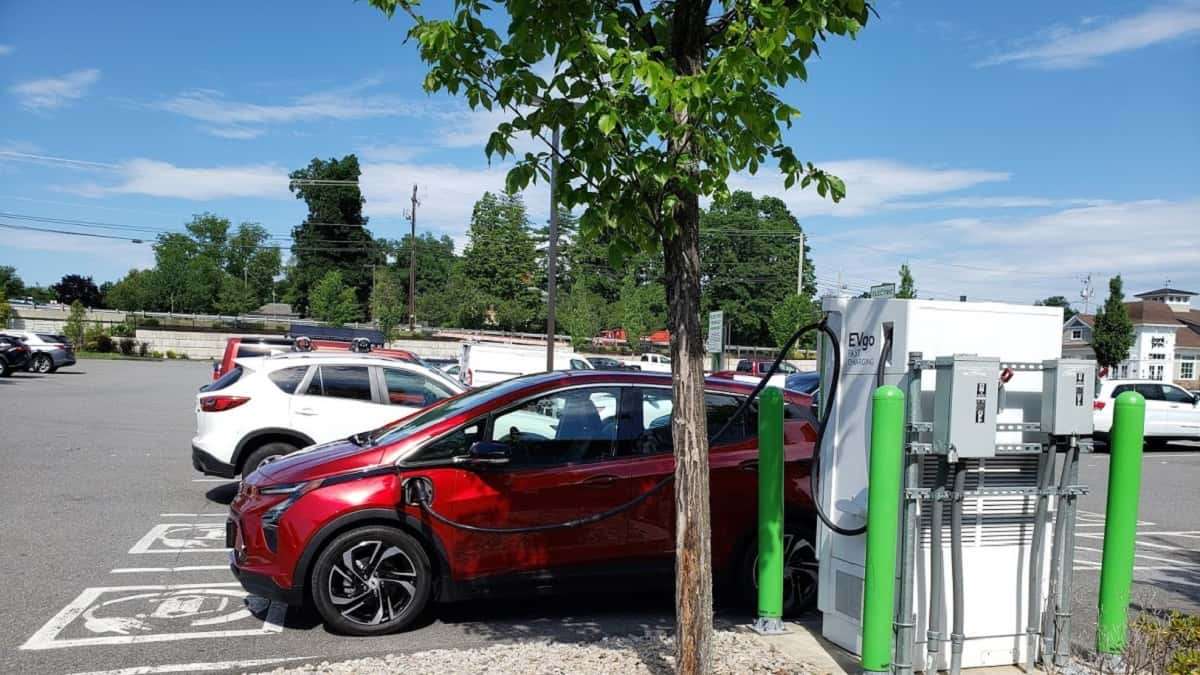

Charging an electric vehicle in public can range in price from free to very expensive. When we recently charged a new 2022 Chevrolet Bolt at an EVgo DC fast charger (DCFC) in Bedford, NH, we discover the pricey end of the spectrum can be more than it would cost to fuel a "gas-guzzling" V8-powered muscle car.
Related Stories:
Big Mistakes To Avoid When Charging an EV In Public
Many Public DC Fast Chargers For Electric Vehicles Are Slower Than You’d Think
Quick Stops At Level 2 Public Electric Vehicle Chargers Are Worthless
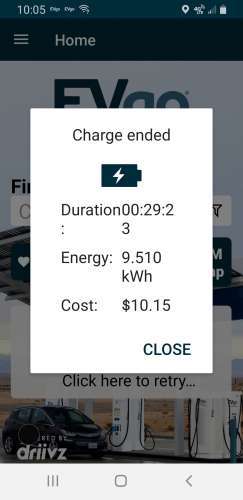
$10.15 To Add 34 Miles of EV Range
We charged up a Chevy Bolt using the EVgo DC fast charger, and the bill was $10.15. That amount of money added 34 miles of range to the Bolt. So, the cost per mile of energy was 30 cents per mile. Let’s compare that to a 2021 Dodge performance car we tested the prior week.
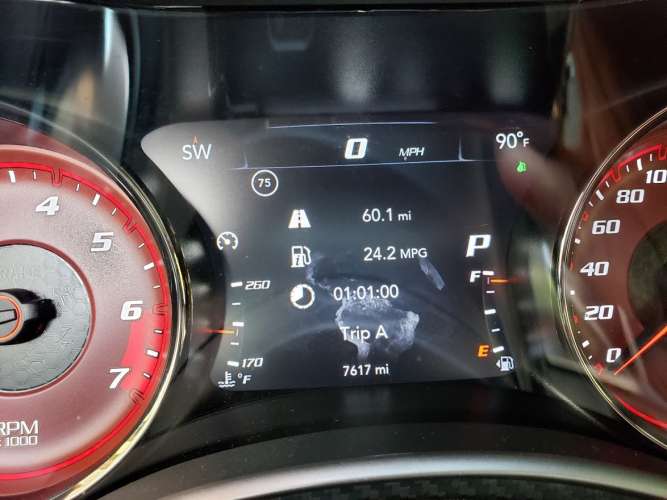
The Dodge had 797 hp, and it returned a combined fuel mileage of 24 MPG in our use on the same route we tested the Bolt. We paid $2.90 per gallon for the gasoline it uses. Doing some “goes in’tahs,” the cost per mile for energy in the muscle car turns out to be 12 cents. Thus, the cost per mile to energize the Bolt was roughly triple what the V8 gas-powered car cost us.
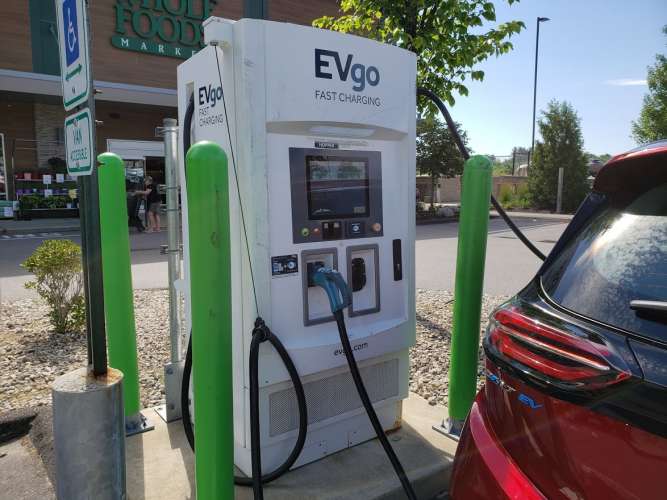
Charging Etiquette
When charging in public one is supposed to quit charging when one’s EV reaches 80% state of charge. The reasons for this are two-fold. First, the rate at which charge can be added to an EV battery is more rapid below 80% and much more time-consuming as the battery reaches full. Second, EV chargers are in very short supply. We need to ration them.
On my route from the metro Boston area to the lakes region of New Hampshire, there are exactly zero public DC fast chargers. In order to charge at a DCFC, I took a slightly longer by time route to swing by one of only two DCFC charging spots in that area. Google “Henniker NH DC Fast Chargers” if you want to see what I mean about no chargers. I needed to top-off in order to complete the 200+-mile route I was making. So, I broke charger etiquette, and I charged to full.
I also charged at the DCFC because I wanted to test my EVgo membership RFID card and account and see how long the DCFC took to add back miles. Both were successful tests.
Charging For Free
Coincidental to my test, GM was running a free-to-charge promotion day during the week I had the Bolt. I think free anything is great, but I always wonder, what’s the hidden agenda? If charging up an EV is very affordable anyway, why does there need to be a promotion to make it “free?” If Dodge offered free gas to muscle car owners, I suppose folks would jump at the chance for a free fillup. But why make EV charging free?
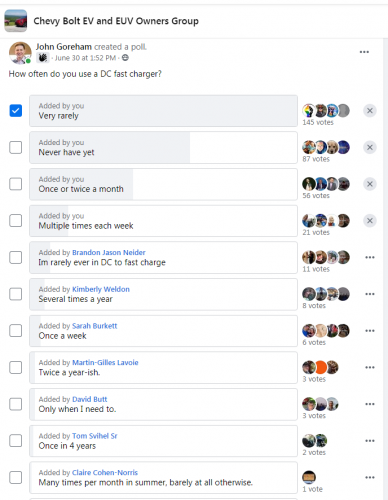
The answer is to get EV owners to the chargers and have them try out the experience. You see, when we poll owners of EVs, most report that they only charge at home, and almost none report using DC fast chargers.
When I plugged into the EVgo DC fast charger, I hadn’t thought about the cost. After all, we constantly hear how affordable EVs are to power up. I have done the math at my own home, and I know that the cost is typically about five to seven cents per mile of range I add back on my home charger using my relatively pricey Boston-area electricity. $10.15 for just 34 miles was a “shock.” Get it, shock. Bet you never heard that in an EV story before.
Related Story: New Hampshire Innkeepers Demonstrate EV-Driving Guest Best Practices
Feel free to tell us in the comments below what you typically pay to charge in public at a DC fast charger and how that cost compares to your cost at home.
John Goreham is a long-time New England Motor Press Association member and recovering engineer. John's interest in EVs goes back to 1990 when he designed the thermal control system for an EV battery as part of an academic team. After earning his mechanical engineering degree, John completed a marketing program at Northeastern University and worked with automotive component manufacturers, in the semiconductor industry, and in biotech. In addition to Torque News, John's work has appeared in print in dozens of American newspapers and he provides reviews to many vehicle shopping sites. You can follow John on TikTok @ToknCars, on Twitter, and view his credentials at Linkedin
Set Torque News as Preferred Source on Google
Follow us today...





Comments
Just a quick thought. Those
Permalink
Just a quick thought. Those of us that drive motor fuel vehicles , I drive a Chevy PU and a 21 year old Vette. , we pay tax on the State snd Federal levels through the fuel tax. I would like to hear from EV owners on how they should pay for the use the Highways and Avenues of the United States. Thanks for reading.
Yeah, New Hampshire isn't
Permalink
Yeah, New Hampshire isn't very green. Very few charging stations.
Someone made a mistake
Permalink
Someone made a mistake somewhere. No 795 HP vehicle would get over 24mpg, highway or combined!
I charge my 2013 Leaf off the
Permalink
I charge my 2013 Leaf off the spare welder outlet at work. At home I get $40 in charging credits from the power company. The rest of the time I use one of the dozens of free level 2 chargers around the Salt Lake Valley. For longer trips I drive an older Subaru wagon. When it eventually gives up the ghost I'll be replacing it with a long range electric. Once you go electric it's difficult to go back to gas.
Ummm…this article must be
Permalink
Ummm…this article must be written from a gasoline enthusiast’s perspective. The fact is, there are several different factors that could affect the cost of charging, I could name them off, but I really just want to get to the point…this is completely false. I drive the same car for my job, and charge on the same fast chargers as in the pictures, multiple times a day. I pay about $12 to fill it up to 80% from 5-10% which normally takes about an hour of charging. That gives me approximately 140 added miles of charge, and that’s with the A/C running. I have no idea where they got these figures.
This article is apples to
Permalink
This article is apples to oranges.
You never use fast charger to top up.
The battery will not take it.
You could have done it at any stage two charger probably for free.
If you were charging that same battery at 10 percent you would have recieved three times the distance. And it would have cost you 10 cents a mile.
I charge my car at home on a stage two charger.
I have a 30 klw battery costs 4 dollars to charge.
I go 130 miles on that charge.
That is 3.5 ish cents a mile.
I hope this adds a reality check on this story.
Something is wrong somewhere,
Permalink
Something is wrong somewhere, one mile per minute? If that vehicle only traveled 34 miles on 9.5 kilowatts there's a major issue.
I think either your math is off or there's so e outright dishonesty here. $10 for 1/2 charge may be about right but my friend can travel a couple hours on a half hour change in his Tesla and not babying it either.
Our 2019 Nissan Leaf Plus EV
Permalink
Our 2019 Nissan Leaf Plus EV averages 270 miles on a full charge. More battery capacity is so worth it. Nissan dealers provide free DCFC. We drive from Brewster to Framingham MA using heat in winter and AC in summer about once ir twice a month. Stop for about an hour at Milford Nissan to recharge to 85-90% on return trip. Mostly recharge in our garage and solar panels on our house fulfills all electrical requirements. Planning your round trips ahead is essential to ensure charging availability and cost.
I've had an avid interest in
Permalink
I've had an avid interest in e-powered vehicles since the sixties when a system was advertised in Popular Science and Mechanics Illustrated by using a large electric jet starter motor which was powered by a series of 'deep cell' marine batteries which in turn were powered by a generator which was spun by a small gasoline engine; and interestingly is how the "submarines" at Disneyland in Anaheim, CA. are powered, except a diesel engine is use to spin a large generator which then provides power to a large electric motor which turns the propeller.
So when the current offerings of e-powered vehicles were first offered it piqued my interest, especially the hybrids such as the Prius, but at the time I already had several vehicles, some of which were capable of obtaining 47 mpg, a Fiat 4dr. 500L, and two large Honda touring motor-cycles so an e-machine was not to be.
However at the present time I'm down to a VW Jetta and a Chevy Silverado with a 5.3 L engine which shows 43 mpg when running on the optional four cylinder configuration on the freeway at 70 mph (!?), and three bikes, each of which are capable of 45 to 55 mpg; but still am considering a used E-Vehicle, such as a Tesla or the fiat 500E which is an absolute blast to drive.
But here's the rub, for long range driving such as from my home in So. Cal. to either Austin, Tx. or Portland, Or. my travel time is greatly increased by several hours due to recharging the batteries.
And one of the problems NOT being mentioned IS now that we in California are faced once again with "rolling brown-outs" or blackouts just how useful is an all-electric vehicle, or hasn't anyone spoken of this before, (?), because in all the research I've done it has Never once been mentioned, (!).
The primary fix, in my opinion, is to equip these vehicles with an array of solar panels on the roof to charge the vehicle in order to provide them with the ability to travel long ranges without adding an unnecessary amount of hours to the trip, meaning having to stay overnight in some instances when a series of charges have added too many hours to keep safely driving to your destination.
Also, one final item re safety, is due to the amount of onboard fires due to the batteries currently being used there is a serious need for an on-board extinguisher system similar to that used on race cars which has also yet to be addressed.
Out of the three vehicles we
Permalink
Out of the three vehicles we drive, all 90s area we average about 15mpg. All can be worked on easily and at low cost. So if you equate what it would cost to replace these with a new ev or petro vehicle its cost prohibited. Long story short i just can't see spending 150g or more on 3 new vehicles on something I'm unable to maintain at home. Neither one is backyard friendly.
My tesla model 3 cost 10
Permalink
My tesla model 3 cost 10 dollars to add 300 miles of range as I took my car from 10% to 95%
Funny you use one of the most expensive EV chargers out there. Thst not even a true supercharger.
Your mistake was using EVGo..
Permalink
Your mistake was using EVGo....They charge by minute.... because apparently they sell time not energy. The lower the charge rate the more money per kWh. They have also modified their attenuation algorithm 2 or 3 years ago to make it slow down more quickly (more money for them)....I haven't gotten any software updates for my Nissan Leaf so it wasn't me.
Use Charge point or Electrify America or just about every other single charging company because most of them will charge you for the energy you receive, not the time you spend connected to it
Eventually EV ranges will get
Permalink
Eventually EV ranges will get up to say a 500 mile range with quick charge times, but for the foreseeable future, car trip vacations are impractical with 30 minute charge times combined with no at home overnight charging. I’ll stick with my large comfortable F150 with plenty of luggage and gear capacity.
Funny drove to Disneyland, so
Permalink
In reply to Eventually EV ranges will get by Doug Jaeger (not verified)
Funny drove to Disneyland, so just over 700 miles, so two charging needed. My sister followed with her family. I left a hour before them and got to the hotel a hour before them. When I needed to charge someone needed the bathroom or food stop. Total 1400 mile trip cost me maybe 25 dollars in charging. But the hotel offered free charging during the stay. Total travel time with stops sames as my sister in her gas car.
Drove to San Diego normally it take 7 hours with Nascar type stops, or 8 hour with normal stops. In my tesla it took 8 hours.
The time you stop for bathroom breaks and food is the time it takes to charge.
I drive about three total
Permalink
I drive about three total hours a day. My 2019 Prius gets 52mpg avg after driving 90k miles. I drive fast and I am not easy on the throttle. I enjoy the efficiency of combining both techs. There is no plug in, my driving style did not change from the sports car I had before. I save enough fuel on a monthly basis, to pay for the car if you compare it to my Dodge Ram 3/4 ton that gets 12.7 mpg without a trailer.
Do your homework Dodge gets
Permalink
Do your homework Dodge gets less than 22 hwy and 15 in the city.
The only EV I would consider
Permalink
The only EV I would consider is the Rivian or the Hummer, granted the Cybertruck seems to be modular which kinda draws me in.
However if I am in the middle of nowhere and I need a charge, I can’t use my external battery pack that is also a jumper. One might opt for solar panels to try and charge their EV, however you would need quite a bit of them in order to get a significant charge.
I am not jumping on the EV bandwagon yet, maybe never I don’t know.
I am happy with my truck and ai don’t worry about the MPG, I get about 250-270, if I baby it 300miles. Plus if I decide to do a cross country trip , I’ll strap on some Jerry Cans or bring a buddy that has a fuel tank in his or her bed.
Repairs on Tesla can be
Permalink
Repairs on Tesla can be expensive but the repairs on any car can be expensive if you take it to the dealer but in the two Years that I'v owned my model 3 other then a flat tire I have had none knock on wood but even if I did the warranty is quite extensive also because I put solar also on my house no Tesla solar because it was before Tesla got it’s act together on solar, I have payed a total of $50 dollars for energy since 2019, and have put some 20,000 miles on my car that’s .0024 cents per mile as for repairs what repairs as previously mentioned there is the computer the Batteries the motor with basically one moving part,
No oil changes, no coolant, brake wear is minimal due to regenerative braking, if you live in a state that cares no smogging as well car pool lanes can be yours I prefer not because I don’t want sticker on my car, and because of auto pilot “not self driving” I don’t feel the need the cruse control is incredible not infallible you are still responsible for continual monitoring but by holding ones wrist on the steering wheel while the car pretty much dose the rest, can it be better what can’t be heck I’m not perfect that’s why 99/100 Tesla owners of Tesla don’t say I think my next care will be a Ford.
Are any jurisdictions
Permalink
Are any jurisdictions applying a road tax to EV charge costs?
In cities throughout Canada,
Permalink
In reply to Are any jurisdictions by Bruce Davie (not verified)
In cities throughout Canada, roads and bike lanes are paid through municipal property taxes. And while drivers pay tax on gasoline, licensing and insurance, none of this revenue pays for city roads.
What the [bleep] were you
Permalink
What the [bleep] were you doing "topping up" at a DCFC?!? The reason no one uses a DCFC past 80% is that the battery pack can't take the charge a DCFC can provide at that state of charge (SOC). The car's battery management forces the charge rte to taper aobove 80%.
You were paying a DCFC price, but the charger was only giving you an L2 charging rate because the car wouldn't let it charge faster. Doing so would have harmed the batteries.
I know EVs are a new thing to many, and it takes time for people to adjust. But seriously - if you're getting paid to provide information on the topic, PLEASE do some homework to avoid spreading disinformation, and it might also prevent putting a patently false click-bait title on the article.
Be better.
Hey CTRomley. Were the
Permalink
In reply to What the [bleep] were you by ctromley (not verified)
Hey CTRomley. Were the paragraphs in the story that said pretty much what you just wrote not clear enough?
You averaged 18kw of charging
Permalink
You averaged 18kw of charging speed, so you decided to fast charge at ~85% battery remaining. That's not when someone should use a fast charger, if you were charging from 10% SOC you would have gained ~27kwh instead of just over 9. The point of a fast charger is to go from a low state of charge to approx 80% not from 80-100% unless it's absolutely necessary as the higher the battery charge is the less energy can be safely put into the battery, it's just a less efficient use of charger time.
So really for that $10 you could have gained over 100mi if you were smart about it.
Excellent summary, John. It
Permalink
In reply to You averaged 18kw of charging by John (not verified)
Excellent summary, John. It augments and expands on our paragraph on charger etiquette nicely.
I'm impressed by how much my
Permalink
I'm impressed by how much my fellow readers know on the subject of EVs.
And I'm curious, what do you guys think is the best SUV to get right now:
Hybrid or EV?
Make and model?
Also, which, in your opinion, is the best VALUE, overall, including price, operation costs, and maintenance?
If you have one, is it the right one?
Or, is there another that you wish you'd waited for?
I'm getting out of a gas SUV, and aiming to go green, on my next one. However, I'm not as familiar with hybrids or EVs, as you guys seem to be, and would welcome your insights.
Thank you.
Waiting for the new Lucid Air
Permalink
Waiting for the new Lucid Air with 500 mile range...
I have a 2019 Nissan Leaf SV.
Permalink
I have a 2019 Nissan Leaf SV. I charge at a DC Fast Charger in Stowe VT that is a 4 minute walk from my house. From 20% to 80% battery charge , which gives me about 100 miles, costs $2.60 and takes 35 minutes.
Is that the ChargePoint on
Permalink
In reply to I have a 2019 Nissan Leaf SV. by Zagnut (not verified)
Is that the ChargePoint on Cottage Club Rd.? I think it's the only fast charger in Stowe if you don't count the Tesla chargers at the resort. It got me thinking. Are DCFCs installed for travelers visiting from long distances or for residents with a house walking distance away? I'm going to noodle on that for a possible story topic. Your comment is appreciated. Stowe is fantastic. Cheers.
I have used the Tesla
Permalink
I have used the Tesla Supercharger network for all my road trips in the Model 3 for the last 3 years. My average price per kWh is $0.209. That's for a total of 2344 kWh of energy. So to add 9.51kWh to my car would cost $1.99.
Tesla's Supercharger network
Permalink
In reply to I have used the Tesla by Rob Kibler (not verified)
Tesla's Supercharger network is great. But not public. You must be a Tesla owner of either the first class, those grandfathered in for free, or second class, those who now pay.