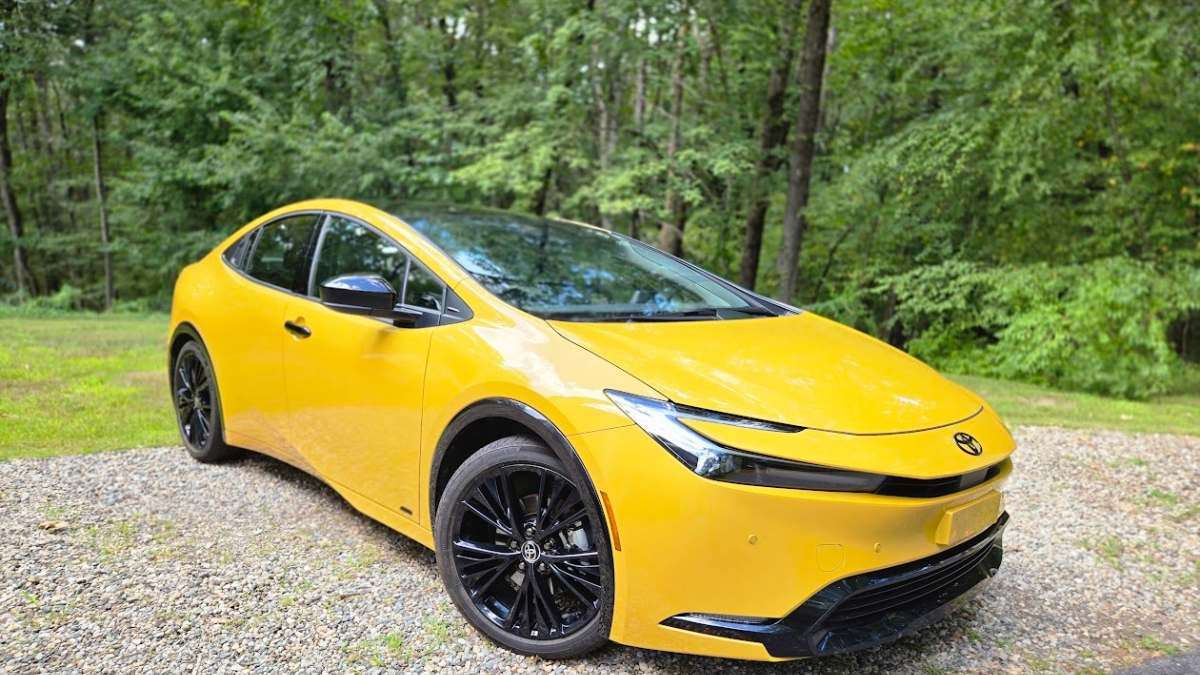

NOT considering buying a 2026 Toyota Prius? Let us save you some time. This is not your story for the day. Rather, this is a story for the approximately 60,000 Americans likely to buy a Prius in 2026, based on current delivery data and sales trends. We’ll tell you which powertrain to choose and which options make the most sense for most people. Ultimately, you need to understand your Prius options, and we will explore them here. How do we know which are worth the cost? We’ve tested the Prius in all its forms for the past few generations. Our focus today is on the current Prius generation for model year 2026. As it stands, the Prius is outselling every battery-electric vehicle in America except two. Its only real competitors are the Corolla Hybrid and the Camry Hybrid.
Prius - Start With Whether AWD Matters To You - Why It Does To Us
Here in New England, we are getting our second storm in two weeks with over a foot of snow. Metro Boston homeowners are struggling to keep ice dams from doing tens of thousands in damage to their ceilings and walls, and any driveway with a slope is a hazard for both driving and walking. From our standpoint, if AWD is an option on any vehicle we are considering, we’ll take it.
The AWD system in the Prius will not enable you to go off-road - ever. It’s not intended to compete with a 4Runner, Land Cruiser, or even a RAV4 Woodland. It’s a great system that offers you secure traction when starting out on slippery roads. That word is key - roads. If you have an inch or two of compressed ice and snow to navigate, the Prius is going to handle that with ease. As good, or better than a 4X4 truck, AWD SUV, or whatever else you can imagine. Pair your Prius with some Michelin CrossClimate2 tires, and you have yourself a fantastic winter commuter.
With its stock tires, the AWD Prius will return an average of 49 MPG to 54 MPG, depending on the trim you select. That’s because the sportier-looking tires eat up more energy. Now for some perspective. The annual fuel cost between those two options (base and XLE/Limited) is abut $50 per year on average in America. If you live where gas is cheap, it’s more like $30 a year. So, don't be a dummy and forgo the options and features you want to squeeze out every drop of MPG. It makes no practical difference in your actual fuel budget.
Prius - Do You Want to Plug It In? If so, Why?
1) Do you have solar with excess capacity each month?
2) Do you live in a location with crazy low electricity costs? Let’s say below fifteen cents per kWh?
3) Can you charge at work for free?
If you answered yes to one or more of these questions, the plug-in Prius has some upsides. You could plug it in and have a lower cost per mile of energy than the versions without the plug. We find plugging in a car a hassle. Our garage has two wall-mounted Level 2 chargers, and we have two additional mobile chargers. Nothing but a pain in the neck for us here in Metro Boston, since it costs less to push the car with gas/hybrid than it does with plug-supplied power. Even using national averages for electricity and gas, the Prius Plug-in only saves its owner about $150 per year in energy costs compared to a Prius with no plug. Meaningless in the total cost of ownership.
The plug-in is a bit quicker, but it's a smidge heavier too. Don’t buy the plug-in thinking you’re getting a more fun-to-drive car. That is entirely subjective. About one quarter of Prius buyers opt for the plug-in version. It sells in volumes similar to those of every Battery-electric vehicle in America, except for two (Tesla Model 3 and Model Y).
Prius - Base or Fancier Trim?
Having been around many Prius trims, we feel like they break down well into just two choices. Base LE, or Limited. The Base makes sense financially for a commuter who wants an inexpensive commuter car. It is packed with standard safety stuff, has an 8-inch infotainment screen, which is enough, and it has wireless Android Auto and Apple CarPlay. It will save you a bit of money on fuel each year, the tires are less expensive to buy and replace, and it will have the same pep as the Limited. If you find an LE in stock, or can snag an incoming one at your local dealer, $30K is your target price (out the door price, as they say). It’s a steal at that price.
The Limited AWD will have better seat adjustability with both heat and ventilation, a glass roof, a bigger screen, a kick-butt audio system, and a digital key option if you want it. Your out the door target price on this Prius is $40K. That’s 33% more money than the base Prius, and notably, we threw in the cost of AWD.
Our Build - 2026 Toyota Prius AWD, No Plug
Because the plug would offer me almost no benefits in Metro Boston with our expensive electricity and low-cost fuel, and since my driveway is a steep hill, I’d pick the Prius AWD, and I’d go for the top trim. I find top trims offer a more enjoyable experience, and the Prius holds its value very well. As good as any vehicle in America. So, the added cost is relative. If you end up selling it or trading it in later, you get back a lot of the premium. If you end up keeping the car long-term, you'll live with a more enjoyable vehicle during that span. It’s either-or in my mind. Base LE, or Limited AWD.
Tell Us Your Preferred Prius Build In the Comments Below
Image by John Goreham.
John Goreham is the Vice President of the New England Motor Press Association and an expert vehicle tester. John completed an engineering program with a focus on electric vehicles, followed by two decades of work in high-tech, biopharma, and the automotive supply chain before becoming a news contributor. He is a member of the Society of Automotive Engineers (SAE int). In addition to his fourteen years of work at Torque News, John has published thousands of articles and reviews at American news outlets. He is known for offering unfiltered opinions on vehicle topics. You can connect with John on LinkedIn and follow his work on his personal X channel or on our X channel. John employs grammar and punctuation software when proofreading, and he sometimes uses image generation tools.
Set Torque News as Preferred Source on Google
Follow us today...