
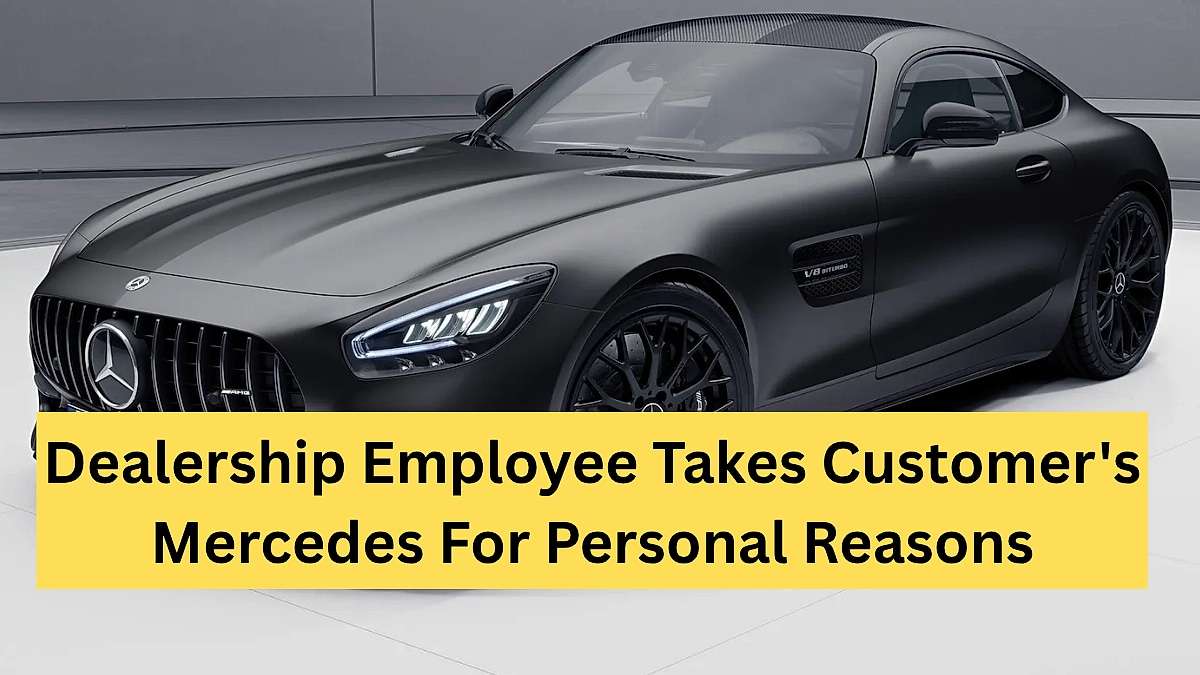

Key Points
- A Collierville, Tennessee dealership service technician was charged with theft after allegedly driving a customer's Mercedes to a local sports bar while the car was supposed to be in for repairs.
- The victim's tracking device exposed the unauthorized use weeks after the car was dropped off, and her attorney says the employee reportedly still works at the dealership.
- Every car owner dropping a vehicle off for service needs to know specific protective steps that can make the difference between being a victim and being in control of the situation.
You drop your car off at a dealership, trust the people behind the counter, and go about your life. You assume your vehicle is sitting safely in a service bay, waiting for skilled hands to fix whatever brought you in that day. That is what every single car owner reasonably expects. But what if your Mercedes is not sitting in the shop at all? What if it is parked outside a sports bar miles away, and the key fob is in the pocket of an intoxicated service technician? That is not a hypothetical. That is exactly what allegedly happened in Collierville, Tennessee, and the story does not stop there.
The victim's attorney was so outraged by the dealership's response that he took to social media and did not hold back one word. Here is the full statement as reported by Action News 5: "Mercedes-Benz Collierville apparently not only thinks this situation and lawsuit is funny, they are now marketing and attempting to profit from this horrible situation. And yes, it is our understanding that he STILL WORKS THERE and they are defending his actions as just fine! Mind blowing! See you in court on April 9 to get a trial date...."
That social media post tells you almost everything you need to know about why car owners have developed such a deep distrust of dealership service departments. We have covered similar issues here at Torque News before, and the pattern is always the same: a customer trusts a dealership, something goes wrong, and then the dealership either downplays it or circles the wagons to protect itself. If you want to understand why so many Ford owners and Toyota owners and Mercedes owners feel burned by dealerships, this story is a textbook example.
What Exactly Happened at Mercedes-Benz of Collierville
According to Memphis police, a woman dropped her vehicle off at Mercedes-Benz of Collierville on South Houston Levee Road on December 10 for repairs. Weeks passed. Then on January 17, her car's tracking device sent her an alert showing movement. The car was not in the service bay. It was located at TJ Mulligan's, a sports bar on Houston Levee Road in Cordova. Officers who responded to the scene found the woman's key fob on a man employed at the dealership as a service technician. According to the arrest affidavit, officers noted that the man was intoxicated and refused to answer questions without a lawyer present. He was arrested and charged with theft of property valued between $10,000 and $60,000.
Here is the detail that will stop you in your tracks: weeks had passed between the drop-off date in December and when the tracking alert fired in January. That means, if the allegations are accurate, this car may have been used more than once during that entire stretch of time the owner believed it was simply waiting in a repair queue. And even after the arrest, the attorney's social media post suggests the employee may still have a job at that dealership. If you feel a knot forming in your stomach right now, you should.
This is not the first time a story like this has landed on our radar. One of the more dramatic cases we have covered involved a Camaro ZL1, where a service advisor and another dealership employee were accused of taking a customer's high-performance car for a joyride and wrapping it around a guardrail at nearly 90 miles per hour on the interstate. The car was totaled, the owner had explicitly told the dealership not to take it off the lot, and the vehicle's onboard data confirmed the reckless driving. These are not isolated incidents.
Why Dealership Employees Taking Customer Cars Is a Pressing and Ongoing Problem
The real pressing problem here goes deeper than one bad employee or one bad dealership. The system itself creates conditions where this kind of misconduct can happen and can even go undetected for a long time. Think about it. When you drop your car off for service, you lose complete visibility of what happens to it. The keys go into a drawer or on a hook. The car sits on a lot. Unless you have an active GPS tracker sending you real-time alerts, you have almost no way of knowing if your vehicle is being moved. Most car owners do not check. Most car owners trust. And most of the time, that trust is honored. But when it is not, the consequences can range from unwanted miles on your odometer all the way up to a totaled vehicle, a drunk driver in your car, or worse.
We have written before about how to spot bad dealership service departments and the red flags that show up even before something serious goes wrong. A Toyota mechanic's breakdown of how to identify untrustworthy service departments and protect yourself from shady practices is still one of the most useful reads for any car owner approaching a service visit. The key insight is this: dealerships operate in an environment of organized chaos, and the culture of accountability at any given location varies enormously from one to the next.
Then there is the uncomfortable truth that some dealerships are not just careless but are actively hostile to accountability. We have covered stories where Ford customers felt completely abandoned by dealership service departments that refused to properly diagnose their vehicles, leaving them frustrated and unsafe on the road. When a dealership culture protects itself rather than its customers, employees who misbehave can feel shielded. That is the environment this kind of misconduct grows in.
What makes the Mercedes-Benz of Collierville case even more unusual and troubling is the allegation that the dealership apparently made light of the situation and even attempted to use it for marketing purposes, according to the attorney's statement. That level of institutional tone-deafness is something that should concern any customer considering that service department. It is exactly the sort of behavior a service customer should never have to encounter.
What Dealerships Must Do Right Now to Prevent This From Happening
Let's flip the lens here, because the solution to this problem has to start with the dealerships themselves. This is not just about one bad technician. This is about systems, policies, and culture. Here is what every dealership service department must put in place to make sure a customer's vehicle is never used for anything other than a test drive directly related to the repair in question.
The first and most obvious requirement is a strict key management protocol. Customer vehicle keys should be tagged, logged, and stored in a locked key box that is audited at the start and end of every shift. Access to that key box should require a supervisor's authorization and a logged reason for key removal. The moment a key is pulled outside of working hours or without a repair order attached, an alert should fire. This is not complicated technology. Dealerships track inventory worth millions of dollars. There is no excuse for not tracking customer keys with the same rigor.
The second requirement is camera coverage of the entire service drive, the key storage area, the parking lot, and the dealership exits. Not just static security cameras, but cameras that are actively monitored. Digital Dealer has covered this topic extensively, noting that live video monitoring has become a practical and affordable layer of protection for dealerships that want to get serious about security, rather than reacting after the damage is done.
The third requirement is mandatory GPS monitoring of all customer vehicles on the lot. If every vehicle in for service has a temporary GPS tag applied to it the moment it arrives, then any unauthorized movement is immediately visible to a supervisor. No GPS tag should be removed until the vehicle is returned to the customer.
The fourth requirement is a culture of zero tolerance written into employment agreements. A service technician who takes a customer vehicle for personal use, whether to the corner store or to a sports bar, must face immediate termination and full cooperation with law enforcement. There can be no ambiguity about this. If the allegations in the Mercedes-Benz of Collierville case are accurate, the dealership's reported response, defending the employee's behavior as fine, represents the precise opposite of the policy any serious business should have.
We have seen this exact playbook fail before. There was the Delaware case where a dealership employee broke into a closed dealership and stole a customer's 2012 Chevrolet Camaro ZL1 for a personal joyride, totaling it, and the dealership did a lackluster job of making the owner whole. It took massive media pressure and the intervention of General Motors itself to force a proper resolution. A customer should never have to rely on a media frenzy to get a dealership to do the right thing.
What You As a Car Owner Must Do Every Single Time You Drop Your Car Off for Service
Now here is the part of this article that directly addresses you, the car owner, because knowledge is your best protection when you cannot be physically present with your vehicle.
First, enable GPS tracking on your vehicle if you have it. Modern vehicles from almost every brand come with a connected services app. Mercedes-Benz has its mbrace system. Ford has FordPass. Toyota has the Toyota app. These apps can show you where your car is in real time. The woman in this story had a tracking device, and it saved her. Not the dealership. Not the service advisor. Her own tracking device is what caught the alleged theft. If you do not use your car's connected app, now is the time to start. Understanding how dealers treat your tracking device, and what they sometimes try to do about it when it suits them, is knowledge every vehicle owner needs.
Second, photograph the odometer and note the exact mileage when you drop your car off. Write it on your repair order if you can. Ask the service advisor to initial it. When you pick up your car, check the mileage again. If there are unexplained miles, you have a documented discrepancy.
Third, make a specific note in writing on your service order that the vehicle is not to be test driven or moved off the premises except for a road test directly connected to the repair, and only with your written authorization. The Camaro ZL1 case, referenced above, showed that having this in writing matters enormously when you end up in court. It is a simple sentence that can protect you significantly.
Fourth, take photographs of your car's exterior before you leave it. Any new scratches, door dings, or damage that appears after service are the dealership's problem if you have before photos. We have reported before on how a dealership horror story involving botched repairs and a vehicle returned with new problems can put the owner's life at genuine risk, and documentation is the only thing that gives you leverage.
Fifth, do not hesitate to ask questions. Why car owners should always listen to and challenge service center technicians is something we have discussed at length here, and the core lesson is always the same: you are the customer, you are paying, and you have every right to ask who will touch your car and why.
The Legal and Financial Fallout When a Dealership Goes Wrong
Let's be real about what is at stake legally. When a dealership employee takes your car without permission, that is theft. Period. It does not matter if the employee planned to return it. It does not matter if your car was not damaged. The moment someone takes your property without consent and uses it for personal purposes, a crime has been committed. In the Collierville case, the accused is facing a charge of theft of property valued between $10,000 and $60,000, which is a serious felony charge in Tennessee.
Beyond the criminal charge, the civil implications are significant. The dealership, as the employer, can be held liable for the actions of its employees while those employees are on duty and have possession of customer property. If the allegations that the dealership was defending this behavior are accurate, that posture could make their legal exposure considerably worse in the civil suit referenced by the attorney. Courts do not look kindly on employers who downplay or excuse employee misconduct.
If you have ever wondered what to do when a dealer refuses to honor your rights after something like this happens, there is a clear path forward. Knowing your rights when a dealer refuses to make things right, from contacting manufacturers to using the Federal Trade Commission, is something every car owner should understand before they ever need it. Knowing those steps in advance puts you in a far stronger position than discovering them in a panic after the fact.
The Moral of This Story Goes Beyond Cars
Here is the thing that gets me every time I cover a story like this. The car is just the surface layer. What is really at stake is trust. When you hand your keys to a service technician, you are extending a form of trust that most of us extend almost automatically, because that is how a functioning society works. We trust the mechanic, the pharmacist, the contractor, the babysitter. We cannot personally supervise every professional we rely on.
The lesson here is not that you should never trust anyone. The lesson is that systems matter. When individuals within institutions face no accountability, when there is no camera watching, no key log being audited, no supervisor checking, some people will take advantage of that absence. That is human nature at its worst. But accountability systems exist precisely to protect the many good people from the actions of the few bad ones.
As a car owner, the moral is this: protect yourself not because everyone is dishonest, but because good protection honors both your peace of mind and the dignity of the professionals who do serve you well. Do not put a good technician in a position where they could be blamed for something they did not do simply because you had no records. Document everything. Not as an act of suspicion, but as an act of responsibility.
Dealerships that handle this kind of thing with integrity tend to be the ones that build genuine long-term trust with their customers, something we have seen even in the luxury segment where poor customer service can drive buyers away permanently. The Mercedes-Benz of Collierville story is a cautionary tale about what happens when that integrity is absent at every level of a dealership's response.
For dealerships that want to understand what customers are really looking for, beyond the car itself, the pattern is consistent: be honest, take responsibility, and never make your customer feel like an inconvenience. That is not complicated. It is just character.
Now It Is Your Turn
This story raises two questions I genuinely want to hear your answers to in the comments below.
Have you ever dropped your car off at a dealership for service and discovered unauthorized miles, unexpected damage, or any sign that your vehicle was used in a way it should not have been? Tell us what happened and how the dealership responded.
And second: do you currently use your vehicle's GPS or connected app to monitor your car's location when it is at a dealership, and if not, has this story changed your mind about doing so going forward? Share your experience in the comments section below, because your story could help someone else avoid the same situation.
Image by Mercedes Benz-Media.
About The Author
Armen Hareyan is the founder and Editor-in-Chief of Torque News and an automotive journalist with over 15 years of experience writing car reviews and industry news. Now based in the Charlotte region (Indian Land, SC, he founded Torque News in 2010, which since then has been publishing expert news and analysis about the automotive industry. He can be reached at Torque News on X, Linkedin, Facebook, and Youtube. Armen holds three Masters Degrees, including an MBA, and has become one of the known voices in the industry, specializing in the landscape of electric vehicles and real-world stories of actual car owners. Armen focuses on providing readers with transparent, data-backed analysis bridging the gap of complex engineering and car buyer practicality. Armen frequently participates in automotive events throughout the United States, national and local car reveals and personally test-drives new vehicles every week. Armen has also been published as an automotive expert in publications like the Transit Tomorrow, discussing how will autonomous vehicles reshape the supply chain, and emerging technologies in vehicle maintenance.
Set Torque News as Preferred Source on Google
Follow us today...






Comments
I encourage my mechanic to…
Permalink
I encourage my mechanic to road test my vehicles.
I have a friend mechanic he…
Permalink
I have a friend mechanic he says he tells his customers that he will be driving and road testing the cars. But the question here, did this person do an authorized road-test?