


3 Key Points:
- The Tesla Semi's battery weighs an estimated 10,000 pounds, and the road damage math is far more alarming than most EV coverage admits.
- Electric semi operators pay nothing at the pump toward road maintenance, and studies show who actually ends up footing that bill.
- There is a specific policy framework that could solve the road funding gap fairly, and most analysts are completely missing it.
The Tesla Semi is real, it is impressive, and it is now in volume production. Yet, I keep asking one question almost nobody in the mainstream press is asking. Who exactly picks up the tab for all those extra tons pounding America's highways every single day?
This question started for me this week after reading a LinkedIn discussion that stopped me cold.
Robin Singh, a media and PR specialist from New Delhi, wrote this about the Tesla Semi's battery pack.
"The sheer scale of the engineering required to electrify long-haul trucking is best illustrated by the massive weight of the Tesla Semi's battery pack. Recent analysis suggests that the battery alone weighs significantly more than an entire Tesla Cybertruck, highlighting the immense energy density required to move a fully loaded Class 8 vehicle over hundreds of miles. This comparison serves as a stark reminder that the transition to electric heavy-duty transport is not just a matter of changing engines, but a complete reimagining of vehicle architecture and weight distribution.
This massive weight profile presents a unique challenge for the logistics industry, as every pound of battery capacity potentially subtracts from the legal payload a truck can carry. Critics often point to this weight penalty as a major hurdle for electric semis, arguing that traditional diesel trucks still offer a superior weight-to-power ratio for long-distance shipping. However, proponents argue that the lower center of gravity and the massive torque provided by the electric drivetrain compensate for the added mass, offering a level of stability and performance that traditional internal combustion engines cannot match."
That last part deserves serious attention. The stability and torque argument is real. I have driven enough test vehicles on real roads to know that lower center of gravity changes how a vehicle feels and handles in emergency situations. Our TorqueNews deep dive into the Tesla Semi's engineering breakdown confirms that the battery sits below the floor, which changes the truck's handling profile in measurable ways. And our recent coverage of why the Tesla Semi's "born electric" architecture cracked the cold weather range problem explains how designing from the ground up as electric rather than converting a diesel platform eliminates entire categories of mechanical failure.
How Heavy Is the Tesla Semi Battery, Really
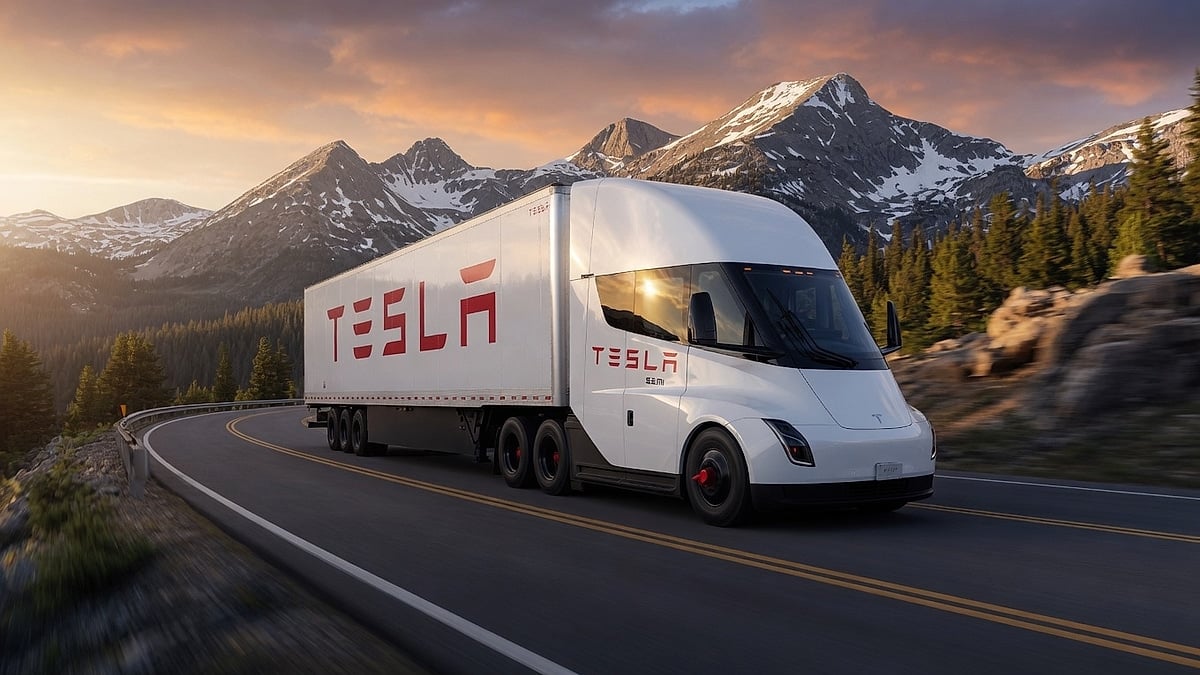
The Long Range Tesla Semi carries an 822 kWh battery pack, weighs roughly 23,000 pounds at the curb, and carries a maximum gross combination weight of 82,000 pounds, which aligns with standard Class 8 trucking regulations in the United States. Earlier engineering estimates put the battery weight alone at around 10,000 pounds, based on scaling from the Model S battery's energy density of 186 wh per kilogram. For context, that battery alone outweighs most compact cars on the road today. Tesla announced a 2026 model update that shaves roughly 1,000 pounds from the earlier design, partly by shifting to a 48 volt architecture. That is progress. But the truck is still enormous, and it still pushes its full legal weight onto the road surface with every mile, reports EVDANCE.
What Does a Heavy Truck Actually Do to the Road Surface
Here is the part of this debate that most EV enthusiasts would rather skip. Mark Gottlieb, a professional engineer and associate director of the University of Wisconsin-Milwaukee's Institute for Physical Infrastructure and Transportation, stated that load-related damage to pavement and bridges is caused almost exclusively by heavy trucks, and that the deterioration from a single large truck can easily equal that of thousands of automobiles. A semitruck with eight axles weighing 80,000 pounds does 2,500 times more road damage than a two-axled 4,000-pound sedan, according to the American Institute of Physics. Road damage does not scale in a straight line with weight. It scales exponentially. That is the number that should be on every policy maker's whiteboard right now, UtkPolitiFact reports.
A reader named Roberto De Paschoal offered one possible answer in the LinkedIn thread. He argued that CATL's battery swap network concept allows trucks to travel with a fraction of the weight, swapping modules in a couple of minutes while drivers take a coffee break. That is a genuinely interesting idea. But it depends on infrastructure that does not exist at scale in the United States today, and it would require a complete standardization across manufacturers that the trucking industry has so far resisted. Another reader, Dave, put it bluntly. "When they can make an electric truck do 600 to 650 miles with no recharging needed, they might become useful for long haul operations. And then you need hundreds of chargers placed at truck stops, rest areas, and some shippers who take forever to load a trailer."
The Road Funding Problem Nobody Wants to Solve
Diesel trucks pay federal and state fuel taxes with every fill, and those taxes fund road maintenance. Electric semis pay nothing at the pump. Our earlier TorqueNews coverage of Washington State's electric vehicle road fee debate captured this problem more than a decade ago, and the problem has only grown since then. Our analysis of Oregon's OReGO pay per mile program identified that a flat per mile fee without weight adjustment actually favors heavier vehicles, which is exactly the wrong outcome when roads are destroyed exponentially more by axle loads, not just by distance traveled.
A study from NYU Tandon School of Engineering found that switching to electric trucks could increase damage costs to New York City's road infrastructure by between 9.19 and 11.71 percent by 2050, with the city already incurring about 4.16 million dollars in annual damage from oversized trucks today. That is just one American city. Multiply that pressure across tens of thousands of miles of interstate and local roads, and the number becomes a serious infrastructure conversation, we read at the NYU Tandon School of Engineering's post.
The Asphalt Industry Alliance estimated that road weight damage could require nearly 80,000 dollars in additional spending for every mile of a local road, with costs passed on through increased taxes and fees. That bill lands on everyone, not just the trucking companies running electric fleets, National Motorists Association reports.
What the Industry Needs to Do Right Now
The solution is not to slow down electric truck adoption. The Tesla Semi's 95 percent uptime record and 13.5 million real world miles already prove the technology works. Globally, trucks and buses represent about 8 percent of total vehicles on the road but create 35 percent of carbon dioxide emissions from road transport. Electrifying heavy freight is not optional if we are serious about climate goals, MIT Technology Review reports.
But the solution is also not to pretend the weight problem does not exist. The road damage math is real. The funding gap is real. The answer is a weight-adjusted road use fee applied to all commercial vehicles, electric or diesel, based on actual axle loads per mile traveled. This already exists as a concept in the trucking industry through the Heavy Vehicle Use Tax. Extending it with weight multipliers to all commercial freight, regardless of fuel type, would be fair, fund the infrastructure that makes trucking possible, and give fleet operators a transparent cost structure. MIT Technology Review's coverage of the Tesla Semi at MIT Technology Review notes that whether the Semi achieves widespread adoption will largely depend on how quickly charging infrastructure expands and whether operators can reduce operating costs compared with diesel over time. Road use fees are a legitimate operating cost, and building them into fleet calculations early is better than being surprised by state levies later.
Our TorqueNews report on Tesla Semis taking over short haul trucking shows where the near term wins are. Drivers converting mandatory rest breaks into recharge windows, running regional loops from depots, and cutting fuel costs dramatically. That is where electric semis win today, and where the road damage question is more manageable because routes are shorter and more predictable.
Our coverage of the staggering economics of the Tesla Semi laid out the payload vs. battery weight trade-off in detail, and the conversation in that comment section was blunt. Every pound of battery is a pound not earning money for a freight carrier. That economic pressure will push the industry toward lighter batteries as energy density improves, which is exactly the right direction for road longevity too.
The Moral Question at the Heart of This Debate
Here is the moral reality. The companies deploying electric semis will collect real operational savings, real fuel cost reductions, and real emissions credits. The roads those trucks wear down belong to all of us. Taxpayers who never haul a single freight pallet will pay to repave the highways those trucks travel daily.
That is not an argument against electric trucks. That is an argument for honesty. The real cost of any transportation system includes the infrastructure it depends on. A truck that saves a company money on fuel while externalizing its road wear cost onto the public has not eliminated the cost. It has just moved it to someone else's bill.
The most fair, most durable solution is to price road use by weight and distance for all commercial vehicles, and let the market sort out which powertrain makes the most economic sense under honest accounting. That is a policy conversation this industry needs to have before the Tesla Semi fleet numbers go from hundreds to hundreds of thousands.
Tesla Semi's cameras and their signal about autonomous trucking's future are already pointing toward a world where the driver cost equation changes dramatically too. The road funding question needs to be solved before that transition accelerates.
Do you think electric semi truck operators should pay a weight-adjusted road use fee based on axle load per mile, and how should that fee be structured to be fair to small carriers? Have you seen road damage in your area that you believe is tied to heavy truck traffic, and do you think state and federal governments are moving fast enough to address the infrastructure funding gap? Share your experience and thoughts in the comments section below.
Editor's Note: A linkable reference tool for Torque News readers: The Federal Motor Carrier Safety Administration maintains a public Heavy Vehicle Use Tax calculator and weight distance reference at fmcsa.dot.gov, which fleet operators and policy analysts can use to model road use cost scenarios under different weight adjusted fee structures. This is the kind of transparent cost accounting the electric trucking transition needs to build into its economics from day one.
About The Author
Armen Hareyan is the founder and Editor-in-Chief of Torque News and an automotive journalist with over 15 years of experience writing car reviews and industry news. Now based in the Charlotte region (Indian Land, SC, he founded Torque News in 2010, which since then has been publishing expert news and analysis about the automotive industry. He can be reached at Torque News on X, Linkedin, Facebook, and Youtube. Armen holds three Masters Degrees, including an MBA, and has become one of the known voices in the industry, specializing in the landscape of electric vehicles and real-world stories of actual car owners. Armen focuses on providing readers with transparent, data-backed analysis bridging the gap of complex engineering and car buyer practicality. Armen frequently participates in automotive events throughout the United States, national and local car reveals and personally test-drives new vehicles every week. Armen has also been published as an automotive expert in publications like the Transit Tomorrow, discussing how will autonomous vehicles reshape the supply chain, and emerging technologies in vehicle maintenance.
Set Torque News as Preferred Source on Google
Follow us today...







Comments
Living in North Central…
Permalink
Living in North Central Indiana it is quite obvious that the Farm machinery on the roads does much more damage than a semi truck does! And yet farmers are subsidized by the government and are required to have no registration fees. I paid almost $4000 in registration fees for my seven electric vehicles a couple months ago here $240 per each vehicle that’s electric in addition to the normal fees and now I am talking about just cars and pickup trucks and vans. Nothing big , nothing heavy , nothing that would be difficult on roads more than any gas car or pick up truck. so things are not balanced right now. electric vehicle drivers are being taken advantage of and mistreated already! fairness would be appreciated!
Wrong. Tesla Semi long…
Permalink
Wrong. Tesla Semi long range 23K. New diesel fueled 23K.
Same weight as diesel semi…
Permalink
Same weight as diesel semi fueled
Exactly. Unless these Tesla…
Permalink
In reply to Same weight as diesel semi… by Michael L Hutcheson (not verified)
Exactly. Unless these Tesla semis got an exemption to the federal weight limits, they may actually be hauling less freight than a regular semi when both are fully loaded.
Update: U.S. House lawmakers…
Permalink
Update: U.S. House lawmakers proposed bipartisan legislation that would require electric vehicles to pay a $130 fee to pay for road repairs annually and $35 for some plug-in hybrid models.
Point 2 of 3 Key points is…
Permalink
In reply to Update: U.S. House lawmakers… by Armen Hareyan
Point 2 of 3 Key points is not accurate. "Electric semi operators pay nothing at the pump toward road maintenance". Operators are currently paying electricity taxes at charging stations in many states that goes to help fund roads.
I have no problem paying my…
Permalink
In reply to Update: U.S. House lawmakers… by Armen Hareyan
I have no problem paying my fair share for maintaining the roads. But since I am driving electric, does that mean I no longer have to pay for the oil subsidies? Or will I be taxed twice?
Last time I looked at my…
Permalink
Last time I looked at my electrical bill it was filled with all kinds of taxes. How about we wait until there are more than a handful of these things before we decide how government can milk them for all they are worth
The comment about cutting…
Permalink
The comment about cutting emissions was silly and fun, wasn't it? We like humor in reporting. So, Tesla solved the ten-mile-tailpipe problem, did it? Sorry...couldn't resist.
The writer is forgetting…
Permalink
The writer is forgetting that all semis have a gross weight limit of 80000 lbs plus 2000 lbs for EV semis. It make no difference how much the battery weighs.
Tired of these tropes of EVs…
Permalink
Tired of these tropes of EVs of any size being called out as morbidly obese when compared to ICE vehicles. A typical semi day trip, no sleeper etc tractor dual axle diesel comes on at a porky 20k lbs. Typically the whole rig is limited to 80k lbs GVW that's vehicle and load total. If the tractor weighs more you need to cut back on the payload or be overgrows weight. An ICE SUV with AWD comes on within or less than an electric SUV. Look at the stats people before you make claims that will negatively affect the pulmonary health of your children.
Is it heavier than a…
Permalink
Is it heavier than a comparable new diesel truck? If not, why does it matter?
Consider a tire tax, based…
Permalink
Consider a tire tax, based on circumference times tread width time tread thickness as a surrogate for distance traveled, with multiplier for load rating. Requires additional safety inspections to deter running on worn out tires.
Another Tesla hit piece, who…
Permalink
In reply to Consider a tire tax, based… by M Melcon (not verified)
Another Tesla hit piece, who sponsored this one?