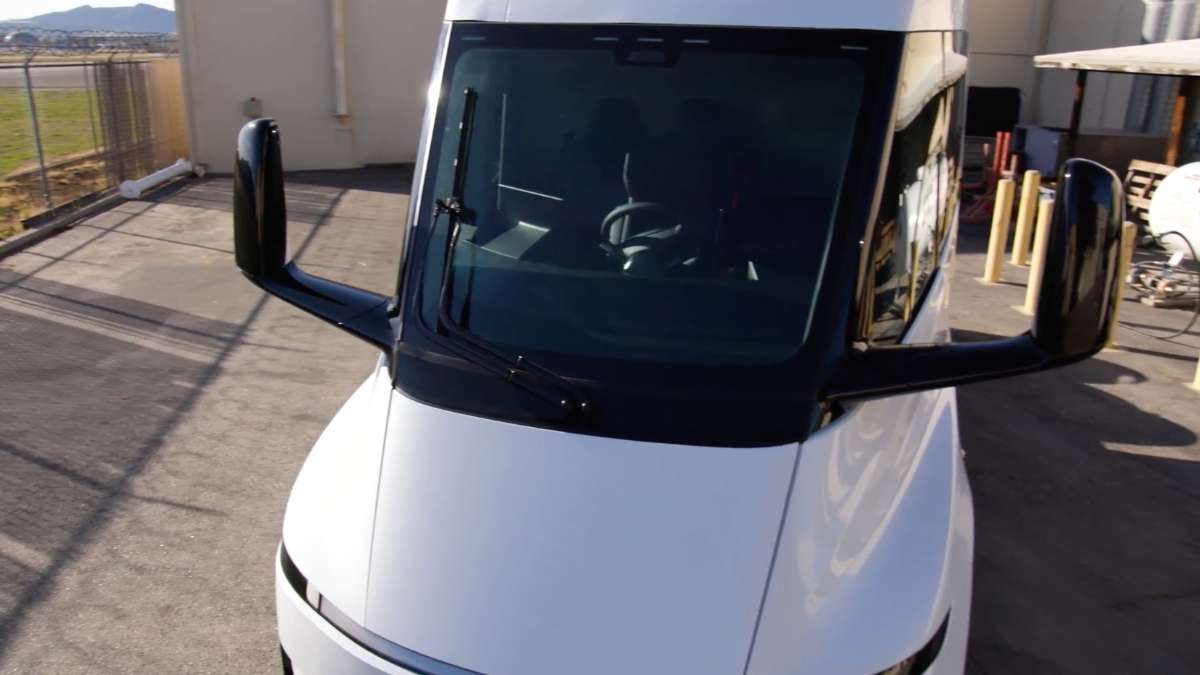

- California diesel hit a record $7 per gallon in 2026, pushing fleet operators nationwide to urgently find cheaper alternatives.
- The Tesla Semi delivers 95% uptime and 15 cents per mile across real freight routes, giving large fleets a proven diesel alternative.
- Small trucking companies cannot yet access the Tesla Semi, but 13.5 million real world miles prove electric semi trucks are a present solution, not a future one.
Let me ask you something. When was the last time you drove past a gas station and did a double-take at the price board? If you live in California and you run a trucking fleet, that double-take just got a whole lot more painful. Diesel in California has crossed $7 per gallon, setting an all-time record high. The national average for regular gas is approaching $4. And while everyday drivers are feeling the squeeze at the pump, as we detailed in our look at why EV owners and gas car owners are now on very different financial trajectories when fuel prices spike, the people really losing sleep over this are fleet operators, logistics managers, and small trucking companies trying to keep goods moving across America. It is worth understanding exactly why, because the true cost comparison between electricity and gasoline in California has reached a point where the numbers can no longer be ignored, especially for anyone operating vehicles at commercial scale.
Here is the thing, though. There is a truck out there right now quietly solving this exact problem, and it has the data to prove it. I am Armen Hareyan, founder of TorqueNews.com, and I have spent 15 years covering the automotive industry. I have watched a lot of products get announced, hyped, delayed, and forgotten. The Tesla Semi is different. And what is happening right now, with diesel at $7 in California, is the moment that makes everything about the Semi suddenly, urgently relevant. Before I get into the numbers, let me take you back to where this story really starts, because understanding why this matters takes a little bit of patience, and patience, it turns out, is the whole point.
Why $7 California Diesel Is a Trucking Emergency, Not Just a Headline
You might think $7 diesel is a California problem. It is not. California is the most important freight market in North America. The ports of Los Angeles and Long Beach move roughly 40% of all containerized imports entering the United States. When diesel costs spike in California, everything costs more. Groceries. Electronics. Clothing. The cost gets passed along the supply chain, and eventually it lands on your receipt at the checkout counter.
For a Class 8 diesel semi truck burning roughly six miles per gallon at $7 diesel, you are looking at well over a dollar per mile in fuel costs alone, before you pay the driver, the insurance, or the maintenance bill. That is not sustainable for small and mid-size carriers. It is painful even for the large ones. The people running ten trucks, twenty trucks, or a hundred trucks out of regional distribution centers in the Inland Empire right now are doing the math over and over, and the math keeps getting worse. If you want to understand the deeper economics of why this moment is so critical for the industry, our own analysis of the staggering economics of the Tesla Semi versus diesel trucks laid this groundwork clearly. The numbers were always pointing toward one conclusion. The fuel price crisis just moved the timeline up dramatically.
The Tesla Semi's 95% Uptime Is the Number Diesel Cannot Match
Here is where it gets interesting. And I mean genuinely interesting, not marketing-speak interesting.
A few hundred Tesla Semis are currently operating in the real world. Confirmed by Tesla Semi program chief Dan Priestley on Jay Leno's Garage, those trucks have collectively logged 13.5 million miles. One single truck has already crossed 440,000 miles. And the fleet is reporting 95% uptime. When 75 to 80% of any breakdowns that do occur are resolved and the truck returned to the customer within 24 hours, and nearly half of all breakdowns are fixed in under an hour, that is not just a reliability number. That is a logistics revolution.
Diesel's traditional argument has always been repairability. Any town, any shop, any wrench. But here is one part of the reality that the critics of electric trucks never fully accounted for. The Tesla Semi does not just fix breakdowns faster. It eliminates entire categories of breakdown. No turbocharger failures. No EGR valve issues. No diesel particulate filter clogging at 3 AM on a mountain pass in Nevada. No DEF fluid drama. No transmission servicing. No engine oil. The truck has fewer failure modes by design, not just by luck. That is a fundamentally different engineering philosophy. When you understand that, the 95% uptime figure stops being a sales talking point and starts being an accounting entry in your favor.
Tesla Semi program lead Dan Priestley has confirmed the fleet maintains 95% uptime, and for breakdowns that do occur, 75 to 80% of trucks are returned to the customer within 24 hours, with nearly half resolved within an hour. For fleet operators managing delivery schedules across dozens of stores or distribution centers, that number is what determines whether your business survives a diesel price shock like the one hitting California right now.
We have been watching this story develop for years, and as we noted when Elon Musk used three specific words about the Tesla Semi that matter more than any production timeline, the language of "high volume production" signals something real, not just aspirational. Fleet operators do not think like car enthusiasts. They think like accountants. They want predictability. And predictability is exactly what that uptime number delivers.
The Real Cost Per Mile Math That Should Wake Up Every Fleet Manager
Stay with me here, because this next part is the part that no one is talking about loudly enough.
Running a Tesla Semi costs roughly 15 cents per mile in energy. A diesel truck runs close to 50 cents per mile. At $7 diesel in California, that diesel figure climbs even higher. We are talking about an 83% reduction in per-mile energy cost, before you even touch the maintenance savings. No oil changes. No fluid services. No DPF regeneration. No turbo replacements. Every one of those line items that diesel fleet managers budget for every quarter simply disappears. As the investment case for Tesla's electric truck program makes clear, Tesla Semi program management has consistently argued that lower energy costs, reduced emissions, and drastically lower maintenance define the ownership proposition. The real-world data is confirming it, mile by mile.
On economics, Tesla Semi program chief Priestley said the Semi is 50% cheaper to operate per mile on energy costs in California compared to diesel, and nationally the total cost of ownership is nearly 20% cheaper per mile. At $7 California diesel, that California-specific advantage grows even larger. This is no longer a futurist argument. It is a spreadsheet argument, and the spreadsheet is winning.
Electrek noted that with current diesel and electricity rates, the Tesla Semi would pay itself back compared to diesel alternatives in a few years for local distribution. At $290,000 for the Long Range version, the Tesla Semi carries a premium upfront. But when your diesel bill alone is running north of a dollar per mile, that premium starts looking like a very short conversation with your CFO.
Now here is something worth sitting with for a moment. PepsiCo, one of the earliest large-scale operators, was not chasing headlines when it deployed Tesla Semis. They were chasing the balance sheet. Our coverage of PepsiCo's real-world Tesla Semi operations and mileage numbers showed exactly how a serious logistics company evaluated this truck. The drivers loved it. The accountants liked the numbers. And in one remarkable instance, a PepsiCo Semi covered more than 1,000 miles in a single day with mid-shift charging. That is not a press release. That is a truck doing its job.
Who This Actually Helps and Who Gets Left Behind
Let me be straight with you, because this is where a lot of cheerleading coverage goes wrong. The Tesla Semi, at this moment, is not a solution for everyone. And knowing who it helps and who it does not is exactly the kind of honest analysis that matters if you are making real business decisions.
The operators who can act on this right now are large regional and short-haul fleets. Companies running predictable routes, depot-based charging, and the scale to negotiate fleet pricing. Companies like Sysco, Walmart, Costco, DHL, and of course PepsiCo, which placed deposits all the way back in 2017. Those companies waited nearly a decade. But the ones who stayed patient, who kept watching the data instead of canceling, are now positioned to deploy the most efficient commercial transport platform ever built for regional freight.
The owner-operator running two diesel trucks in Fresno, taking a beating at $7 diesel every week, does not have a path to a Tesla Semi today. That is the honest gap in this story, and I think it is worth naming. The Semi's economics are transformative for large fleets. For small carriers, the upfront cost remains a real barrier, even as the running cost argument gets stronger every week that diesel stays elevated.
There is also an important charging infrastructure question. We covered the significance of Tesla Megacharger locations like the one in Baker, California, supporting Semi routes between Las Vegas and Los Angeles, and while Tesla has been expanding its Megacharger network, the infrastructure is still being built. Tesla Semi program lead Dan Priestley has said the company aims to deploy 46 Megacharger stations by early 2027, with approximately 37 sites planned for 2026, targeting major freight corridors including I-5 on the West Coast and I-10 as an east-west artery. That is meaningful progress, but it is still progress in motion, not a completed network.
Critics of the Semi have raised some legitimate questions about charging infrastructure, payload weight trade-offs on maximum-load runs, and how reliability holds up as the fleet scales from a few hundred trucks to tens of thousands. Those are fair questions. We covered the broader debate around the pros and cons of electric semi trucks from the perspective of actual truckers, and the skepticism from working drivers has always been grounded in real operational concerns, not just resistance to change. And there have been setbacks. We also covered how a Tesla Semi fire in California raised questions about battery safety that deserve serious answers. No credible automotive journalist should wave those concerns away. The industry holds Tesla to the same safety standard as every other truck manufacturer, and it should.
But here is the thing. The critics who said the Semi would never hit its efficiency targets have been proven wrong by DHL's real-world data. The ones who said charging time would make it impractical are overlooking that 1.2-megawatt charging can add up to 300 miles in 30 minutes, which lines up neatly with mandatory DOT rest breaks. And the ones who said the short-haul market was not large enough to matter never spent enough time studying just how wrong the long-haul-only argument actually is when you look at the data. The enormous short-haul and regional market is exactly where the Semi is thriving right now.
What This Moment Means for the Future of American Freight
We are watching something shift in real time. Not because of ideology, and not because of government mandates. Because of fuel prices and uptime data and the kind of math that fleet managers do at midnight when they are trying to figure out whether to renew their diesel contracts or make a different bet.
I have spent 15 years covering this industry. I have seen a lot of technology promised and a lot of technology deliver. The Tesla Semi has been slower than anyone wanted. The delays were real. The pricing went higher than Elon Musk's original promise in 2017, which is a conversation worth having honestly. But the truck that exists today, the one running 13.5 million combined miles with 95% uptime, is real. And it is arriving at exactly the moment when diesel in California has never been more painful to buy.
The moral underneath all of this is simple but worth saying clearly. The people who will benefit most from this moment are not the ones who moved fastest on hype. They are the ones who moved carefully, waited for data, updated their thinking when the evidence changed, and kept asking the right questions. In business and in life, the willingness to change your mind when the facts change is one of the most valuable things you can develop. The fleet operators who put deposits on Tesla Semis in 2017, kept their orders, and watched the data build over nearly a decade are about to see that patience turn into competitive advantage. That is a lesson worth carrying beyond the trucking industry. The Tesla Semi's factory ramp toward 50,000 units per year signals that this advantage will eventually reach more operators. But the early movers will have done it first.
California diesel at $7 a gallon is painful today. But it is also a moment of clarity. And sometimes clarity, as uncomfortable as it is, is exactly what an industry needs to finally move.
Now I want to hear from you directly. Drop your answer in the comments section below:
- If you run a fleet or know someone who does, has the $7 diesel reality in California already started conversations about switching to electric trucks, or does the upfront cost of the Tesla Semi still feel like too large a barrier to cross?
- For everyday drivers following this story, does real-world data showing 95% uptime and 13.5 million combined miles across a few hundred Tesla Semis finally change how you think about EV reliability for your own next vehicle purchase, or are you still waiting to see more proof before you commit?
Tell us your experience in the comments below. Your perspective matters, and this conversation is worth having.
Armen Hareyan is the founder and Editor-in-Chief of Torque News and an automotive journalist with over 15 years of experience writing car reviews and industry news. Now based in the Charlotte region (Indian Land, SC, he founded Torque News in 2010, which since then has been publishing expert news and analysis about the automotive industry. He can be reached at Torque News on X, Linkedin, Facebook, and Youtube. Armen holds three Masters Degrees, including an MBA, and has become one of the known voices in the industry, specializing in the landscape of electric vehicles and real-world stories of actual car owners. Armen focuses on providing readers with transparent, data-backed analysis bridging the gap of complex engineering and car buyer practicality. Armen frequently participates in automotive events throughout the United States, national and local car reveals and personally test-drives new vehicles every week. Armen has also been published as an automotive expert in publications like the Transit Tomorrow, discussing how will autonomous vehicles reshape the supply chain, and emerging technologies in vehicle maintenance.
Set Torque News as Preferred Source on Google
Follow us today...