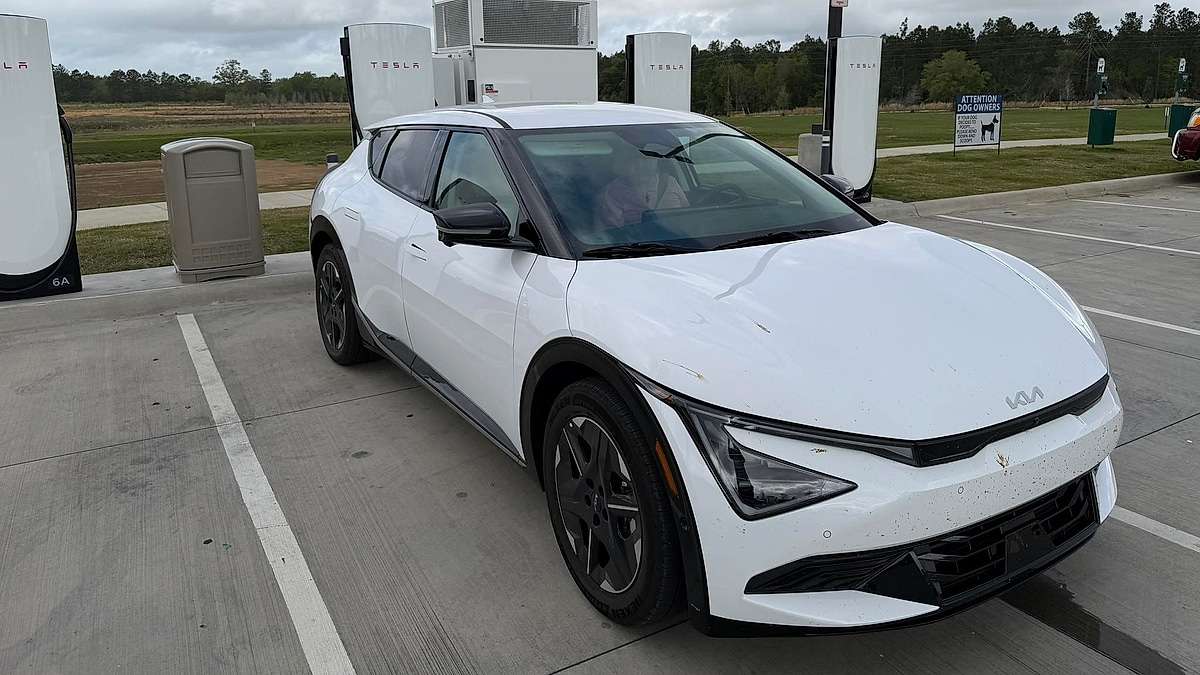

Gas prices are climbing again, and if you are still reaching for your wallet at the pump every few days, you may want to hear what one Kia EV6 owner just pulled off. A family drove all the way from South Carolina to Louisiana in an all-electric Kia EV6, and the total charging bill for one stop came to under $30. That is less than many people spend on a single tank of regular unleaded these days. If you have been sitting on the fence about whether electric vehicles can truly handle long-distance travel without becoming a stressful experience, this story might just be the one that changes your mind. In fact, right here at Torque News we have been closely following the experiences of real Kia EV6 owners on long highway stretches, and the data keeps pointing in one direction. We recently covered how a Kia EV6 owner drove 400 miles comparing 65 mph versus 80 mph speeds and saved nearly an hour going faster, and we have also documented the growing story of real-world cross-country treks in the Kia EV6 that reveal just how capable this platform has become.
Alex Gomez, a member of the Kia EV6 Owners Facebook public group, shared the full account of his family's experience this past week. He wrote: "Since gas prices are going up, our first trip in an all-electric vehicle went super smoothly from South Carolina to Louisiana. We used apps like PlugShare, Kia Map, Tesla, and ChargePoint to find charging stations quickly, and we managed to recharge the car in under 30 minutes fully. While it was charging, we ate, relaxed, used the bathroom, and shopped without any problems. Driving the Kia EV6 was really easy and smooth. Charging the car costs less than $30 for a full fill-up, at Buc-ee's."
Let that sink in for a moment. A full charge for under $30, at one of the most popular travel stops in the American South, while the family sat down for a meal and handled the usual road trip pit stop business. No pumping gas in the heat. No fuel smell. No extra stop just for fuel when you are already stopping anyway. That is a fundamentally different kind of road trip experience, and more drivers are discovering it every week.
How Kia EV6 Owners Are Using Apps to Plan Stress-Free Long-Distance EV Trips
One of the most pressing problems that stops people from taking their electric vehicle on a long road trip is the fear of the unknown. Where do I charge? What if a station is broken? What if I run out of range between stops? This is what the automotive industry calls range anxiety, and it is very real for first-time EV road trippers. The good news is there is a concrete solution, and it comes in the form of good trip planning with the right apps before you ever back out of the driveway.
Alex mentioned using PlugShare, Kia Map, Tesla, and ChargePoint, which is a solid combination. Group member Jay Martin had an excellent piece of advice for future trips, adding that A Better Route Planner (ABRP) would make the process even smoother. Jay explained that ABRP tells you specifically where to stop and how much to charge at each station, making the overall trip faster and more efficient. He recommended using PlugShare mainly to verify that the planned stations are actually working at the time of travel. This two-app strategy, ABRP for route intelligence and PlugShare for real-time charger status verification, is something experienced EV road trippers swear by. Right here on Torque News, we have explored how managing multiple EV charging apps and charger networks is a real challenge that EV owners face on every long road trip, and the community consensus is clear: plan ahead, have a backup, and verify charger status before you count on it.

The Kia EV6 is also part of Kia's Charge Pass network, which gives owners access to more than 35,000 DC fast chargers across North America, including more than 25,000 Tesla Superchargers with the appropriate adapter. That network reach is a game-changer for long haul travel in the American South and Southwest, where charging infrastructure used to be the weakest. With that kind of coverage, finding a working station in under 30 minutes is increasingly the norm, not the exception.
The 80 Percent Rule: Why Experienced EV Drivers Stop Charging Earlier
Here is one piece of advice from the Facebook thread that deserves its own spotlight, because it can save you real time on the road. Group member Harold Maude put it plainly: do not charge past 80 percent unless you specifically need the extra range to reach your destination or the next charging station. If you do not need the electrons, you are just wasting your time sitting at the charger.
This is not a quirky opinion. It is rooted in how lithium ion batteries charge. The Kia EV6 is built on Hyundai Motor Group's 800-volt E-GMP platform, which allows it to go from 10 percent to 80 percent in approximately 18 to 20 minutes at a compatible DC fast charger. That speed is impressive. But once you cross the 80 percent threshold, the charging rate slows considerably as the battery management system steps in to protect the cells. Sitting at a charger waiting to go from 80 to 100 percent can take nearly as long as the entire 10 to 80 percent session. Unless you need that extra range, you are doubling your stop time for a relatively small gain.
Experienced EV road trippers plan their legs in 70 to 80 percent increments, stopping when they need to eat or rest anyway, and leaving when the car hits 80. That approach, combined with ABRP for route planning, means charging stops genuinely align with natural human breaks. We have seen this same pattern play out in detailed reports right here, including the story of a 2022 Kia EV6 Wind AWD that covered 275 miles on a single charge from San Diego to Los Angeles and back, where the driver's discipline around energy management made all the difference between arriving confidently and sweating out the last few miles.
Booking Hotels With Level 2 Chargers: The Overnight Charging Strategy That Changes Everything
Perhaps the smartest piece of wisdom to emerge from Alex's post came from group member Karen Campagna, who offered a strategy that turns the entire charging conversation on its head. Karen wrote that all of her family's cars are electric, and that they always book hotels with Level 2 chargers. The result is simple: plug in at night, wake up with a full charge, and pay nothing for the electricity. Most chain hotels across the country now have at least one Level 2 charger, and many have several, often available at no charge to guests.
Think about what this means for a multi-day road trip in a Kia EV6. If you are covering 250 to 300 miles per day, which is a comfortable day of driving for most people, you can handle a large portion of your charging needs simply by choosing the right hotel. You arrive, plug in, sleep, eat breakfast, and leave with a full battery. The only DC fast charging you need is during the day when you stop to eat or rest anyway. The math becomes very favorable very quickly. At Torque News we have already shown in detailed cost comparisons that most drivers who charge primarily at home or at hotels spend roughly half what they would pay for gasoline over the same distance, and the difference only grows as gas prices rise.
For a deeper look at how to navigate the sometimes confusing world of hotel charger types, adapters, and compatibility, Torque News has previously reported on what can go wrong when you book a hotel expecting J1772 charging and discover Tesla Destination Chargers instead. The lesson there is simple: always call the hotel or check PlugShare before you arrive. Do not assume. A five-minute phone call can save you a very frustrating evening.
Is the Kia EV6 Truly Ready for Cross-Country Travel in 2025?
The short answer, based on 15 years of covering the automotive industry here, is yes, with good planning. The EV6 has proven itself as one of the most capable long-distance electric vehicles on the market. In our own ongoing coverage, we have documented a high-mileage Kia EV6 that was still delivering 344 miles of range at 105,000 miles, which says a tremendous amount about battery longevity. The 2025 EV6 has an EPA-estimated range of up to 319 miles on the rear-wheel-drive long-range trim, and real-world owners consistently report range that meets or exceeds the EPA estimate in moderate conditions.
Group member Alex Theodossi put the bigger picture into words that many EV drivers feel deeply: there are plenty of options, EVs are the future, and depending on the Middle East for oil cannot be the long-term answer. Whether you agree with his enthusiasm or you are still weighing your options, the economic argument is becoming harder to dismiss. Our own coverage comparing EV charging costs versus gasoline prices across different regions and driving habits shows that home and destination charging, the kind Karen and Alex's family used on this trip, consistently offers a strong financial advantage over gasoline in most American markets.
Our friends at Edmunds, who conducted their own independent EV range test on the Kia EV6, found that the GT-Line model delivered 296 miles of real-world range versus the EPA's 270-mile estimate for that trim, and measured a charging speed equivalent to 592 miles of range added per charging hour. That performance puts it among the fastest-charging non-Tesla EVs you can buy today.
It is also worth reading the experience of Kia EV6 owners who have charged on Electrify America and encountered billing surprises that can quietly cost you money if you are not paying attention, particularly when switching between vehicles or charging plans. Being informed about how the billing works at each network, and choosing a subscription plan where it makes sense, can meaningfully reduce your road trip energy costs.
Finally, for new EV6 owners wondering whether road trips in winter or challenging conditions are manageable, we has covered what happens when you test the Kia EV6's range in snow using Snow Mode and smart efficiency tricks. The core lesson there echoes what Alex and his family found on their South Carolina to Louisiana run: when you know your vehicle, plan your route, and use the available tools intelligently, the EV road trip becomes a genuinely enjoyable experience rather than a source of stress.
The Moral of This Road Trip
There is a life lesson woven into Alex Gomez's story that goes beyond kilowatt hours and charging apps. Real growth, whether in technology, habits, or thinking, requires a willingness to try something new, even if you are not sure how it will go. Alex and his family had never taken a long all-electric trip before. They planned well, kept an open mind, stopped when they needed to, and came home with a story worth sharing. The world is full of people waiting for perfect conditions before they try something different. Perfect conditions rarely arrive. The family that simply decided to go and figure it out together is often the one that ends up with the best story, and the most money still in their pocket.
Choosing to be informed rather than fearful, and choosing to share what you learn with others, makes the whole community smarter. That is what good road trippers and good neighbors do.
Now I want to hear from you. Have you taken your Kia EV6 or another electric vehicle on a long road trip and found charging to be easier than you expected? What apps or strategies made the biggest difference in your experience? Share your story in the comments section below.
Images by Alex Gomez and Armen Hareyan (from one of my latest Kia EV6 reviews).
About The Author
Armen Hareyan is the founder and Editor-in-Chief of Torque News and an automotive journalist with over 15 years of experience writing car reviews and industry news. Now based in the Charlotte region (Indian Land, SC, he founded Torque News in 2010, which since then has been publishing expert news and analysis about the automotive industry. He can be reached at Torque News on X, Linkedin, Facebook, and Youtube. Armen holds three Masters Degrees, including an MBA, and has become one of the known voices in the industry, specializing in the landscape of electric vehicles and real-world stories of actual car owners. Armen focuses on providing readers with transparent, data-backed analysis bridging the gap of complex engineering and car buyer practicality. Armen frequently participates in automotive events throughout the United States, national and local car reveals and personally test-drives new vehicles every week. Armen has also been published as an automotive expert in publications like the Transit Tomorrow, discussing how will autonomous vehicles reshape the supply chain, and emerging technologies in vehicle maintenance.
Set Torque News as Preferred Source on Google
Follow us today...