
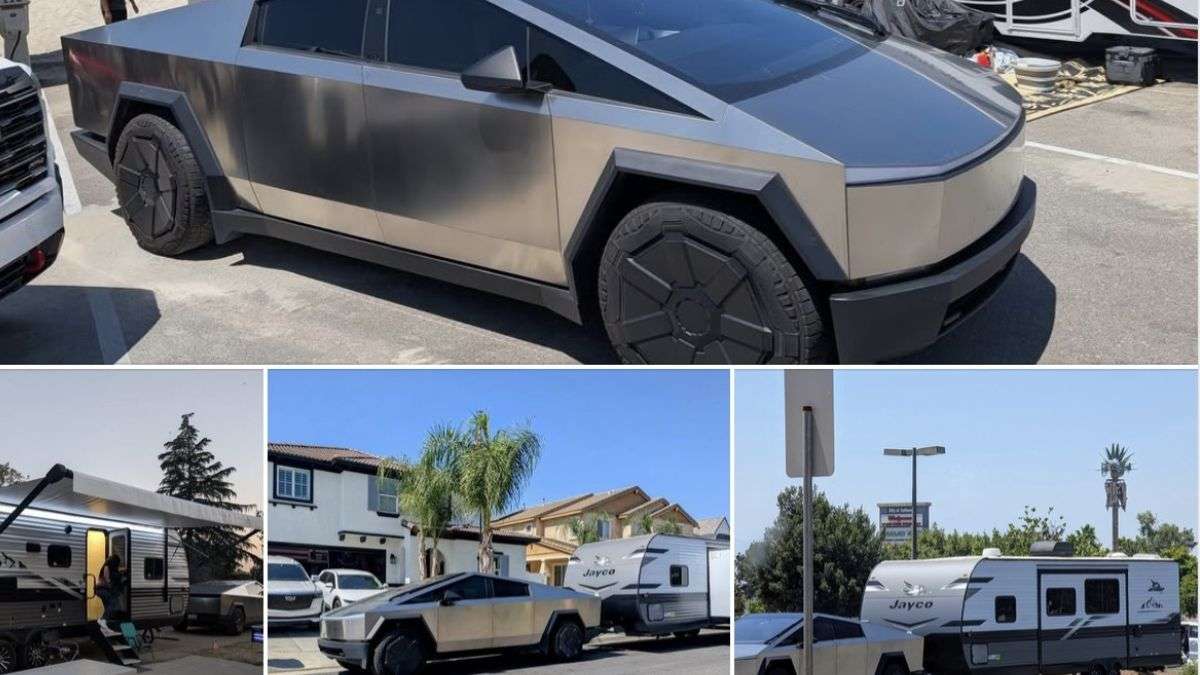

By now, you've probably heard the stories about Tesla Cybertruck tires not holding up. From high-speed vibration reports to unexpected flats, and even tire insurance surprises that are hard to justify, there's been no shortage of concern surrounding the longevity and reliability of the Cybertruck's footwear. So when a Cybertruck owner recently posted something that turned the whole narrative on its head, I had to take a closer look.
The post came from Mario Flores, shared by Greggertruck on X, and it was a bit of an eyebrow-raiser. “My Cybertruck held very well, towing 5k pounds and fully loaded with electric bikes, cases of water, plus groceries. I only charged once from Redlands to San Diego beaches at Coronado, only because I would have arrived with a 5 percent charge. My Cybertruck is over one year old. It has 44,000 miles on it and is still on original tires at 6/10ths. The tires have never been rotated.”
44k miles, original tires. Never rotated. These are crazy results. pic.twitter.com/KYo5Sdos3H
— Greggertruck (@greggertruck) July 9, 2025
Let that settle in. Forty-four thousand miles. Towing. Loaded down. Still on the same set of tires. And no rotations. In a world where EV owners are changing tires as if they’re on a NASCAR pit crew, this post came across as surprisingly pleasant and, in some ways, even a little disruptive.
But it didn’t take long for other owners to jump into the conversation, raising questions, sharing their own experiences, and poking at Mario’s tire math. One user on X quipped, “He must use chill mode only lol. I think our truck with 60k miles has been through 3 sets.” That’s not a stretch, especially when we’ve seen multiple Cybertruck owners dealing with tire issues far earlier than expected. In fact, if you're curious just how early tire issues can show up, you should read about this owner who got two nails in a Cybertruck tire side by side and was quoted $1,200 by Tesla.
Greggertruck responded with his own take. “That’s amazing man. I have OG’s on my current truck, and 24,000 miles. Tires still look pretty good. Those two have been replaced because of road hazards like nails.” He brings up a good point. Many tire failures are less about wear and more about road damage, especially on trucks that go off the beaten path.
Another Tesla enthusiast chimed in with a detail that might catch you off guard. “I did almost 50k before swapping mine. Also just heard Goodyear may not make these tires anymore,” shared Tesla Owners of Joaquin Valley. That’s something worth keeping an eye on. If OEM Cybertruck tires become unavailable, owners might be forced into replacements that impact range or noise. Speaking of which, here’s what happened when an owner swapped to BFGoodrich tires that hurt their Cybertruck’s range but surprisingly didn’t increase road noise.
Randy Witt dropped an insight that brings the issue closer to Tesla’s broader vehicle family. “My cars (Model X and Model Y) both made it to about 41k miles before I had to change tires, which were never rotated.” And Matthew Donegan-Ryan added, “I’ve never had to rotate tires on a Tesla, they have always worn evenly or been staggered.”
But then came a subtle correction from Ricky Lucero, who wasn’t buying Mario’s math. “Nobody measures tire tread in 10ths. That's 19/32. Stock Cybertruck tires are between 10-11/32. Probably meant 6/32. Not too shabby, if that's the case.” And he’s probably right. Measuring tire tread in tenths could be a simple mistake, or it might just be part of how different owners gauge things casually. But if Mario’s still at 6/32 after 44,000 miles of towing and hauling, that’s worth talking about.
This leads us into a deeper issue that affects all EVs, but especially large electric trucks. Tire wear. Many EV owners still underestimate just how quickly heavy electric vehicles chew through rubber, especially under torque. And when you add towing or aggressive acceleration into the mix, it’s a recipe for unchecked tire wear. This is why understanding your vehicle’s weight distribution, load balance, and even regenerative braking settings can make a huge difference. To learn more about how this affects ride quality and handling, you might want to read about Cybertruck owners who reported stability issues at high speeds.
There’s also a real-world concept worth applying here. It’s called preventative ownership. In essence, it’s the idea that even if your vehicle doesn’t “require” something, you do it anyway because it pays off in the long run. Rotating tires, for example. Some Tesla owners swear by never rotating. Others make it a part of their quarterly routine. And some don’t think about it until they’re stuck on the roadside, like the guy who got a flat on his Cybertruck and wished he hadn’t skipped the basics.
What’s interesting is how Mario’s post seems to fly in the face of all these challenges. He’s not rotating. He’s towing. He’s traveling long distances. And still, he’s not complaining. That forces us to consider: maybe driving habits really do make or break tire life. Or maybe his truck is the exception. Either way, his story reminds us that expectations should always be tested against real-world data.
That brings us to something people rarely talk about. The cost of maintaining tires on an EV. Many owners think their main worry will be charging costs, but over time, tire expenses can sneak up fast. There’s even a story where a Cybertruck owner was shocked by how much tire insurance cost compared to his Model X. It’s not just about tire price, it’s about how insurance companies view the risk of replacement on vehicles with limited tire availability.
And if you do need to change tires, you might face compatibility issues or even aesthetic ones. One Cybertruck owner recently ditched the original Cyber wheels for more conventional Pirelli Scorpions, citing looks and balance. Which makes sense, because if your ride feels like it’s floating at high speeds or pulling to one side, a tire upgrade might be the only fix. Just ask the owner who discovered a simple tire balance solved his Cybertruck’s highway wobble.
Here’s where the moral of the story comes in. Whether your tires are at 6/32 or 19/32, whether you rotate them or not, the point is to pay attention. Don’t let expectations or trends dictate your maintenance. Look, listen, feel, and act. Caring for your EV isn’t just about cost savings or convenience. It’s a mindset. The more you understand about your vehicle’s actual behavior on the road, the better equipped you’ll be to make decisions that help others too. Think about the next owner, your fellow drivers, and even those who might learn from your experience online.
1. Tire Cost & Sticker Shock: What Every Cybertruck Owner Should Know
Owning a Cybertruck means enjoying that raw torque and futuristic exoskeleton, but it also means paying up when it comes to tire replacement. As expected, EV tires usually cost more - often $300–$400 per tire versus the $175–$225 for comparable ICE tires - thanks to thicker load ratings, low-rolling-resistance compounds, and sound insulation foam. Given EVs tend to consume tires up to twice as fast, that’s not just a one-time cost—it’s a recurring one. Earlier, Torque News dove into EV owner hidden expenses, highlighting tire lifespan as a major line item in the ownership budget, which you may find useful.
Here’s where it gets real: the Cybertruck is heavier, it has insane torque at zero rpm, and toss in towing or off-roading, and tire wear skyrockets. Let’s say you replace tires every 25,000 miles at $350 each; that’s $1,400 per rotation cycle - or about $5,600 over 100,000 miles. That may well offset the lower fuel and maintenance costs you expected. And that’s before you factor in tire insurance - or that Goodyear might stop making OEM sizes - so you may pay a premium just to keep the correct size and tread pattern. It’s more than just a wheel - it’s a financial commitment.
2. Tire Rotation, Alignment & Balance: Preventative Habits That Save You Money
One of the easiest ways to minimize tire wear - and your long-term costs - is a consistent rotation and alignment routine. Tesla generally suggests rotating EV tires every 6,250 miles. Contrary to some beliefs, swapping tires isn’t just for good looks—it evens out wear, especially on a heavy vehicle like the Cybertruck. A Torque News guide on tire and brake maintenance for EVs recommends rotating action every 5,000 miles for better longevity.
Alignment and balance deserve attention too. Uneven wear, pull-to-one-side, or vibrations - all symptoms of misalignment - lead to premature tread loss. A Torque News article on when an alignment might actually matter explains that even small misalignments accelerate wear, and that the minor cost (under $150) can protect tires that cost several hundred dollars. And don’t forget rebalancing—that foam inside EV tires can shift, causing vibrations if untreated. A simple balance and alignment session after tire service can be a smooth ride saver.
3. Aftermarket & Spare Tire Strategies: Preparing for the Unexpected
Let’s face it: EVs rarely come with spares, and flat repairs often fail due to sidewall damage. That means one puncture could leave you stranded and out $400+. Many savvy owners are opting for alternatives, like keeping a compact spare purchased from aftermarket suppliers to have the option for field repair.

Then there’s the question of tire choice. If OEM sizes go extinct, you’ll need viable substitutes - whether AT, touring, or even run-flats - that maintain Cybertruck ride, range, and safety. A helpful starting point is Torque News’s roundup on cost of ownership, which compares OEM Cooper and BFGoodrich options to competitor truck tires. Plus, fits affect handling as some aftermarket owners have suggested tire mix strategies or staggered setups to counterbalance weight distribution. Once again, a small tactical purchase now could save you big time later.
By diving into these areas such as cost awareness, proactive maintenance, and redundancy planning, Cybertruck owners can avoid uncontrolled surprises and build confidence in long-term ownership. After all, knowing what lies ahead lets you make decisions not just for yourself, but for the broader EV community.
Would you rotate your tires every 5,000 miles like recommended? Or do you run a compact spare just in case? Drop your thoughts and real-world experiences in the comments below!
Now I want to hear from you. How many miles did you get on your original set of Cybertruck or Tesla tires? Do you rotate regularly, or have you also skipped rotations with good results? Share your experience in the comments section below.
Armen Hareyan is the founder and Editor-in-Chief of Torque News. He founded TorqueNews.com in 2010, which since then has been publishing expert news and analysis about the automotive industry. He can be reached at Torque News Twitter, Facebook, Linkedin, and Youtube. He has more than a decade of expertise in the automotive industry with a special interest in Tesla and electric vehicles.
Images by Mario Flores, screenshoted by Greggertruck on X.
Set Torque News as Preferred Source on Google
Follow us today...






Comments
Did you notice how this…
Permalink
Did you notice how this bloke didn't discuss two of the most well-known features?
1. Recall history
2 Stratospheric depreciation
Eight recalls 50%…
Permalink
Eight recalls
50% depreciation in one year
What's not to love, right?