

Full-size trucks have always had a long-standing dilemma. Trucks that are very powerful typically cannot be efficient, and trucks that can achieve great gas mileage often do so by sacrificing power. The trade-offs have defined what drivers expect in their trucks for many years. But this is beginning to change due to the development of new types of power trains replacing the typical V8 engine. Sometimes it takes a real-world experience owning one of these new trucks to challenge the long-held beliefs about how things should be done.
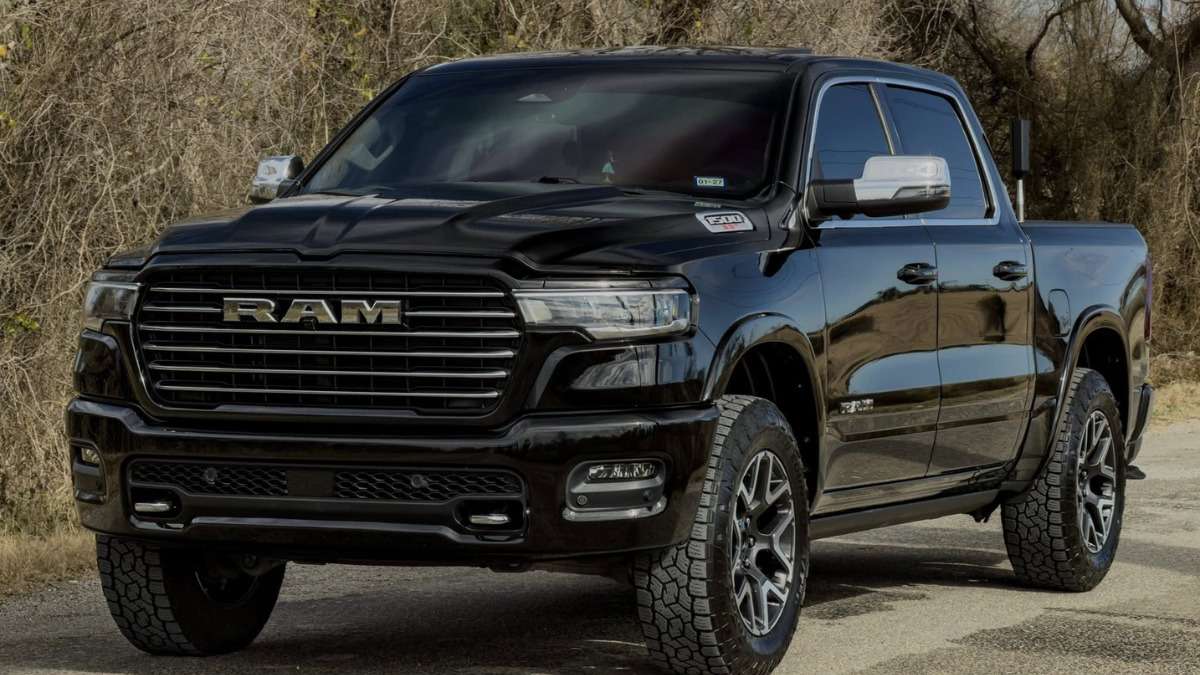
Nolan Huber shared that experience in the "Hurricane 3.0 TT Rams" Facebook group stating that after installing additional performance parts to enhance his Ram 1500’s performance (larger all-terrain tires), he was able to average nearly 21 MPG during Texas traffic conditions. Additionally, Nolan stated he could reach over 600 miles before having to refuel while still achieving 13 second quarter mile times. His post challenges what most drivers believe about the capabilities of a full-size truck.
Here’s how he put it: “Nobody ever believes me when I talk about this engine. I’ve been on the road all over Texas this week, on highways and stop and go DFW traffic and I’m still getting a calculated 20.8 mpg. The truck is leveled 2.5in with 275/65r20 Toyo AT3 EV (43lbs), K&N CAI, Cat6 map 3 on 93, and AWE cat back. It still blows me away that I can get 650+ miles on a tank, run low 13’s in the 1/4 mile, ride this smooth/quiet, and look this good doing it all.”
A Combination That Wouldn’t Have Made Sense a Few Years Ago
Nolan describes a lot that sounds great but also seems like a contradiction. Typically, a full-size pickup truck with an average quarter-mile time of around 13 seconds will not be able to get better than 20 MPG combined in real-world use especially after being modded.
In another real-world comparison I recently reported on, one longtime Ram owner explained how after owning six Ram trucks with the 5.7L HEMI including a Hellcat TRX, the Hurricane SST delivered a much smoother and more refined driving experience, reinforcing the idea that this new engine isn’t just about efficiency but also about how it delivers power.
That’s really the key shift here. Instead of chasing peak horsepower numbers, engines like this focus on usable torque and smoother delivery. And when everything comes together correctly, it creates a combination that feels almost too good to be true.
Numbers Like This Are Starting to Change the Conversation
An extremely valuable detail within Nolan's experience is that his 20.8 mpg was not only achieved through an ideal amount of highway cruising. This result was obtained by incorporating both stop-and-go traffic into the Dallas-Fort Worth area. The Dallas-Fort Worth area has unpredictable traffic which requires a high level of driver attention and ability to be able to drive efficiently under these types of demands.
This is especially interesting since the vehicle is altered with heavy modifications. These include the leveling kit, all-terrain tires, intake system, tuning and exhaust setup. Most people assume that modifications such as these will lower the gas mileage. However, due to modern technology associated with turbocharged engines, they have the ability to adjust to various driving conditions, thus maintaining good fuel efficiency.
In addition to actual fuel efficiency, the range of a vehicle is also another major factor when determining whether or not drivers view their vehicles as efficient. Getting over 650 miles on a single tank changes how often you think about fueling up, and for many drivers, that convenience matters just as much as the MPG number itself.
That’s part of the reason why some buyers are making the switch. In another case I covered recently, a driver traded a 2025 Toyota Tundra for a Ram 1500 with the 3.0 Hurricane engine and said they don’t think they’ll go back, and the discussion wasn’t just about power but it was about how the truck performs day-to-day.

There’s Still Something About the Old V8 That’s Hard to Replace
As impressive as these numbers are, not everyone is ready to move on from the traditional V8. The conversation around these trucks often becomes less about numbers and more about identity.
Carlos Olave sees the transition as obvious: “I love my new SST Big Horn, but I do not understand the financial clumsiness of many people. How is it possible that, even after seeing the numbers, analyzing the statistics, and feeling the hit in their wallets, there are still people who give in to an old and inefficient engine like the HEMI? Do they really like throwing their money away on purpose, paying more for fuel and getting less performance? Hurricane is the new step forward and by far much better.”
His perspective reflects a growing group of drivers who see efficiency and performance gains as a clear upgrade. But that’s only one side of the story.
Shashi Suda offers a completely different take: “Can't beat the good ol' Hemi baby. Some people love the new 6 but I'm not one of them even if it hurts my wallet a little.”
And Jordan Solis adds another layer to that sentiment: “I love the sound of the Hemi. I know the Hurricane outperforms it but I feel like the Hemi still has more character. I’m 105k miles into my 2020 Limited and it’s been great. Other than the sound, that price tag is a bit of a showstopper.”
These answers show that there are aspects of driving a HEMI that go beyond what can be shown in numbers. The majority of buyers will tell you that the HEMI's charm goes well beyond pure performance. They want a certain sound from their car and want to know they're getting a familiar product that is dependable, as they have grown comfortable with the brand for years. Even though the Hurricane may win on both performance and efficiency, it also has to win the hearts and minds of owners which is typically done through real world experience. It's not something that can happen overnight.
Not Every Ownership Experience Has Matched the Hype
While performance and efficiency are clearly improving, not every ownership experience has been as smooth. Dau Au shared: “I have a 2025 SST HO with 15k miles and I use 91 octane getting 16.2 mpg as per the computer. The truck is due to get a complete software reset this week due to lots of electronic gremlins.”
That comment introduces an important shift in the conversation. As more of these trucks hit the road, some owners are beginning to report issues that go beyond performance.
In a report I published previously, an owner described how their 2025 Ram 1500 started experiencing multiple odd electrical issues and the response from Stellantis left them frustrated, pointing to the growing complexity of modern trucks. And, once again, in another ownership experience I covered, they went even further explaining how their 2025 Ram 1500 Rebel left them wishing they had never gotten rid of their HEMI due to major ongoing problems, which highlights the uncertainty that sometimes comes with new technology.
That's why it’s important to keep perspective here. These are still relatively new vehicles and not every truck is experiencing these issues. But it does raise a fair question about how these engines and systems will hold up over time.
My Thoughts on Ram’s New Engine
I believe the most compelling aspect of this scenario is how rapidly the expectations of performance are shifting. More importantly, how fast the practical realities of owning a vehicle are beginning to mirror what previously seemed like marketing hype. In order to achieve this level of efficiency from a full-size truck, it was considered unrealistic by many drivers who had been accustomed to "traditional" V8 powered vehicles. We are now seeing these types of performance increases occur not under ideal testing conditions but as a result of day-to-day driving such as during rush hour Texas commutes.
While I believe there may be several reasons as to why some owners do not immediately accept all of the benefits associated with increased fuel economy, performance gains are easier to notice right away, and improvements in smoothness or power delivery can be felt almost instantly too. On the other hand, reliability takes longer to develop. As consumers begin to realize that the new engines being produced today are more complex and rely much heavier on computerized systems than those built yesterday, they have every right to question reliability. This concern will create natural uncertainty and ultimately become an inherent part of the overall ownership experience regardless of whether you want it to or not.
In my opinion, this does not represent a clearly defined winner/loser outcome. Rather, I perceive this as a transitional phase in which the technology is advancing at a much quicker pace than the trust of consumers. The capability exists, however, until consumers gain confidence in their ability to own these vehicles for extended periods of time, this will continue to remain an open question for the time being.
Key Takeaways for Drivers
- Modern engines are redefining expectations: Performance and efficiency are no longer mutually exclusive in today’s trucks.
- Real-world data matters more than specs: Mixed driving results like Nolan’s give a better picture than EPA estimates alone.
- Driver preference still plays a huge role: Some buyers prioritize efficiency while others value sound and familiarity.
- New technology comes with uncertainty: Early ownership reports suggest that reliability is still something to watch closely.
- The truck market is evolving quickly: What feels surprising today may become the new standard sooner than expected.
Your Thoughts Matter
Do you think numbers like 21 MPG and low 13-second performance are enough to convince you to move away from a traditional V8?
Or would you still stick with something like the HEMI for its sound, simplicity, and proven track record?
I'd love to hear your thoughts and experiences in the comments section below.
About The Author
Aram Krajekian is a young automotive journalist bringing a fresh and analytical perspective to the evolving automotive landscape by reporting on real-world ownership experiences and providing industry analysis. Based in North Carolina, he covers electric vehicles, trucks, and broader automotive trends with a focus on contributing a balanced evaluation. His reporting cuts through brand bias to provide readers with grounded insight into how vehicles perform for everyday drivers beyond marketing narratives.
Aram can be reached on X and LinkedIn for ongoing automotive coverage.
Image Sources: The “Hurricane 3.0 TT Rams” Facebook group and Ram’s gallery.
Set Torque News as Preferred Source on Google
Follow us today...







Comments
This truck was heavily…
Permalink
This truck was heavily modified. How does a factory truck do ?
Fords been doing this for…
Permalink
Fords been doing this for well over a decade. The ecoboost has been the superior engine in the truck market. My 2021 xlt f150 is the best truck I have ever driven. 400 horse and 500lb torque. Bone stock. Its acceleration is insane. Reliable as the day is long. I’ll never own another inferior brand!
People choose the HEMI to…
Permalink
People choose the HEMI to avoid bring testers of the Hurricane, they did the same thing with the Ecoboost and that is now the most sold engine in the F150s