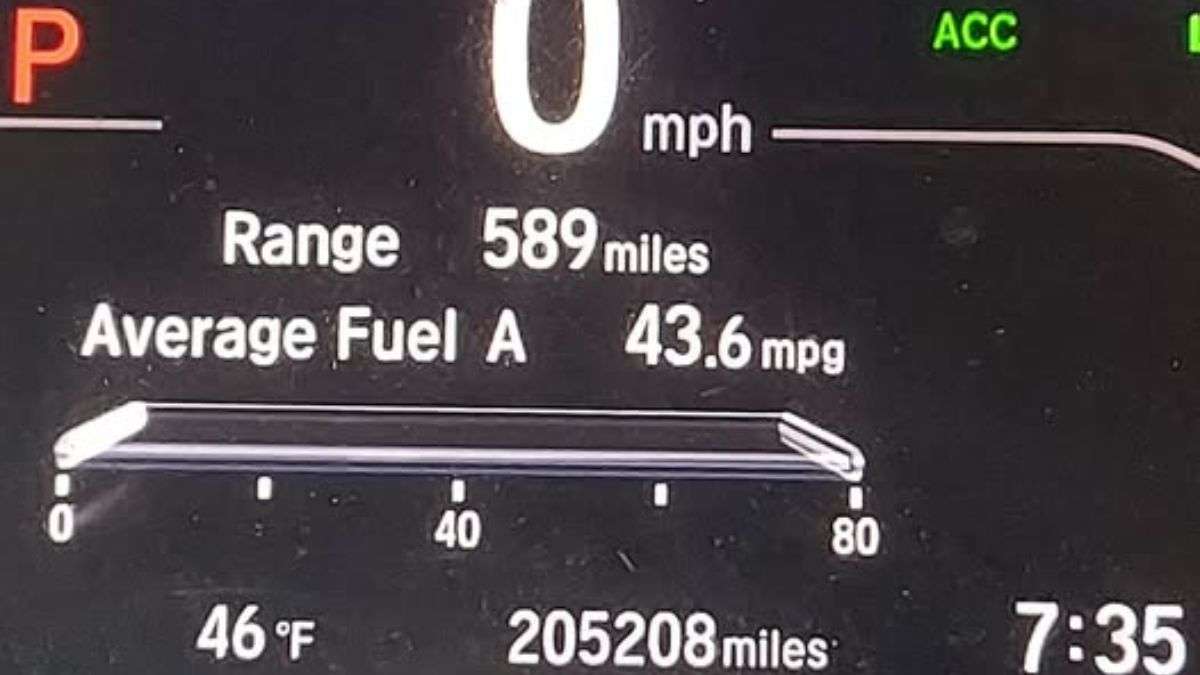

Every automaker prints a fuel economy number, but real life has a way of proving whether those numbers were conservative marketing or optimistic fantasy. That is why it always catches my attention when I see a high‑mileage owner post their actual long‑term results. That's because five years on the road tells a truth no showroom sticker ever could. Earlier this morning, one of those rare posts showed up in the Honda CR‑V Hybrid community, and the numbers were better than what Honda claimed when the vehicle was new. This post came from a member named Md Masud Ali in the "Honda CR‑V Hybrid Enthusiasts Group." He wrote that after five years of daily use and more than 205,000 miles on his 2021 HondaCR‑V Hybrid, the SUV is still returning fuel economy figures most new owners would be thrilled to see.
“After driving for 5 years and 205,000 miles, I am still getting 43.6 MPG. I drive both on the highway and in the city. Honda announced it’s 35 for highway and 40 for city.”
That claim does two important things at once. First, it beats Honda’s published highway and city estimates, which means the vehicle is outperforming its own window sticker even past the 200k‑mile mark. Second, it dismantles the idea that hybrid efficiency falls off sharply as components age. If anything, Md’s experience suggests the opposite. It seems the CR‑V Hybrid platform has matured gracefully under real‑world use.
Real‑World MPG vs Rating Claims
We tend to treat EPA ratings as if they are the ceiling when in fact, they are a blended laboratory estimate. Air temperature, traffic mix, tire pressure, terrain, driving discipline, and seasonal fuel all play into whether real‑world numbers fall short or exceed the decal. That is why owner‑reported long‑term outcomes matter more than anything printed at purchase. Md’s post reinforces that lesson effectively.
Even in cases where the CR‑V Hybrid faced severe events, like a 2025 model getting rear ended but leaving the passengers unharmed, the long‑term narrative around this SUV keeps leaning toward competence and consistency.
Community Reactions and Patterns
Under Md’s post, other owners quickly joined the discussion with their own results. David Plumb wrote, “I get 42.3 MPG average on my ‘24 Hybrid AWD.”
His comment aligns with Md’s outcome and reinforces that these vehicles can sustain high efficiency in mixed driving when treated consistently. What stands out is that these numbers all come from people who live with these SUVs daily.
Then a different angle entered the thread. Holland Jancaitis asked, “Wow! Still on the original high voltage battery too?” Md replied, “It’s the same battery. Still running smooth.”
That answer matters because hybrid skepticism often centers on fears of early battery degradation or expensive replacements. Yet here is a high‑mileage example showing the opposite: longevity without catastrophic expense.
Another user, Rob Guerra, added a comparative datapoint by asking, “Damn, do u drive in eco mode? Is yours a hybrid? I have a 2026 Hybrid Sport L with 1,300 miles and I’m stuck at 34.5 MPG.”
New owners often assume their early results are the ceiling when, in reality, early mileage rarely represents the long-term state of a drivetrain. That idea was echoed when Chris Simpkins responded, “It’s still breaking in until about 5 miles. Mine went up to 39 MPG.”
His point became the segue to a broader debate on whether break‑in periods matter.
Break‑In Period: Real Effect or Just Perceived?
Some drivers claim hybrids “wake up” after the first few thousand miles. Others argue what changes is not the drivetrain but the driver. Smoother throttle use and better route familiarity all tend to appear over time. But mechanically, there is truth to the idea that internal components seat, lubricants stabilize, and control software adapts based on usage. There's also truth in the psychological side though: better mileage often follows better behavior more than mechanical magic.
The debate is worth noting because it affects how new owners interpret early numbers. Someone sitting at 34 MPG at 1,300 miles may wrongly assume they bought an underperformer, when in reality they are looking at a temporary snapshot. Stories like Md’s make clear that hybrid ownership must be measured in years, not in break‑in weeks.
Spec Sheets Don't Tell the Full Story
High‑mileage evidence is what separates marketing from truth. The same community has seen the CR‑V Hybrid praised in extremely different contexts, including cases where structural engineering protected families, one owner saw a serious crash left their CR‑V totaled but proved the car did its job by protecting occupants. The consistency across safety, economy, and longevity is what gives the CR‑V Hybrid its reputation.
Even owners who upgraded have reflected on it carefully, such as one who said they traded their 2021 CR‑V Hybrid for a 2025 CR‑V Sport Hybrid and now are unsure it was the right decision after living with both versions. Threads like these show that the CR‑V Hybrid is not a shallow purchase, but a platform that people think about, compare, defend, and revisit.
That's why When I look at Md’s numbers, I don’t just see a single data point in isolation, I see validation. Anyone can build a hybrid that tests well on launch week, but very few can survive to 205,000 miles while still outperforming their EPA sticker. People usually end up arguing about ratings while the real story is happening years later in people’s driveways. Honda may not market itself with the drama that some brands do, but stories like this show that it’s engineering often wins the long game quietly.
Key Takeaways for Readers
- Real‑world history beats advertised numbers. Lab figures are only a baseline, as long‑term owners reveal what actually holds up.
- Battery fear is often overstated. Md’s original high‑voltage pack surviving past 200k miles is not an anomaly anymore.
- Early MPG does not predict final MPG. Break‑in behavior, both mechanical and human, pushes numbers upward over time.
- CR‑V Hybrid’s value is multi‑dimensional. Efficiency, safety, and longevity all have independently verified examples in the community.
Join the Conversation
Have you seen your hybrid’s fuel economy improve, worsen, or stay flat as the miles climbed? What patterns have you noticed over the life of your own vehicle?
And for those past 100,000 miles, do your long‑term results line up with what Honda promised on day one? Or did your CR‑V surprise you in either direction?
I'd love to hear from you in our comments section below.
Aram Krajekian is a young automotive journalist bringing a fresh perspective to his coverage of the evolving automotive landscape. Follow Aram on X and LinkedIn for daily news coverage about cars.
Image Sources: The “Honda CR-V Hybrid Enthusiasts Group” and Honda’s gallery, respectively.
Set Torque News as Preferred Source on Google
Follow us today...