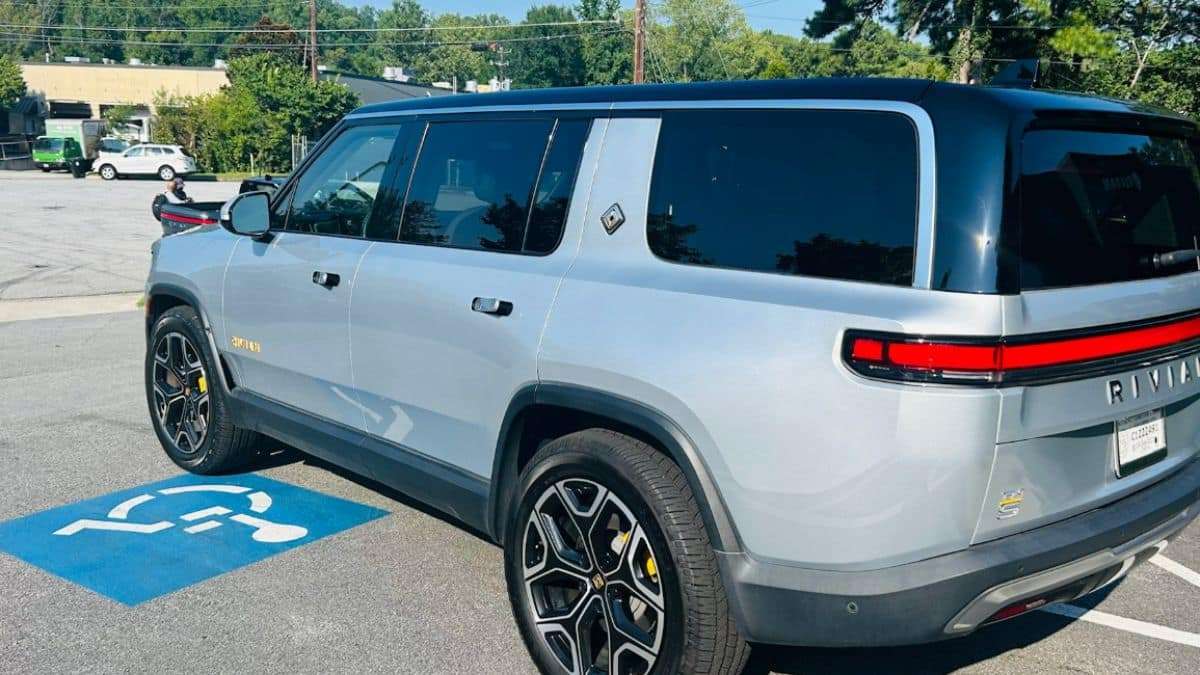

Owning an EV often brings excitement mixed with curiosity about how it will hold up long-term. For some, it’s the thrill of cutting gas costs, while it’s the joy of driving something high-tech and forward-thinking for others. But there’s another side of the ownership journey that EV buyers quickly learn: warranty repairs and service visits can be part of the experience even when the car is fairly new. That’s where today’s story comes in, drawn from a post I came across in the “RIVIAN Electric Vehicles Discussion” group on Facebook. There, Asim Saiyed explained that he had recently bought a pre-owned 2023 R1S Adventure, already owns a Tesla Model Y, and is now fully electric. While he’s loving the Rivian so far, his SUV is already in the service shop for multiple warranty recalls including an HVAC leak with carpet replacement, an auto steer issue, and a leaking front left shaft all covered under warranty.
“I am new to the R1S. I just bought it a few weeks ago. It’s a pre-owned 2023 Adventure. I’m loving it so far. I already got a Model Y so I went completely electric. So far, the customer service is good to me. My car is in the service shop for warranty recalls. They found the following during inspection: 1.HVAC leak with a carpet replacement. 2.Auto steer issue. 3.Front left shaft is leaking. (All under warranty.) Is there any other issue the R1S has that’s common? I can get it added since it's at the shop. The 12v battery has already been replaced. Thanks.”
First Impressions and Service Experience
What struck me right away in Asim’s post was how balanced his reaction was. He isn’t upset or bashing Rivian, as he’s loving the SUV and even complimenting Rivian’s customer service. That’s something we’ve seen echoed by other Rivian owners too, like in one case where a driver described Rivian’s rapid response even when a loaner failed during service, which lines up with what to expect from Rivian customer service turnaround times in busy markets. Customer service quality can make or break an ownership experience, and so far, Rivian seems to be doing better than some larger automakers in that department.
The issues listed are significant though. An HVAC leak requiring carpet replacement suggests water intrusion risk, which is something Rivian has had to address before. An auto steer issue could be tied to the SUV’s advanced driver assistance, a system Rivian continues to refine through over-the-air updates. And a leaking half shaft is the kind of mechanical defect you wouldn’t expect in a 2023 model.
Breaking Down the Warranty Items
Each of the reported repairs points to an area of concern many new owners should watch for. For context, common Rivian R1S warranty issues owners report early include items like HVAC drains, trim alignment, and occasional drivetrain seals:
- HVAC leaks leading to carpet replacement – Some Rivian drivers have reported condensation and HVAC drain issues leading to water pooling. Left unchecked, this could impact interior electronics.
- Auto steer issues – Advanced driver-assist systems are still evolving across the EV industry. Rivian’s system has room to grow, and software-related complaints are fairly common among early adopters.
- Leaking half shaft – This raises reliability questions, since drivetrain leaks are not typically expected in a nearly new premium SUV.
This combination of fixes shows why a pre-owned Rivian R1S reliability review is becoming increasingly important for potential buyers. Many want to know which issues tend to appear early and which are rare one-offs.
Community Reactions
One of the most helpful parts of these Facebook discussions is when other owners chime in. In this thread, multiple comments added context and perspective to Asim’s story.
Corrie Claiborne asked: “Okay, what is a half shaft and how do you know something is wrong with it? I got a used R1S and had the HVAC/carpet replaced, but what other warranty replacements should I preemptively take my car in for?”
Asim responded: “Good catch. I did not find any issues or found oil leaks in the garage. When I took it in for the HVAC recall, they found the leak during a courtesy checkup.”
Corrie’s question highlights something many new EV owners face, as understanding mechanical terms and how they relate to their ownership is important. If you’re learning this vocabulary, how to spot a leaking half shaft on an R1S starts with checking for grease at the inner boot and listening for vibration under load. A half shaft is essentially part of the axle that helps transfer power from the differential to the wheels. Leaks can be subtle and not immediately visible, which shows the importance of thorough dealer inspections.
Another commenter, John Vojtech, brought up reliability worries: “You just bought it and it has 3 things broken? Sounds like mine.”
This taps into a recurring theme. We’ve covered other Rivian owners experiencing reports of R1S units locking while driving and being towed within months. While Asim’s tone was positive, John’s echoes the frustration many buyers feel when luxury-level vehicles encounter multiple repairs so early in ownership.
Finally, George Yui asked: “I know it's early as you just got your R1S, but I'm curious what your thoughts are between the Model Y and R1S. I own a Model Y but I’m thinking of getting a R2 next year.”
Asim’s reply: “There is no comparison, but both have their pros and cons. The Model Y has better technology but the R1S is built stronger, and customer service is better than Tesla so far.”
This is a perfect bridge into a broader conversation, as the R1S and Model Y are in different classes, yet comparisons are inevitable since many Tesla owners are looking at Rivian for their next purchase.
Rivian R1S vs Tesla Model Y
Comparing these two is like comparing an electric luxury SUV to a tech-forward family crossover. The differences between Tesla Model Y technology and Rivian build quality often come down to software polish versus hardware robustness. The Model Y offers efficiency, charging network dominance, and software features Tesla has refined over a decade. On the other hand, Rivian’s R1S boasts off-road readiness, stronger build quality, and a customer service experience that feels more attentive than Tesla’s.
Asim’s side-by-side ownership of both brands is particularly valuable. It reinforces what many have said: Tesla is ahead on tech, but Rivian is making waves with quality of build and customer relationships. For buyers cross-shopping, this distinction matters.
Why Real Warranty Service Stories Count
Stories like this help prospective buyers understand what they might encounter. Just as seen in a three-year, nearly 100,000‑mile Rivian R1T ownership perspective, these reports add real-world data points.
But reliability isn’t just about long-term wear. These threads collectively paint real world Rivian R1S reliability from new owners and veterans rather than marketing claims. Sometimes, it’s about sudden and surprising failures, like a harrowing report of an R1S entering turtle mode in extreme heat. The mix of positive customer service stories and serious technical issues creates a nuanced picture, and it's one that buyers must carefully weigh.
Reading Asim’s experience, what stands out to me is the balance between excitement and reality. He’s clearly enthusiastic about going fully electric, and the fact that he’s willing to share issues openly without bashing the brand shows maturity as an owner. From what I see, Rivian’s path to long-term success will depend on how consistently they can handle these service challenges while maintaining trust. Customers can forgive mechanical hiccups if they feel supported, but that goodwill has limits. If Rivian wants to grow, minimizing repeat issues and maintaining that responsive service edge will be crucial.
Key Takeaways for Readers
- Customer service matters just as much as product quality: Even with repairs, positive interactions with service teams can keep owners loyal.
- Early warranty issues should be expected: Especially with newer EV brands, recalls and repairs are part of the early-adopter experience.
- Comparisons between Tesla and Rivian highlight different strengths: Tesla dominates in software and charging, while Rivian is gaining a reputation for strong build and support.
- Inspection checks catch hidden problems: As Asim’s story shows, leaks and failures may not always be visible at home.
- Real-world ownership stories add perspective: Hearing from owners helps prospective buyers know what to look out for beyond brochure promises.
- Keep paperwork organized because maintaining records of EV warranty repairs and service visits can help later if you pursue buyback or coverage disputes.
Join the Conversation
Have you had to deal with multiple warranty recalls on a new or pre-owned EV? How did your customer service experience shape your opinion of the brand?
And if you’ve driven both a Tesla and a Rivian, which stood out more to you? Technology and efficiency, or build quality and service?
I'd love to hear your thoughts in the comments below.
Aram Krajekian is a young automotive journalist bringing a fresh perspective to his coverage of the evolving automotive landscape. Follow Aram on X and LinkedIn for daily news coverage about cars.
Image Sources: The “RIVIAN Electric Vehicles Discussion” public Facebook group and Rivian’s gallery, respectively.
Set Torque News as Preferred Source on Google
Follow us today...