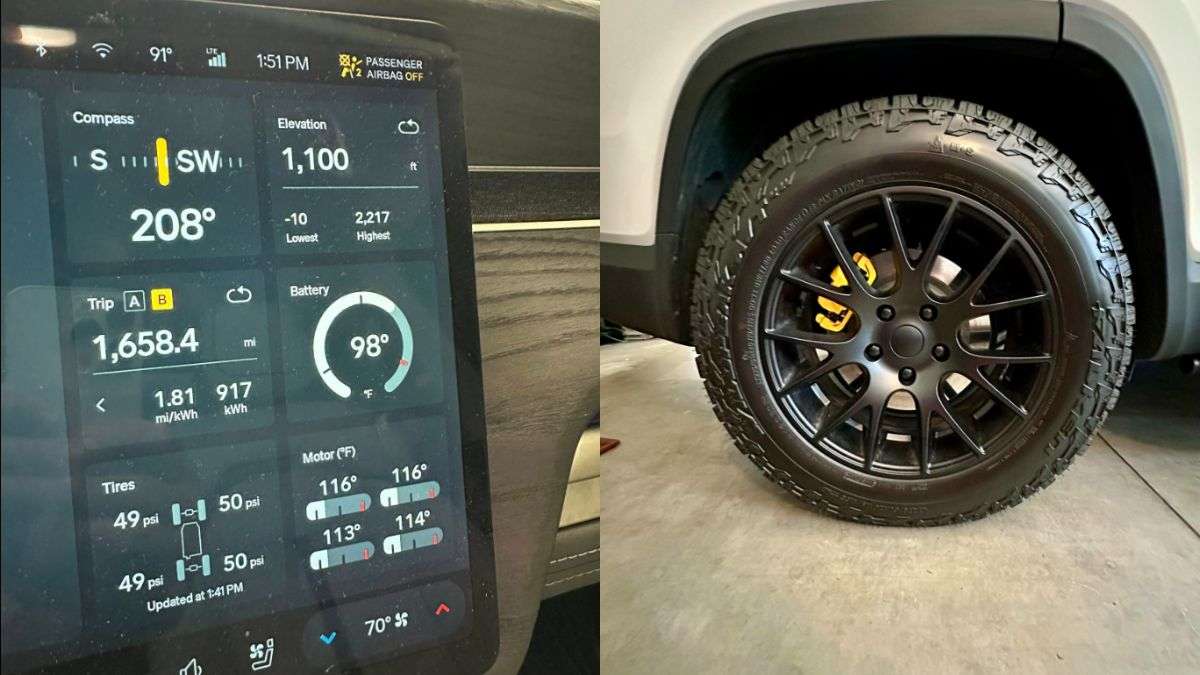

When most people think about EV range, their first thoughts are typically related to battery size or driving style. But tires are another factor that often gets overlooked, and knowing the type of rubber under your car can dramatically change how efficient it is. That’s why a recent post I came across in the “RIVIAN Electric Vehicles Discussion” group on Facebook caught my attention. A Rivian R1T owner with the name of Spencer Mosness shared detailed efficiency data after driving 1,600 miles on his R1S with upgraded Falken Wildpeak all-terrain tires and 20” custom wheels. Despite a noticeable drop in range from 2.0 to 1.8 miles per kWh and increased road noise, he says the look and capability of the setup make it all worth it. Here’s his story:
“If anyone’s curious about the real-world efficiency impact of swapping tires and wheels on the R1T or R1S, here’s what we’ve seen after 1,600 miles of mixed driving in our R1S:
• Current Setup: Gen1 Quad Motor, Falken Wildpeak A/T4Ws (LT275/50/R20) and custom 20” rims, which match the rolling diameter of the stock Rivian 22s.
• Driving Mode: Always in All-Purpose Mode with Standard Height selected and “Auto” height adjustment turned off.
• Conditions: A balanced mix of city and highway driving, with elevation changes ranging from 1,000 to 1,500 ft.
• Driving Style: We’re not slow or hypermiling, but we’re not drag racing either—just typical, spirited driving. With this setup, our R1S is averaging about 1.8 miles per kWh. Road noise is noticeably higher, but given limited range impact and the awesome look, we love the setup. For comparison:
• Our R1S with stock 22s w/ the Pirellis averaged around 2.0 m/kWh.
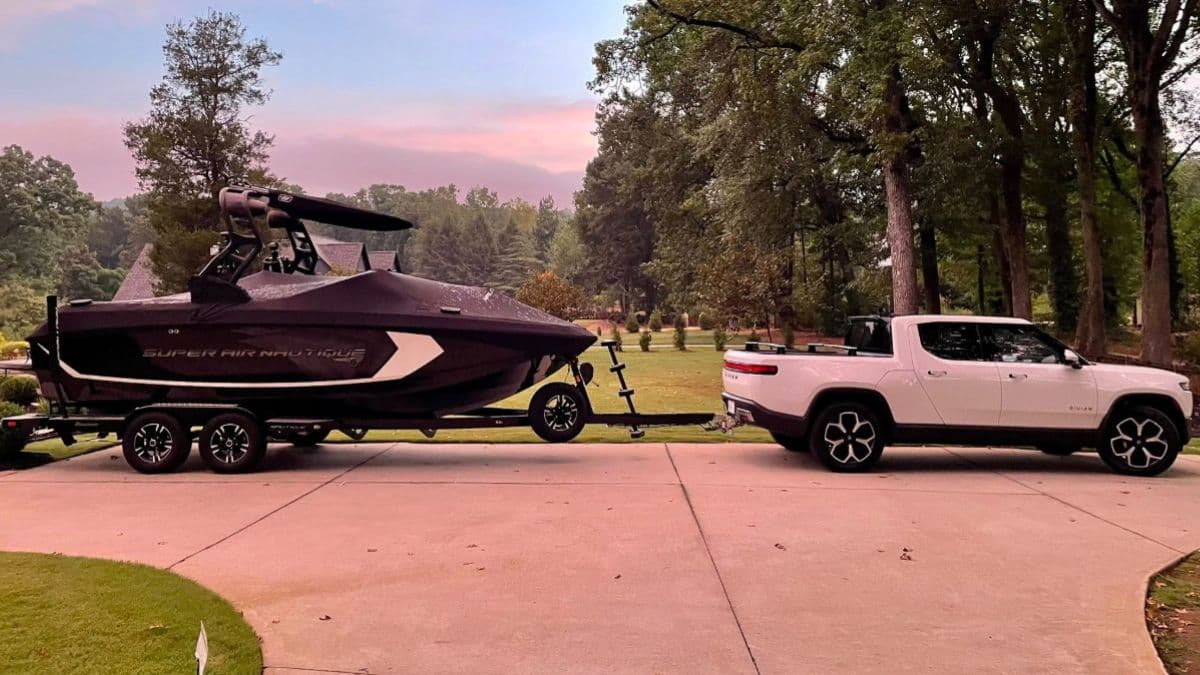
• Our R1T with stock 21s w/ the Pirellis averaged about 2.1 m/kWh—and that includes towing a ~9,000 lb boat, which it handles impressively (though efficiency drops to ~1.2 m/kWh while towing). These vehicles continue to amaze us with their capability and versatility!”
Community Responses to Spencer’s Post
Ryan Geraghty joined the discussion, sharing: “I was getting around 2.15 m/kWh on my stock 22s, switched to aftermarket 20s with Toyo AT3 EV LTs and am getting like 1.95 m/kWh now.”
Ryan’s comment reinforces Spencer’s findings that switching to more aggressive tires almost always costs some efficiency. Yet his numbers also show that the hit isn’t catastrophic. For many owners, the trade-off is acceptable when factoring in better looks or added capability.
Next, John Stoj commented: “I’m curious to see what the difference will be for us when we switch from 20” stock Pirelli ATs to Michelin LTX M/S 2 all seasons.”
John’s curiosity highlights how tire choice can be a fascinating experiment in itself. Different tread patterns and compounds can significantly influence real-world range, and for Rivian drivers who are interested, every swap is an opportunity to test just how much efficiency can change.
Mike Hoelzle then added a more technical perspective: “Do you mean /60 for the middle number on the custom 20” rims? There’s no way that two tires with the same /50 aspect ratio will have the same diameter and circumference if one has a 22” ID and the other one has a 20” ID. Thinking they’re the same is going to have your efficiency way off and your speedometer showing a 4 mph difference when going 65. The 22” has a 32.82” tire height and the 20” has just a 30.82” tire diameter when using 275/50/20 tires since the sidewall height is 5.41” on a 275 tire with 50 aspect, regardless of whether the ID of the tire (OD of the rim) is 20” or 22”. Looking at the photos, I believe those are /60 and the /50 was just a typo. Those sidewalls look pretty thick and much taller than the 22” version.”
Why Tire Choice Matters So Much for EVs
Mike’s detailed breakdown shows that tire sizing isn’t always straightforward. Even small differences in aspect ratio or diameter can impact efficiency and speedometer accuracy. Those changes are magnified even more in EVs because every bit of rolling resistance or aerodynamic difference translates directly to range. This is why discussions about understanding how tire size impacts EV range and performance have become so important. A mismatch between expected and actual tire specs could leave you seeing surprising efficiency losses or inaccurate dashboard readings.
We’ve already seen cases where Rivian drivers burned through multiple sets of tires in relatively short mileage. One owner shared his experience that two sets of tires vanished in just 21,000 miles on a Rivian R1S, sparking questions about longevity and cost. That insight adds another layer to what Spencer found: tire selection has a ripple effect on efficiency, durability, and expenses over time.
Rivian Owners Experimenting With Tire Swaps
Some Rivian owners have had their fair share of frustrating experiences when making changes on their tires, such as this driver who struggled with stubborn settings after a tire swap on the Rivian R1T. The combination of software, ride height settings, and tire circumference can create challenges that go beyond just efficiency sometimes.
On the other side of the spectrum, some Rivian owners have traded in their trucks entirely but still reflected on what they loved and what they’d change. It highlights how even satisfied owners are constantly thinking about improvements, with tire-related efficiency often being part of that conversation.
As someone who spends a lot of time writing about EVs, I find Spencer’s story interesting because it’s such a relatable example of the trade-offs EV owners face. Yes, you end up losing some efficiency, but for many, the added capability and tougher look of all-terrain tires are worth it in the end. What stands out to me most is how open the community is in experimenting and sharing real-world numbers. It shows how collaborative EV ownership can be, almost like a crowdsourced science project where data points come from garages and driveways instead of labs.
Key Takeaways
- Tire choice can have a bigger effect on EVs than on gas vehicles, making it a crucial consideration for owners.
- Real-world Rivian efficiency testing by owners like Spencer provides more useful data than official ratings alone.
- Community knowledge-sharing helps highlight both the benefits and drawbacks of aftermarket modifications.
- Tire sizing accuracy matters for efficiency, ride comfort, and even speedometer accuracy.
- Aesthetic and capability upgrades often outweigh small efficiency losses for many EV owners.
Let's Hear From You
Have you ever noticed a big change in range after swapping tires or wheels on your EV?
And if you’re a Rivian owner, would you sacrifice a little efficiency for better looks and off-road capability?
I'd love to hear your opinion in our comments below.
Aram Krajekian is a young automotive journalist bringing a fresh perspective to his coverage of the evolving automotive landscape. Follow Aram on X and LinkedIn for daily news coverage about cars.
Image Sources: The “RIVIAN Electric Vehicles Discussion” public Facebook group.
Set Torque News as Preferred Source on Google
Follow us today...