

A broken trim clip is an annoyance. A failed hinge is inconvenient. A liftgate crashing down hard enough to cause a head injury crosses into a very different category. That is the line one 2023 Toyota Prius owner says was crossed when the liftgate strut mount on his car failed without warning, sending the hatch down onto his head and leaving him fighting Toyota over a $3,000 repair estimate he believes should never be his responsibility.
The owner, who posted his experience in the Toyota Prius 5th Gen Club, describes a failure that occurred during normal use. According to his account, the strut mount ripped free from the hatch structure, instantly removing the support that keeps the liftgate open. The hatch dropped unexpectedly, striking him in the head and causing an injury serious enough to linger weeks later. This was not the result of an accident or misuse, but what he describes as ordinary ownership of a two-year-old car.
“The liftgate strut mount broke off.
Needed to be recalled as it dropped and hit my head a couple of weeks ago.
The $3000 body-shop estimate includes an aluminum hatch. Not a steel one, I have on my 2023 LE.
I'm having the Toyota of Redlands service department look into it.
I hope to have a new aluminum hatch installed at no cost to me!”
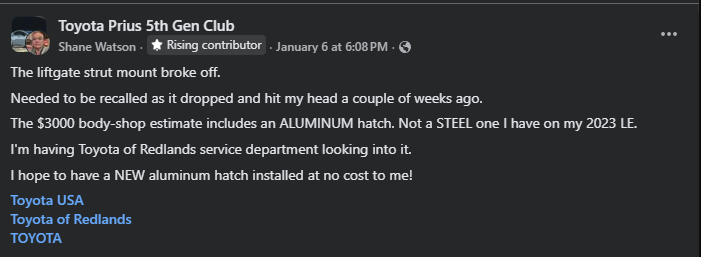
What followed was almost as shocking as the failure itself. A body shop estimate came back at roughly $3,000, largely because the repair involves replacing the entire hatch assembly. The estimate specifies an aluminum liftgate, rather than the steel hatch originally fitted to his 2023 Prius LE. In other words, a single failed mounting point turns into a full hatch replacement, not a reinforced bracket or localized repair.
Toyota Prius: Engineering Efficiency and Practicality
- The Toyota Prius helped popularize hybrid vehicles and has been on the market for more than two decades.
- Its hybrid system automatically switches between electric power, gasoline power, or a combination of both to maximize efficiency.
- The hatchback design allows for flexible cargo space, making it more practical than a traditional sedan.
- The Prius is best known for fuel economy and reliability rather than performance or sporty handling.
That detail has become central to the owner’s argument. He believes Toyota should replace the hatch at no cost and address what he sees as a design flaw in the strut mounting area. His reasoning is straightforward. If the mount tore out of the hatch under normal use, then the structure was inadequate from the start. The fact that Toyota’s own repair path involves switching materials only strengthens his case in his eyes.

Not everyone in the comments agreed. One user questioned whether aluminum would actually be stronger than steel in this application, pointing out that lighter does not necessarily mean more durable. The owner responded that weight reduction could lessen stress on the mount, and that he hopes Toyota would also reinforce the mounting area itself rather than simply swapping materials. He urged others to inspect their own vehicles before a similar failure occurs.
Other commenters were less skeptical and more alarmed. Several described the failure as poor design, suggesting there was insufficient material or reinforcement around the strut mounting point. One pointed out that non-powered liftgates on lower trims appear to use a different strut design than the powered hatches found on XLE and XSE models, which mount their struts using brackets secured with multiple bolts. That distinction has led some owners to wonder whether cost-driven simplification created an unintended weak point.
The comparison to older vehicles only adds fuel to the frustration. The Prius owner notes that his older van, more than 20 years old with over 100,000 miles, still has a perfectly functioning liftgate. That contrast highlights an uncomfortable reality of modern vehicle design. As structures get lighter and more optimized, margins for error shrink. When something fails, it can fail abruptly.
Toyota has not issued a recall related to Prius liftgate strut mounts, and there is no confirmation that this is a widespread issue. Still, the consequences matter. A liftgate is not just a convenience feature. It is a large, heavy panel positioned above a person’s head. When it drops unexpectedly, the risk of injury is real, not theoretical.
From a legal and safety perspective, the owner’s case rests on a simple question. Should a structural mounting point for a liftgate strut ever fail under normal use, especially on a relatively new vehicle? If the answer is no, then the cost of repair should not fall on the person who was injured by the failure.
For now, the owner says Toyota of Redlands is reviewing the situation, and he is pushing for a full replacement at no charge. Whether that results in goodwill coverage, a broader investigation, or nothing at all remains to be seen. But the story has already accomplished something important. It has put a spotlight on a failure most owners would never think to check, until it checks them first.
Image Sources: Toyota Media Center
Noah Washington is an automotive journalist based in Atlanta, Georgia. He enjoys covering the latest news in the automotive industry and conducting reviews on the latest cars. He has been in the automotive industry since 15 years old and has been featured in prominent automotive news sites. You can reach him on X and LinkedIn for tips and to follow his automotive coverage.
Set Torque News as Preferred Source on Google
Follow us today...