
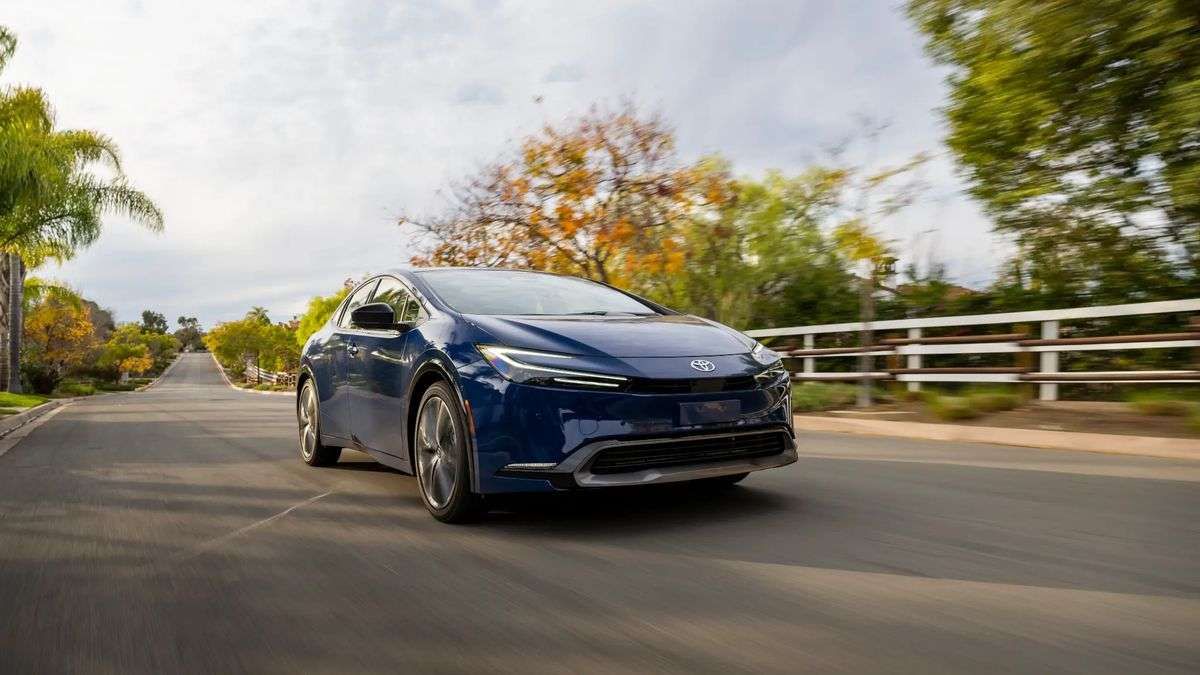

For nearly a quarter century, the Toyota Prius has stood for a very specific idea of transportation: simple, efficient, and largely invisible in daily life. That’s why one longtime Prius owner’s reaction to the fifth-generation model is so revealing. After buying his third Prius, this time a 2026 plug-in hybrid, he says the fuel economy is extraordinary, but almost everything else about the car leaves him cold.
The headline number is hard to ignore. He reports seeing between 90 and 120 miles per gallon in real-world use, the very metric that motivated his purchase in the first place. As a plug-in hybrid with meaningful electric range, the new Prius Prime can deliver remarkable efficiency for short commutes. On that front, Toyota has absolutely delivered. For drivers who prioritize minimizing fuel stops above all else, the car still does what a Prius has always done best.
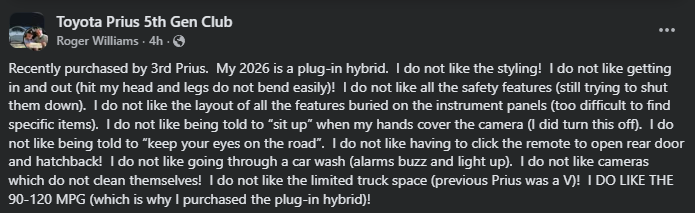
“Recently purchased by 3rd Prius. My 2026 is a plug-in hybrid. I do not like the styling! I do not like getting in and out (I hit my head, and my legs do not bend easily)! I do not like all the safety features (still trying to shut them down). I do not like the layout of all the features buried on the instrument panels (too difficult to find specific items). I do not like being told to “sit up” when my hands cover the camera (I did turn this off). I do not like being told to “keep your eyes on the road”. I do not like having to click the remote to open the rear door and hatchback! I do not like going through a car wash (alarms buzz and light up). I do not like cameras that do not clean themselves! I do not like the limited truck space (previous Prius was a V)! I DO LIKE THE 90-120 MPG (which is why I purchased the plug-in hybrid)!”
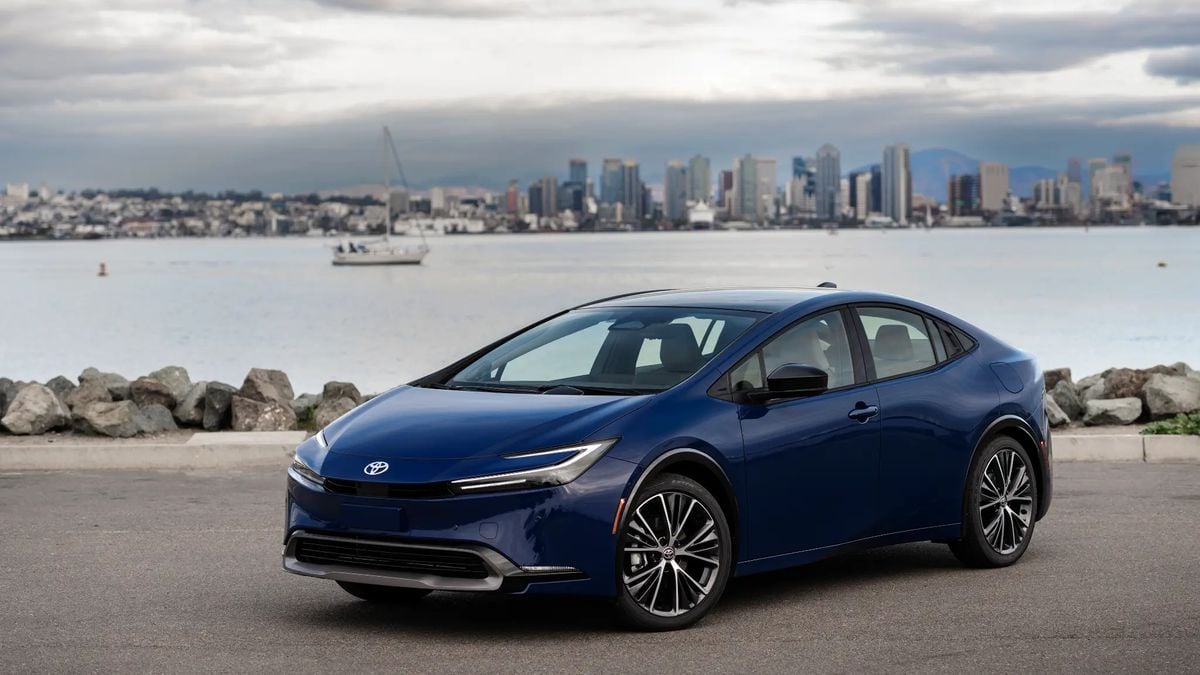
The problem, in this owner’s view, is that the Prius no longer behaves like a Prius. He takes issue with the styling, calling it uncomfortable to live with physically. Getting in and out is more difficult, with headroom and leg movement cited as recurring annoyances. Compared to earlier generations, especially the taller and more practical Prius V, the new car feels lower, tighter, and less forgiving, particularly for aging drivers.
Toyota Prius: Aerodynamics & Drivetrain
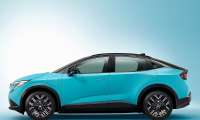
- The Prius focuses on aerodynamic efficiency, with a tapered roofline and low front profile that improve fuel economy while constraining rear visibility.
- Hybrid power delivery emphasizes smooth, uninterrupted acceleration rather than speed, aligning with its efficiency-first mission.
- Interior design adopts a minimalist layout with centrally positioned displays, freeing up dashboard space but requiring driver acclimation.
- Suspension tuning favors urban and suburban comfort, though road noise becomes more noticeable during extended highway driving.
Technology, rather than winning him over, has become a source of constant irritation. He describes fighting the car’s safety systems, from posture alerts telling him to “sit up,” to repeated warnings to keep his eyes on the road. Even after disabling some of these features, the experience feels adversarial. Where earlier Priuses quietly went about their business, this one feels like it is constantly supervising its driver.
The interior layout only adds to the frustration. Frequently used functions are buried in menus, requiring more attention and familiarity than he believes should be necessary. Simple tasks feel complicated, and the learning curve feels steep for a car whose mission has traditionally been ease of use. Even routine activities like going through a car wash trigger alarms and warning lights, breaking the illusion of simplicity.
Practicality also takes a hit. Compared to his previous Prius V, the new model’s cargo space feels constrained. Small usability details, like needing to click the remote to open the rear doors or hatch, stand out more when stacked on top of other annoyances. Even the lack of self-cleaning camera systems becomes part of the larger complaint: the car demands more from the driver than it gives back.
The comments responding to his post highlight a generational divide. Some argue that the efficiency numbers are misleading because they ignore electricity consumption from the grid. Others defend the safety systems, noting that blind-spot warnings and lane alerts can and do prevent accidents. A few are blunt, asking why someone would buy a car they dislike so much. But that question misses the point.
This is not a buyer who wandered into the wrong showroom. This is someone who knows exactly what a Prius used to be. His other car, he notes, is a 1966 Austin Mini Cooper S, a vehicle defined by mechanical honesty and minimalism. From that perspective, the frustration makes sense. The fifth-generation Prius is no longer an appliance. It is a statement, packed with technology, style, and oversight.
And that may be the real story here. Toyota has transformed the Prius into something more desirable, more powerful, and more modern. In doing so, it may have left behind some of the very customers who made the nameplate successful in the first place. The new Prius is faster, sleeker, and vastly more efficient on paper. But for drivers who valued simplicity over sophistication, it no longer feels like home, even if it still delivers astonishing miles per gallon.
Image Sources: Toyota Media Center
Noah Washington is an automotive journalist based in Atlanta, Georgia. He enjoys covering the latest news in the automotive industry and conducting reviews on the latest cars. He has been in the automotive industry since 15 years old and has been featured in prominent automotive news sites. You can reach him on X and LinkedIn for tips and to follow his automotive coverage.
Set Torque News as Preferred Source on Google
Follow us today...




Comments
I agree. Compared to my '17…
Permalink
I agree. Compared to my '17 PP, you have to contort to get in and it's indeed more cramped inside.
Plus they have unnecessary larger tires that are much more expensive to replace.
The new dash design/setup feels like an afterthought. It feels more "cheap" inside.
Most Prius customers place a higher value on overall functionality.
I was excited about this new generation until I tried to get in one.
Did he order this car sight…
Permalink
Did he order this car sight unseen delivered to his home? It seems that most of the complaints he has with this car would have set off alarm bells with a decent test drive.
It's evident that he didn't…
Permalink
It's evident that he didn't take the car for a test drive, before he bought it...
I like my 2020 Prius Prime…
Permalink
I like my 2020 Prius Prime Limited better than this one. Maybe this guy should look for a nice used low mileage one, before Toyota went to this new style. I test drove this one and they suck.
I just bought a 2024 Toyota…
Permalink
I just bought a 2024 Toyota prius. My previous was a 2010 prius I loved that car more than my wife. I'm 6'5 had to adjust the seat to max but it was do able. The dashboard was spacious and the insterment cluster perfect. The 2024 was built-in japan so can't take interest off the loan. Getting into the car is very difficult. The instrument panel and radio panel was an aftter thought. Just not very well thought out. Seams like the car was designed for a small person then sent to the united states to frusrate us and show their superiority. Had to let it go after an accident. A buy back and repair a week later got run over buy a Dimler semi truck and trailer. No one was hurt but the 2010 was totaled twice. OK I'll get off my soap box now. Thank you for hearing me.
I just bought a 2024 Toyota…
Permalink
I just bought a 2024 Toyota prius. My previous was a 2010 prius I loved that car more than my wife. I'm 6'5 had to adjust the seat to max but it was do able. The dashboard was spacious and the insterment cluster perfect. The 2024 was built-in japan so can't take interest off the loan. Getting into the car is very difficult. The instrument panel and radio panel was an aftter thought. Just not very well thought out. Seams like the car was designed for a small person then sent to the united states to frusrate us and show their superiority. Had to let it go after an accident. A buy back and repair a week later got run over buy a Dimler semi truck and trailer. No one was hurt but the 2010 was totaled twice. OK I'll get off my soap box now. Thank you for hearing me.
The prius is still a great…
Permalink
The prius is still a great car in fact I would say the best.Look at your manual.You can turn options off u don't like.Enjoy the best car ever.
The first stop after leaving…
Permalink
The first stop after leaving the dealership with her 2026 Prius Prime was at ADVANCED AUTO to buy and install 2 rectangular convex mirrors on each side view mirror. The Prime has a serious “blind spot” issue exactly where it’s usually expected at 7:00 and 5:00 aft.
I am a CDL OTR driver, former school bus driver and I’m all about safe driving.
The main user manual is over 600 pages, the stripped down “User” manual is barely able to help navigate the interior controls. The digital version is almost impossible to use as reference on my iPhone. You shouldn’t need a manual to use your rear view mirror but you absolutely do need to for this one, same with the dash controls with all those menus.
This is her 3rd Prius: the 2007 blew its drive battery at 192k miles , replacement at $5500 was above Blue Book value. Her 2010 Tour I replaced the drive battery myself, $2200 at 205k miles then the headgasket blew at 209 k miles, traded in regretfully as that one was well loved.
The Prime is a gorgeous version with a steep learning curve and yes, it is a bit of an effort to get in and out for folks like us in our late 70s but doable. The Corvette C6 and the Lotus Emira are much worse to enter and depart from, small consolation. Being at the wheel of the Prime I would compare to being in a fighter jet cockpit: glass roofed, strapped in and oddly by comparison lower to the pavement than her previous models, hence the “ road noise” amplification.
The safety features are overbearing but manageable: I’ll be the one to disable the worst offenders. We have 18 solar cells so the plug-in mileage bonus is a given. NONE of the Prius we owned ever lived up to advertised mpg so I have low expectations for this one, plug-in miles excepted. 90% of her driving is around town short trip anyway so we’re convinced we bought the right new PRIUS for her.
As a previous prius (2013)…
Permalink
As a previous prius (2013) owner who bought a prius prime (2025) I couldn't agree more with this article. My double knee replacement legs struggle to get in and out of the vehicle. I love the blindspot detection, but when I'm looking both ways at an intersection, I don't need to keep my eyes up front. The 17 inch low riding tires aren't very forgiving on rough roads either.
I own a 2008 Prius with 198…
Permalink
I own a 2008 Prius with 198,000 miles on it. I thought I needed a new car and went to buy a 2024 Prius, but getting into it, I hit my head on the roof every time. In fairness, I am old and large and don't bend too well. However the difficult entry eliminated the new style Prius for me. I purchased a very low mileage 2022 model and love it. Easy in and Easy out. So now I am a Prius fleet owner. I use the older one every day and the newer one for long trips.
If Toyota had cut out the roof for the top of the door to fit, like the Volvo, it would have sold one more Prius...to me.
100%. Same issues. Can…
Permalink
100%. Same issues. Can barely get in & out. Intrusive tech, difficult to turn off. Horn blares if parking close to a building etc. This my 4th Prius. The 2017 was just right. On + side: looks great, power.. can & do drive like a sports car. Have had for 3 months.. 1 tank of gas. Daily driver
Have had my 2026 PHEV Prius…
Permalink
Have had my 2026 PHEV Prius for about six weeks. I know exactly what he's talking about. I can't figure out features and when I think I do there's no consistency . Alarms drive me crazy. I have a small one car garage. Horn honking alarms scream at me. The brakes slam on. Way too much unfriendly technology. I too had a Prius V and this too is my third Prius. Missing the old one big time.