
What You Need to Know
- NHTSA requires automated driving system operators to file crash reports with detailed narratives
- Waymo filed 697 incidents with full explanations; Tesla filed 18 with every narrative redacted.
- Two of Tesla's 18 crashes caused injuries, one requiring hospitalization
- Five of Tesla's 18 crashes involved fixed objects; four involved SUVs
- The cyclist and bus incidents cannot be assessed without narrative detail
- Insurance analysts say limited crash data forces underwriters into worst-case pricing assumptions
Eighteen crashes. One sentence. Every single time.
That is the entirety of Tesla's public explanation for its automated driving system crashes under a federal reporting mandate designed to promote transparency.
The sentence reads: "[REDACTED, MAY CONTAIN CONFIDENTIAL BUSINESS INFORMATION]." It appears in all 18 of Tesla's incident reports filed with the National Highway Traffic Safety Administration under the Standing General Order for Automated Driving Systems. No details. No context. No explanation of what went wrong, why the system failed to prevent contact, or what Tesla is doing to prevent it from happening again.
By comparison, Waymo's reports read like accident reconstruction narratives. The company's 697 filed incidents include multi-paragraph descriptions of complex lane changes, intersection behavior, the specific actions of human drivers in other vehicles, weather conditions, and whether passengers were wearing seatbelts. Zoox follows the same pattern: detailed, descriptive, transparent.
The contrast isn't subtle. And it matters more than the crash counts themselves.
The NHTSA dataset contains 825 total reported ADS incidents across four companies. Waymo accounts for 697, a figure that reflects its massive fleet exposure in dense urban environments like San Francisco, Phoenix, and Los Angeles, where its vehicles operate without human safety drivers. Avride follows with 41 incidents, Zoox with 32, and Tesla with 18.
Raw numbers without context are misleading. Waymo's higher incident count is a function of scale and operational intensity, not safety deficiency. The company's vehicles have driven millions of fully autonomous miles in some of America's most chaotic traffic environments. More exposure naturally produces more incidents. Tesla's lower count reflects a much smaller and slower-than-expected robotaxi rollout, not superior safety performance.
What the numbers don't show, because Tesla won't let them, is what actually happened in those 18 crashes.
NHTSA's Standing General Order gives companies an opportunity to explain themselves. The "Narrative" section of each report is where engineers describe the sequence of events leading to contact, the system's response, and any mitigating factors. This is where transparency lives or dies. Waymo's narratives frequently exceed 200 words, describing precise maneuvers like "the ADS initiated a lane change into the left lane and detected the approaching vehicle decelerating." Zoox provides similar detail.
Tesla's narrative section is identical in every report. The same 47-character string, copied and pasted 18 times. The company uses an identical boilerplate for every narrative, which limits the public's ability to assess whether crashes represent edge cases or systemic issues.
For all 18 of Tesla's reported crashes, the system status was marked "Verified Engaged", meaning the automated system was actively controlling the vehicle when contact occurred. Two of the 18 incidents involved injuries, one requiring hospitalization. The most common collision partners were "Other Fixed Object" (five incidents) and SUVs (four). Tesla also reported single incidents involving a cyclist, an animal, and a bus.
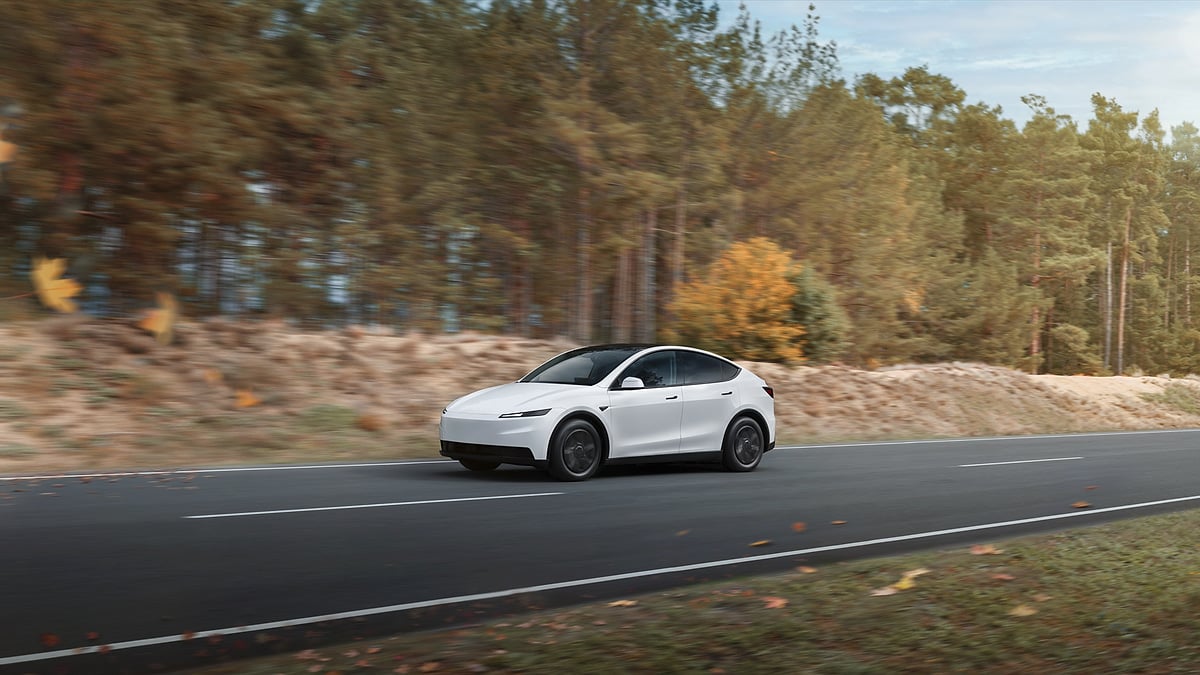
But without narrative detail, the public cannot assess whether these crashes represent edge-case failures or systemic problems. Did the cyclist dart into traffic, or did the system fail to detect a stationary bike lane user? Did the SUV cut off the Tesla, or did the Tesla merge blindly? Was the fixed object a traffic barrel that blew into the lane, or a concrete barrier that the system simply didn't see?
The following analysis is based on the collision-type categories reported in NHTSA's public dataset, not on the redacted narrative details. TorqueNews analyzed the collision pattern in Tesla's 18 redacted reports, and the distribution raises questions that the narratives would answer. Five incidents involved "Other Fixed Object", a category that includes traffic barrels, concrete barriers, parked vehicles, and construction equipment. Tesla's vision system, which relies on cameras without LiDAR or radar, has been scrutinized in previous NHTSA investigations involving stationary object detection, a concern TorqueNews previously explored when My Tesla Model 3 Hit Traffic Cones While in Full Self-Driving Mode, Causing Significant Damage documented the real-world consequences of camera-only vision failing to identify obstacles in the roadway. Four incidents involved SUVs, which raises questions about side-detection during lane changes or intersection behavior. The single cyclist incident and the bus incident cannot be assessed without detail; researchers cannot determine whether the Tesla was at fault, whether another vehicle cut it off, or whether environmental factors played a role.
These patterns matter because they suggest where Tesla's system may have blind spots. Waymo's detailed narratives allow researchers to determine whether a crash was caused by an edge case, a construction barrel blowing across three lanes, or a repeatable failure mode. Tesla's redactions erase that distinction entirely. Every crash becomes an unclassified mystery, and every mystery weakens the case that the system is ready for unsupervised robotaxi operation.
These questions have answers. Tesla has them. NHTSA probably has them, behind redaction stamps. The public does not.
Waymo's transparency serves a strategic purpose beyond regulatory compliance. When the company's narratives describe a human driver running a red light and T-boning an autonomous vehicle, or a pedestrian stepping into traffic against a signal, that context shapes public perception. It demonstrates that autonomous systems are often not at fault, a critical message for an industry fighting skepticism.
Tesla's opacity produces the opposite effect. By redacting everything, Tesla invites speculation. Every crash becomes a potential system failure in the public imagination because the company refuses to provide evidence otherwise. In an era where a single viral video of a robotaxi glitch can generate national headlines, controlling the narrative through transparency isn't just ethical, it's strategic.
The timing makes this particularly significant. Tesla is preparing its robotaxi launch, which CEO Elon Musk has described as the company's primary value driver. The service depends on regulatory approval, insurance partnerships, and public trust. All three of those pillars weaken when a company treats crash data as proprietary business information rather than public safety data.
Dr. Missy Cummings, director of the Autonomy and Robotics Center at George Mason University and a former NHTSA senior safety advisor, made the point directly in a 2023 House subcommittee hearing.
"The crash narratives provided to the public are heavily redacted, and it appears that the redactions may not be limited to information that is confidential business information," she wrote in submitted testimony to the House Subcommittee on Highways and Transit.
"Other variables in the dataset are also heavily redacted including whether the ADAS/ADS was operating within its operational design domain, the ADAS version, and crash location specific information. Information which is essential to evaluating the performance of Level 2 ADAS/ADS equipped vehicles should not be withheld from the public because industry alleges it is CBI."
NHTSA has already opened multiple investigations into Tesla's Autopilot and Full Self-Driving systems, and Tesla's FSD Might Be 200 Times Safer Than Human Drivers, even as NHTSA opens a New Safety Investigation, which examined the complex question of whether advanced driver assistance systems reduce collision risk even as the agency deepens its oversight. The agency's Office of Defects Investigation examines crash data specifically to identify defect patterns that might warrant recalls. When one of the largest players in the autonomous driving space submits identical boilerplate for every incident, the agency's ability to perform that analysis is compromised.
A legitimate counterargument exists. Tesla might claim that detailed narratives reveal competitive information about its Full Self-Driving neural network architecture, sensor fusion approach, or edge-case handling. Autonomous driving is a fiercely competitive space, and technical details could theoretically benefit rivals. But that argument collapses under scrutiny. Waymo and Zoox operate in the same competitive environment and provide detailed narratives without apparent commercial harm. The narratives describe what happened, not how the system's algorithms process it. There's no engineering secret in stating that "a vehicle failed to yield at a four-way stop."
NHTSA's Standing General Order already allows companies to request confidential treatment for specific technical details. Tesla isn't selectively redacting sensitive engineering data. It is blanket-redacting every narrative in its entirety, including descriptions of events that contain no proprietary information whatsoever.
The regulatory implications are equally concerning and not abstract. One owner documented a parking-lot failure so basic it undermined confidence in Tesla's entire automation stack: My New 2025 Tesla Model 3's FSD Backed Into My Truck While Parking in My Driveway and It Also Failed to Stop for the Mailman shows what happens when automated systems misjudge stationary objects at low speed in residential settings. NHTSA's ability to identify systemic safety defects depends on pattern analysis across incident reports. When one major player submits identical boilerplate for every crash, the agency's capacity to compare Tesla's failure modes against industry benchmarks is severely compromised. A recall decision that might be obvious from detailed narratives becomes guesswork when those narratives are hidden behind confidentiality claims.
For investors and industry observers, the transparency gap raises questions about Tesla's confidence in its own system. Companies with strong safety records typically welcome scrutiny because scrutiny validates their claims. Companies with something to hide, or something they fear, tend toward opacity. Tesla's blanket redaction doesn't prove its system is unsafe. But it does limit the information available for independent assessment.
The insurance industry is watching this transparency gap closely, too. Autonomous vehicle liability is still a gray area in most states, and insurers base their risk models on available data. When Waymo provides detailed crash narratives, insurance underwriters can assess whether the AV was at fault, whether the collision was preventable, and whether the system's response was reasonable. Tesla's redactions deny underwriters that data, which forces them into worst-case assumptions for pricing models.
Commercial auto insurance underwriting is fundamentally a data-driven business. When a company provides detailed crash narratives, underwriters can assess whether the AV was at fault, whether the collision was preventable, and whether the system's response was reasonable. When narratives are redacted, underwriters lack the data to make those assessments and must build worst-case assumptions into their pricing models. Higher assumed risk translates directly into higher premiums or coverage refusals from carriers unwilling to underwrite a safety record they cannot evaluate.
The international context makes Tesla's approach look even more isolated. In the United Kingdom, the Law Commission has recommended that AV crash data be treated as a public safety record, not proprietary business information. In Germany, the Federal Motor Transport Authority publishes detailed reports on automated system failures as part of its type-approval process. The European approach treats transparency as a prerequisite for deployment, not an afterthought. European regulators generally require more detailed AV incident disclosure than the U.S. Standing General Order mandates, a difference Tesla would need to navigate if it expands robotaxi service internationally.
The robotaxi race will be decided on trust as much as technology. Waymo has chosen to build that trust through openness, accepting the short-term pain of public crash reports in exchange for long-term credibility. Zoox has done the same. Even smaller players like Avride provide meaningful detail in their filings.
Tesla has chosen the opposite path, treating every incident as a potential liability to be minimized rather than a data point to be shared. In a race where public acceptance determines regulatory approval, and regulatory approval determines market viability, that choice carries consequences that extend far beyond any single crash report.
In the end, 18 crashes with no explanation says something that 18 crashes with full context never could. It says the company would rather you didn't ask.
And in this industry, that's the most revealing data point of all.
Image Sources: Tesla Media Center
About The Author
Noah Washington is an automotive journalist based in Atlanta, Georgia, covering sports cars, luxury vehicles, and performance culture. His reporting focuses on explaining the engineering, design philosophy, and real-world ownership experience behind modern vehicles.
Noah has been immersed in the automotive world since his early teens, attending industry events and following the enthusiast communities that shape how cars are built and driven today. His work blends industry insight with enthusiastic storytelling, helping readers understand not just what a car is, but why it matters.
Noah is also a member of the Southeast Automotive Media Association (SAMA), a professional organization for automotive journalists and industry media in the Southeast.
His coverage regularly explores sports cars, luxury vehicles, and performance-driven segments of the automotive industry, including the evolving culture surrounding Formula Drift and enthusiast builds.
Read more of Noah's work on his author profile page.
You can also follow Noah here:
Set Torque News as Preferred Source on Google
Follow us today...