
Tesla’s Full Self-Driving system continues to sit at the center of one of the most complicated debates in the modern automotive world. It is simultaneously praised as a glimpse into the future of transportation and criticized for reminding drivers, sometimes abruptly, that autonomy still has limits. As technology improves, many of its most revealing moments no longer happen on highways or test tracks, but in everyday environments where drivers expect the car to handle simple tasks without drama.
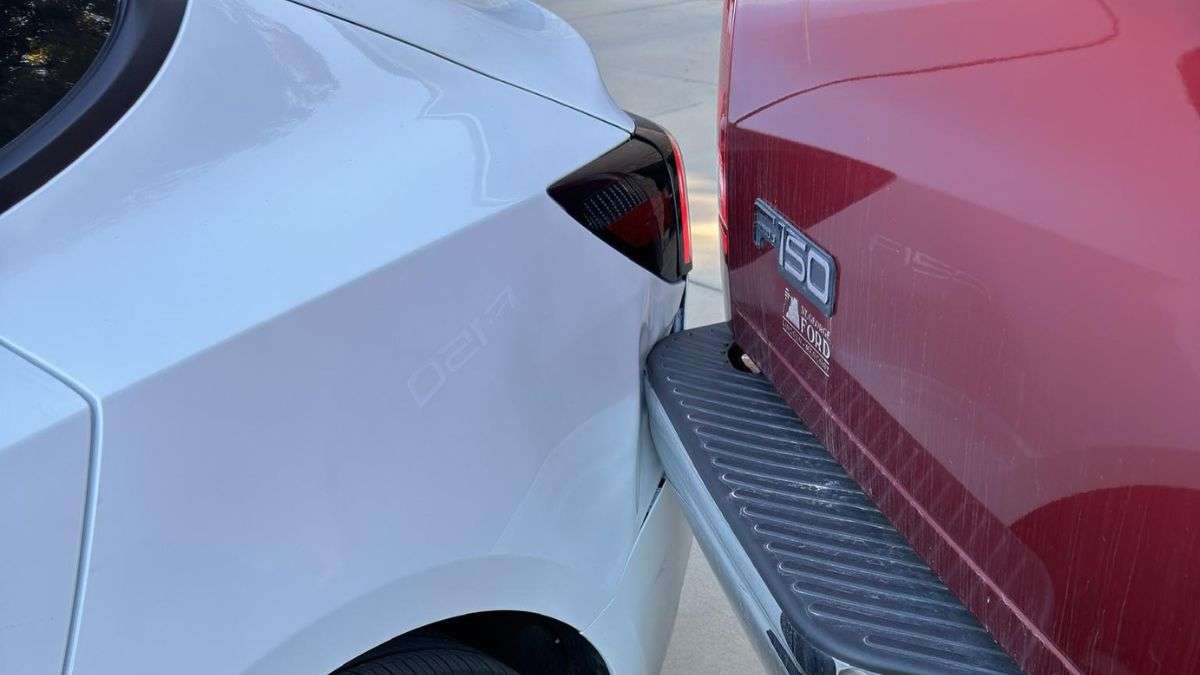
That contrast became clear after I came across a post in the “Tesla Model 3 and Model Y Owners Club” group on Facebook shared by Jeff Graf. Jeff owns a new 2025 Tesla Model 3 and was using the latest version of Full Self-Driving when the incident occurred. According to Jeff, the car was attempting to back into his driveway when it instead backed directly into his truck, and to make matters worse, the system did not save any recording of what happened.
As Jeff explained it himself, “I was using my new FSD and the 2025 Model 3 just backed into my truck while trying to back into my driveway. It also failed to record the event.”
Low-Speed Situations Can Be the Hardest Test for FSD
At first glance, a driveway incident may sound far less serious than high-speed highway failures, but from a technical perspective, these situations are often more complex. Driveways are unpredictable spaces. They can include tight angles, parked vehicles, trailers, shadows, uneven pavement, and objects that change position frequently. Unlike highways, there is no standardized layout for a driveway, which means Full Self-Driving has far less consistent data to rely on.
This is one reason Tesla emphasizes that FSD is still a supervised system. While the company has argued that its software may already outperform human drivers in certain scenarios, even pointing to data that has triggered deeper scrutiny and discussion around whether Tesla’s Full Self-Driving could be hundreds of times safer than human drivers, those claims do not eliminate edge cases where human judgment remains essential.
Missing Footage Raises a Different Kind of Concern
Beyond the collision itself, Jeff’s frustration appears to center heavily on the fact that the event was not recorded. Tesla’s camera and recording systems are often seen as a safety net for owners, providing clarity when something goes wrong. When no footage exists, it leaves owners with questions about accountability and limits their ability to review what the system actually perceived.
This is not the first time Tesla owners have raised concerns about how consistently events are logged, especially during low-speed maneuvers. While Tesla vehicles record vast amounts of data, not every incident triggers a saved clip, which can be surprising for owners who assume the car is always watching.
Others Say They’ve Seen Similar Behavior
Jeff’s post quickly drew responses from other Tesla owners who had experienced comparable situations. One of the most striking came from Sig Goldberg, who described an incident involving his own vehicle.
Sig wrote, “I have a 2023 Model Y, and it backed up into a gardener’s trailer at 7-Eleven. It was a $5,000 repair covered by insurance ($500 deductible). Zero warning, no red bars, no nothing. I talked with Tesla and they said it was my fault for not seeing it.”
Sig’s experience adds weight to Jeff’s story because it highlights a recurring concern among some owners. Moments where the system provides little or no warning before making a poor decision are still possible. It also reinforces Tesla’s consistent stance that the driver is ultimately responsible, regardless of whether Full Self-Driving is engaged.
The Supervised Label Is Not Just a Disclaimer
Not all commenters viewed Jeff’s situation as a failure of the technology itself. Abanoub Mikhail offered a reminder that aligns closely with Tesla’s own messaging, writing, “I mean it is called Full Self Driving (SUPERVISED). Supervised refers to the driver of the car. So you have to be aware of your surroundings.”
That perspective is important because it reflects how Tesla expects owners to interact with the system. Full Self-Driving is designed to assist, not replace, the driver. In low-speed environments where mistakes can happen quickly, constant attention is not optional.
Sterling Archer Hazard echoed that sentiment more bluntly, saying, “It sucks but you chose to participate in a beta test and now you’re going to pay the cost. Even if it did record it and it’s 100% the fault of FSD, you still signed the form assuming all liability.”
While that viewpoint may sound harsh, it captures a reality that many Tesla owners accept over time. Using FSD means accepting that the technology is still evolving and that responsibility does not shift away from the driver.
How Tesla Defines Responsibility When FSD Is Active
That's why the important lesson in stories like Jeff’s is how Tesla formally defines responsibility when Full Self-Driving is engaged. Unlike systems that are marketed as hands-off or eyes-off, Tesla has been consistent, at least in writing, that FSD does not transfer control away from the driver. Every activation screen, every warning, and every update reiterates that supervision is mandatory.
This matters because many owners, especially newer ones, may gradually relax their vigilance as the system performs well day after day. Familiar environments like a home driveway can feel especially low risk, which ironically makes them more dangerous from a supervision standpoint. When a driver expects the car to handle a maneuver flawlessly, reaction time can slip just enough for a mistake to become unavoidable.
Why These Stories Exist Alongside Positive FSD Experiences
What makes Full Self-Driving so polarizing is that stories like Jeff’s exist alongside moments where the system performs impressively. Many owners continue to share experiences where FSD handled difficult situations smoothly or intervened at just the right moment, including cases where drivers believe Tesla’s Full Self-Driving stepped in at exactly the right time to avoid a serious crash and potentially save lives.
At the same time, there are also more serious incidents that continue to raise questions about readiness, such as reports involving newer vehicles where Full Self-Driving unexpectedly crossed multiple lanes and struck divider posts at highway speeds early in ownership. These contrasting outcomes help explain why Tesla’s technology inspires both confidence and caution, often at the same time.
Why Owners Keep Using FSD Despite These Incidents
So if stories like Jeff’s raise valid concerns, it is fair to ask why so many Tesla owners continue to use Full Self-Driving daily. The answer lies in consistency. For many drivers, FSD works exceptionally well most of the time. Long highway drives, stop-and-go traffic, and even complex urban routes can feel noticeably less stressful with the system engaged.
Some owners even describe FSD as the most enjoyable part of ownership, not because it replaces driving, but because it reduces mental load. That satisfaction helps explain why isolated failures do not necessarily outweigh hundreds of uneventful or impressive miles for frequent users.
The Psychological Shift That Happens With Automation
There is also a psychological element at play. As automation improves, drivers tend to recalibrate their expectations. What once felt miraculous becomes normal. Over time, that normalization can blur the line between assistance and autonomy even when warnings remain visible.
This is not unique to Tesla. Aviation, industrial automation, and even basic cruise control have shown similar patterns. When systems work well repeatedly, humans are more likely to trust them implicitly, sometimes more than they should. Jeff’s experience fits squarely into that broader pattern.
I think Jeff’s experience is a reminder that progress and patience have to coexist when it comes to automation. Tesla’s Full Self-Driving has improved dramatically compared to earlier versions, and in many situations, it works remarkably well. But moments like this show that everyday environments, especially low-speed ones, still demand human judgment.
I also think it is important not to frame stories like this as proof that FSD is broken or useless. At the same time, they should not be dismissed as user error without discussion. The truth usually sits somewhere in the middle. Full Self-Driving is powerful, but it is not infallible, and the responsibility placed on the driver is very real.
Key Takeaways for Tesla Owners and Shoppers
• Low-speed environments demand extra attention. Familiar spaces can create false confidence.
• Camera-based systems have limitations. Depth and object priority remain challenges.
• Supervision is not optional. Tesla places responsibility squarely on the driver.
• Positive experiences still dominate for many owners. Consistency keeps people engaged with FSD.
• Expectation management matters. Treat FSD as an assistant, not an autopilot.
Join the Conversation
Have you noticed yourself becoming more relaxed or more cautious over time when using Tesla’s Full Self-Driving?
And do incidents like this change how much trust you place in automation during everyday maneuvers like parking or backing into a driveway?
I'd love to hear from you in our comments below.
Aram Krajekian is a young automotive journalist bringing a fresh perspective to his coverage of the evolving automotive landscape. Follow Aram on X and LinkedIn for daily news coverage about cars.
Image Sources: The “Tesla Model 3 and Model Y Owners Club” public Facebook group and Tesla’s gallery, respectively.
Set Torque News as Preferred Source on Google
Follow us today...