
The often-overlooked practice of a pre-warranty inspection has once again proven its worth, potentially saving a Tesla owner over a thousand dollars on critical repairs. As vehicles approach the end of their factory warranty, a thorough check-up can uncover latent issues that, if left unaddressed, quickly become out-of-pocket expenses for the owner. This particular instance sheds light on common wear points in Tesla models, specifically concerning suspension components, and reveals the financial prudence of such preventative measures.
The original social media post, shared on r/TeslaLounge, detailed the owner's proactive approach and its significant payoff:
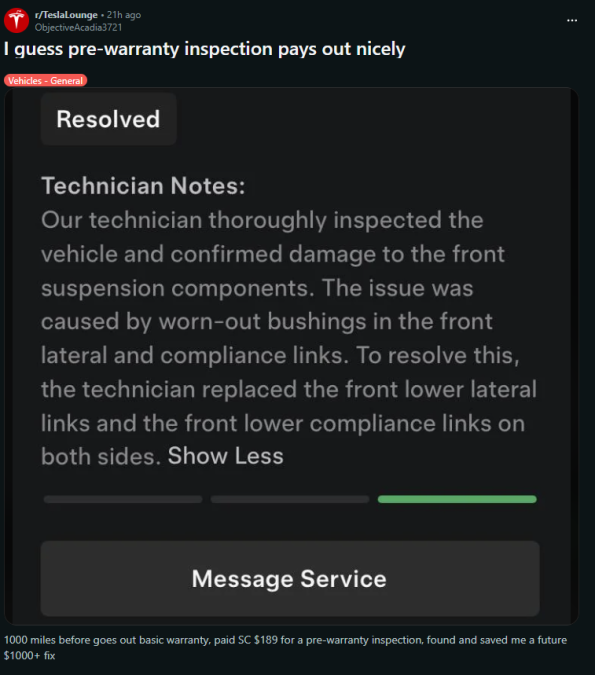
"I guess pre-warranty inspection pays out nicely
1000 miles before goes out basic warranty, paid SC $189 for a pre-warranty inspection, found and saved me a future $1000+ fix."
This account immediately sparked discussion among other Tesla owners, many of whom were unaware of such a service or its potential benefits. One user, ConclusionOne5240, promptly inquired, "How do you book this? How structured/involved is this inspection?" This question shows a fundamental gap in consumer awareness regarding warranty management and the availability of preventative service options. It suggests that while many owners are keen to protect their investment, the pathways to do so are not always clearly communicated by manufacturers or service centers.
Tesla Model 3: Understanding Warranty Coverage and Common Issues
- The basic vehicle limited warranty for most Tesla models, including the Model 3, typically covers four years or 50,000 miles, whichever comes first. This warranty covers the repair or replacement of any parts that fail due to manufacturing defects.
- Beyond the basic warranty, Tesla also offers a battery and drive unit limited warranty, which extends for eight years or 100,000 to 150,000 miles, depending on the model. This separate coverage is crucial for the most expensive components of an electric vehicle.
- Common issues reported by Tesla owners often include premature wear of suspension components, particularly control arm bushings, which can lead to noises and compromised handling. These issues frequently surface as the basic vehicle warranty approaches its expiration.
- A pre-warranty inspection, though sometimes requiring a fee, can identify these developing problems while the vehicle is still under factory coverage. This proactive measure can save owners significant out-of-pocket expenses for repairs that would otherwise become their responsibility.
The question of how to book such an inspection was quickly answered by DigitalJEM, who provided practical advice: "Create a service visit using the 'other' option and in the notes put 'my warranty is about to expire. I’d like you to inspect the car, including all bushings and links”. And they’ll take care of the rest. Price varies depending on your service center, but should be around $150-$250 USD." This guidance is invaluable, transforming a vague concept into an actionable step for owners. It also subtly points to the reality that these inspections are not always explicitly advertised, requiring owners to know precisely what to ask for to initiate the process.
This advice, while helpful, also exposes a less-than-ideal situation: owners must effectively diagnose potential problem areas themselves to ensure a comprehensive inspection. The fact that an owner needs to specifically request "all bushings and links" to be checked implies that a standard pre-warranty check might not be as thorough as one might hope. This places an undue burden on consumers, who are not typically automotive technicians, to anticipate common failure points in their vehicles. It’s a stark reminder that true customer service would proactively offer such detailed inspections, rather than requiring owners to navigate a system designed for more general service requests.
The sentiment that this is a "popular problem" for Teslas was echoed by Initial_Row_6400, stating, "That’s a pretty popular problem for the front end of Teslas. The bushings almost always go out." This comment is particularly damning, suggesting that the issue isn't an isolated incident but a systemic vulnerability. For a vehicle positioned at the premium end of the market, the notion that a critical component like suspension bushings "almost always go out" before or shortly after the basic warranty expires is simply unacceptable. It points to either a design flaw, a material quality issue, or inadequate validation testing that should have been addressed long before these vehicles reached consumers.
Further reinforcing the prevalence of this issue, Otto_the_Autopilot shared their own experience: "Yep, also had mine replaced a month before warranty expired. I specifically knew this issue and asked them to inspect it along with some other minor items. They charged for the inspection I requested, but the warranty work was covered. I suspect if you specifically complain about "creaking," you can get it totally free. 4 years and 30k miles." This account solidifies the pattern, indicating that experienced owners are often aware of these weaknesses and leverage their knowledge to ensure repairs are covered. The suggestion to "complain about 'creaking'" to potentially avoid the inspection fee is a telling insight into how some owners navigate the system, effectively using known symptoms to trigger warranty work without upfront costs.
The collective experience shared by these owners paints a clear picture: Tesla's front-end suspension bushings appear to be a common failure point that often manifests just as the basic warranty period concludes. This pattern is not just an inconvenience; it represents a significant reliability concern that impacts owner satisfaction and long-term cost of ownership. While proactive owners can mitigate the immediate financial impact, the underlying issue remains a black mark against the vehicle's engineering and durability.
Such recurring issues, particularly in components as fundamental as suspension, erode consumer trust and add an unnecessary layer of anxiety for owners. The expectation for any modern vehicle, especially one with a premium price tag, is that critical components will last well beyond a mere 30,000 to 50,000 miles. When owners must pay for inspections to uncover known flaws, it shifts the burden of quality control from the manufacturer to the customer, a practice that is fundamentally at odds with the principles of robust automotive engineering and customer care.
The proactive approach taken by ObjectiveAcadia3721 serves as a valuable lesson for all vehicle owners, not just those of Teslas. It shows the critical importance of understanding your vehicle's warranty coverage and taking deliberate steps to identify potential issues before they become expensive problems. While this owner successfully navigated a potential financial pitfall, the broader implication is that manufacturers need to address these common failure points with more robust designs and stand by their products with more transparent and comprehensive warranty support.
Image Sources: Tesla Media Center
Noah Washington is an automotive journalist based in Atlanta, Georgia. He enjoys covering the latest news in the automotive industry and conducting reviews on the latest cars. He has been in the automotive industry since 15 years old and has been featured in prominent automotive news sites. You can reach him on X and LinkedIn for tips and to follow his automotive coverage.
Set Torque News as Preferred Source on Google
Follow us today...