
Sometimes the upgrade you think will improve everything turns out to have a hidden cost. That is exactly what one Rivian R1S owner discovered after swapping his factory tires for a set widely regarded as smoother, quieter, and more durable: his efficiency cratered by roughly 25 percent overnight. The shock was not just the magnitude of the drop, but the fact that it came from a tire choice that most consumers would assume was a step up in every way.
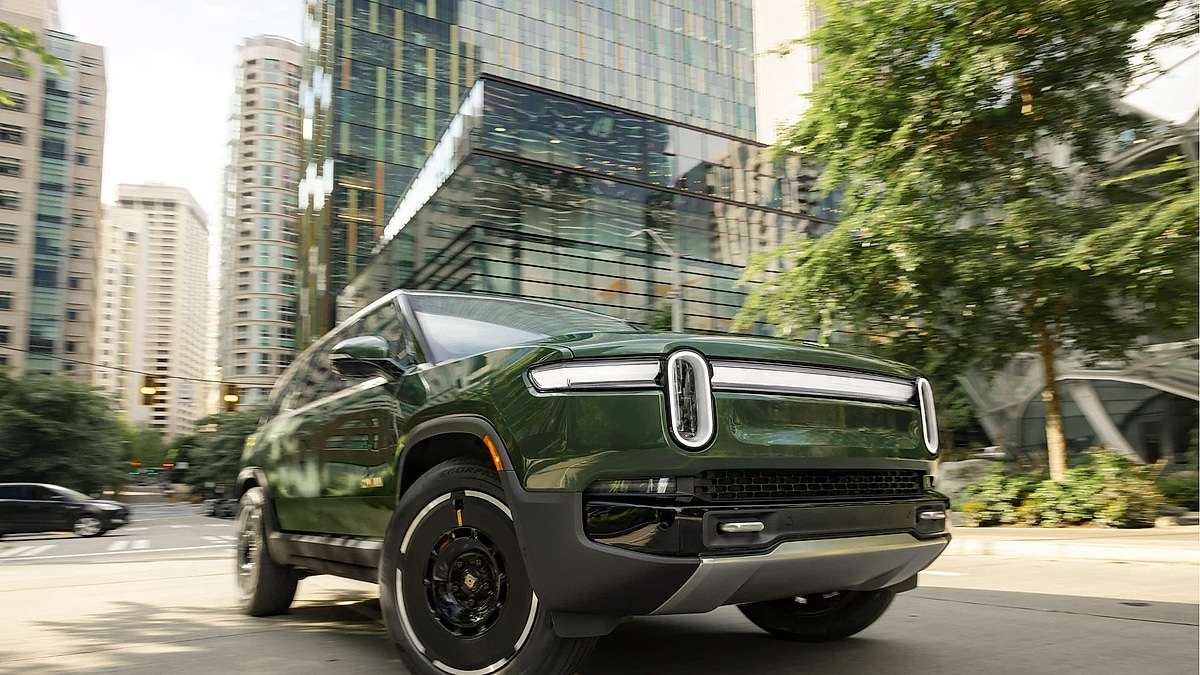
The owner, posting under the Reddit handle GrantMeThePower, drives a Rivian R1S Launch Edition out of Southern California. At just over 21,000 miles, he replaced the original equipment 275/65R20 Pirelli tires with a set of Michelin Defender M/S2 all-seasons, expecting the kind of refined highway behavior that the Defender name typically delivers. The vehicle had been driven under consistent conditions, on familiar routes, with no recent changes to driving style, climate settings, or cargo load.
The result was immediate and unsettling. While the ride did become noticeably quieter and smoother, exactly the comfort gains he had hoped for, the efficiency meter told a different story. Despite driving extra conservatively, avoiding hard acceleration, and monitoring every variable he could control, GrantMeThePower saw a massive efficiency decline with only 155 miles on the new Michelins. He checked tire pressure repeatedly, confirming 49 PSI cold against a 50 PSI rating, and found the alignment felt straight and true with no pulling or vibration. The weather in his area was mild, eliminating extreme heat or cold as culprits. Nothing explained the drop.
The r/Rivian community quickly offered a chorus of reassurance mixed with physics. User arithmetike, who has followed multiple tire-swap threads, advised checking back after 1,000 and 3,000 miles, noting that "new tires always have worse efficiency" and that "1/3 worse efficiency sounds about right" during the early phase. Another owner, RickySpanishLives, confirmed the pattern from personal experience on a different R1 vehicle: efficiency was "complete trash for a couple thousand miles" before improving markedly afterward. Even a Tesla owner, I_C_Weaner, chimed in with data from a 2021 Model S tire change, reporting that the car's own efficiency software initially blamed tire drag, yet after approximately 5,000 miles, the replacement tires actually delivered better efficiency than the factory set.
The science behind the phenomenon comes down to rolling resistance, the often-invisible force that determines how much energy a tire consumes simply by rotating. Electric vehicles are uniquely vulnerable to this variable because they lack the thermal and mechanical inefficiencies of internal combustion that would otherwise mask small differences. Every aspect of a tire, tread compound, carcass construction, sidewall stiffness, tread depth, and weight, affects how much battery energy is lost to heat and deformation. As commenter MistaHiggins pointed out, the Defender M/S2 is not categorized as a low-rolling-resistance (LRR) tire, meaning it was never engineered with EV range as a primary target. He recalled an eerily similar experience on a 2017 Hyundai Ioniq, where switching to non-LRR Michelins cost more than 25 percent of range; only after returning to LRR tires did the range fully recover.
Long-term owner data adds important nuance to the break-in narrative. Redditor squarecmb, running a 2022 R1S Quad Motor with 22-inch sport rims, averaged 2.11 miles per kWh across 27,000 miles on OEM tires, then dropped to 1.85 miles per kWh over roughly 8,000 miles on Michelin replacements, a 12 percent deficit that persisted. Yet Hrothgar_unbound reported the opposite arc after switching from 22-inch Pirelli Scorpions to Defenders: a 10 percent efficiency loss during the first 1,000 to 1,500 miles, followed by gradual recovery to the point that, 17,000 miles later, the Defenders were outperforming the original tires. Another owner, FuelzPerGallon, documented an R1T swap in September and found efficiency nearly identical for the first 8,000 miles,2.28 versus 2.24 miles per kWh, before climbing to 2.37 in recent driving, suggesting that some compounds need extended mileage to reach their optimal energy profile.
Not everyone believes aftermarket tires can ever match the factory specification. User dancing__narwhal offered what he admitted was an unpopular opinion: "you're not gonna find a better tire than OEM." His argument rests on the reality that Rivian's engineers optimize every component that affects the published range figure, and the tires are selected specifically to deliver the maximum efficiency the vehicle can achieve while still meeting traction, braking, and durability requirements. From that perspective, any deviation is inherently a compromise, even if the trade-off improves comfort, noise, or tread life.
One technical theory emerged from commenter DeathRabbit679, who suggested GrantMeThePower verify whether the vehicle's software was correctly registering the new tire size. An incorrect entry in Rivian's system could throw off the odometer and speedometer calculations, which in turn would corrupt efficiency math. The owner confirmed, however, that the size was properly logged as 275/65R20 and that cold pressure sat at 49 PSI. Another owner, aperlei, expressed skepticism that the Defenders could truly be less efficient than all-terrain Pirellis, arguing the drop had to be "some combo of too-small sample size, break-in period, and software inconsistencies." With tire size ruled out, both the break-in and sample-size explanations remain the leading theories.
New tires typically carry mold-release agents and have an unworn tread surface that creates more friction during the first several hundred to a few thousand miles. On an internal-combustion vehicle, that extra drag might cost half an MPG...
GrantMeThePower is far from the first Rivian owner to discover that tire choice is one of the most consequential modifications an EV driver can make. In recent months, TorqueNews has covered multiple cases of R1S owners navigating the same compromise between comfort and efficiency, with widely varying outcomes. For example, one R1S owner who replaced his Pirelli Scorpions with Hankook iON HT tires at 25,000 miles saved $1,400 and reported comparable efficiency with a noticeably quieter ride.
And the phenomenon is not unique to Rivian, as one Cybertruck owner saw his range drop by nearly 30 percent after switching to Goodyear Duratracs and admitted he may have made a mistake, underscoring just how severely the wrong rubber can punish an electric powertrain.

So what should GrantMeThePower, and any Rivian owner facing a similar shock, expect? The consensus from owners who have lived through it is clear: wait. Most report that the worst of the efficiency penalty fades within the first 1,000 to 3,000 miles as the tread wears in and mold-release compounds scrub off. By 5,000 miles, many say the numbers approach, or in some cases exceed, the original baseline. However, if the replacement tire lacks an LRR designation, a permanent gap of 5 to 15 percent may remain, which owners must weigh against gains in ride quality, noise reduction, and tread longevity. For now, the data support patience over panic. With only 155 miles logged, GrantMeThePower is still in the earliest phase of a break-in cycle that could span several thousand miles. The lesson echoing across the Rivian community is that tires are not just wear items on an electric SUV; they are range-critical components, and changing them is less like swapping brake pads and more like recalibrating the entire energy equation. Time, and plenty of miles, will tell whether the Defenders earn their place on his R1S.
Image Sources: Rivian Media Center
About The Author
Noah Washington is an automotive journalist based in Atlanta, Georgia, covering sports cars, luxury vehicles, and performance culture. His reporting focuses on explaining the engineering, design philosophy, and real-world ownership experience behind modern vehicles.
Noah has been immersed in the automotive world since his early teens, attending industry events and following the enthusiast communities that shape how cars are built and driven today. His work blends industry insight with enthusiastic storytelling, helping readers understand not just what a car is, but why it matters.
Noah is also a member of the Southeast Automotive Media Association (SAMA), a professional organization for automotive journalists and industry media in the Southeast.
His coverage regularly explores sports cars, luxury vehicles, and performance-driven segments of the automotive industry, including the evolving culture surrounding Formula Drift and enthusiast builds.
Read more of Noah's work on his author profile page.
You can also follow Noah here:
Set Torque News as Preferred Source on Google
Follow us today...