
For the century-long reign of the internal combustion engine, the ritual was simple: find a station, fill up, and move on. Now, in our new age of electric mobility, the ritual has changed, but the frustrations have not.
Plugging in is usually as simple as parking and letting the electricity flow, yet every so often bureaucracy finds a way to remind us that the future, however elegant, still has to contend with the past.
"I use ChargePoint located nearby to charge overnights or during the day if I can because I don’t have a home charger. Well, 2 months in as a new EV owner, and my car was just towed yesterday at 1145pm. The building that houses the ChargePoint station doesn’t have any signage stating you have to vacate after certain hours. I mean, I am entrusting this app I’m using. So, technically, a public charging system? Right? Well, no! According to ChargePoint, they outsource all of their units, and they only use the platform for their services. My issue is this: how, if in the app there are no visible hours of closing? I have charged overnight before, and I never overstay past my charge. I don’t abuse this, in other words. The tow company has signs for non-residents in a separate designated area stating do not pass a certain point because it’s residential. However, nothing at or around the EV stations staying hours of opening/close. They literally unplugged my vehicle and just took off. When calling the tow truck, they said the EV charge points are closed at 11 pm. I’ve called the local PD, making an illegal tow report. Notifying both the Management company and the tow truck with a reimbursement request. Any advice ??
Cross-posted in another Tesla ladies group. Looking for some peace of mind.
Update: I was in fact not on a free public charger but one I was paying for. Spoke to the building manager of said property, who then said they actually do not own it and it belongs to ChargePoint. Take it up with them. Then I proceeded to say, since it's on private property with no signage, it would also be on her and the tow truck company that illegally unplugged me. She was a nasty, rude woman who basically said I will not respond to my 5-day notice of an illegal tow, and good luck, and to see you in court."
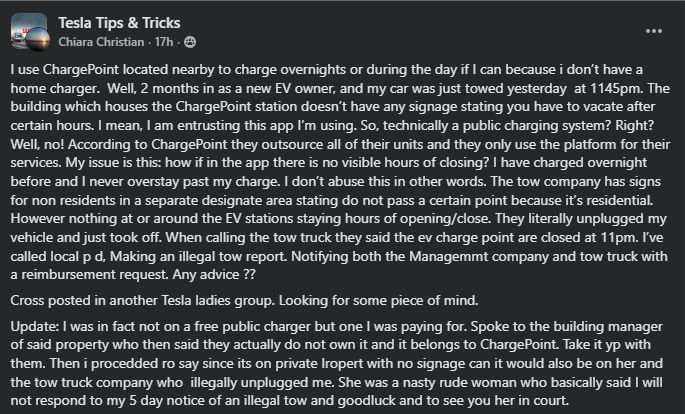
This wasn’t a case of a car left to collect dust in a forgotten lot. When another user asked, “How long was it there?” Chiara Christian, the Tesla owner, answered simply: “Four hours.” Four hours to charge, no posted hours, no warning, no violation listed. Yet at 11:45 p.m., a tow truck arrived, unplugged a paying vehicle mid-charge, and hauled it away. In the absence of clear rules, arbitrary enforcement took its place.
What unfolded next was a familiar dance of responsibility avoidance. The property manager said the chargers weren’t theirs. ChargePoint explained that they only provide the platform, not the site management. The towing company claimed they were contracted to patrol the area after 11 p.m. The result was a bureaucratic Bermuda Triangle: a car paid for a charge, received none, and ended up in impound limbo. Chiara’s experience reflects what happens when the promise of seamless electrification collides with the fragmented reality of private ownership and third-party oversight.
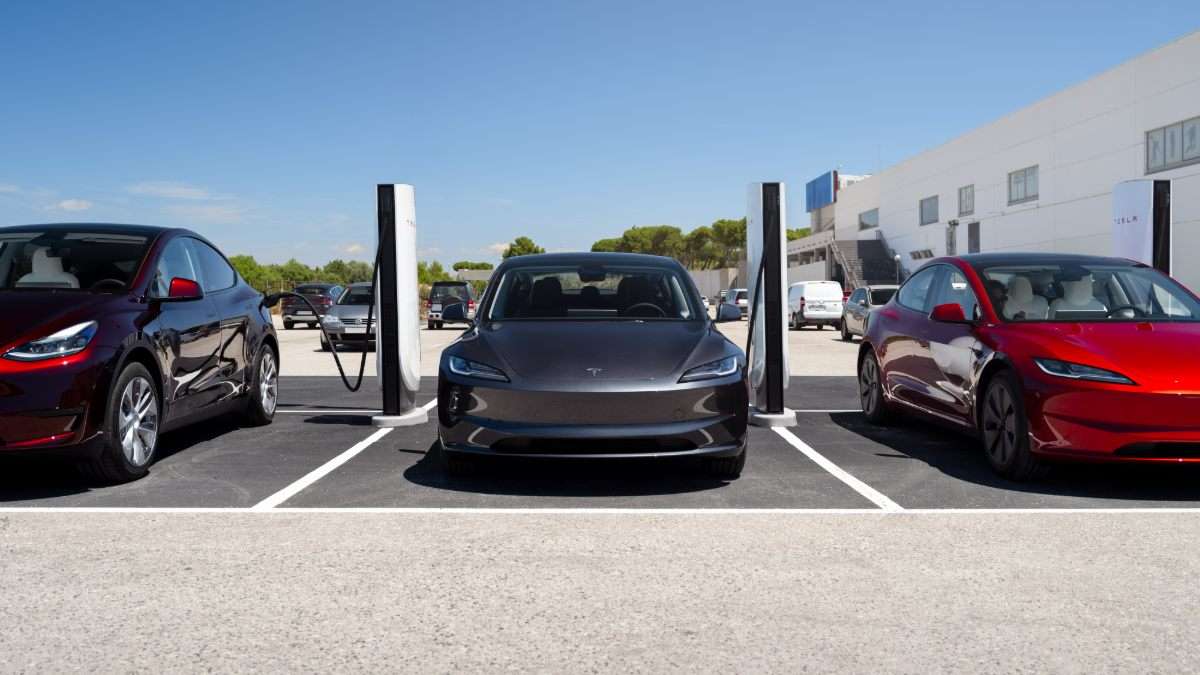
Tesla Model 3: Why It Was Made
- The Model 3 was conceived by Tesla, Inc. as the company’s “mass-market” electric sedan—meant to bring EV performance, Tesla technology, and the brand’s halo factor down into a more affordable segment.
- Globally, it became a massive success: for example, by the end of Q3 2024, cumulative Model 3 (and its sibling Model Y) sales had already exceeded 2.6 million units. In 2024, Tesla delivered about 1.704 million units of the combined Model 3/Y line.
- In the U.S., the Model 3 has held top-EV status for years: in 2019, it sold just over 300,000 globally, making it the world’s best-selling plug-in car that year.
- Beyond the brand halo and tech leadership, the Model 3 was key to Tesla’s ambition to scale production, reduce its cost-per-vehicle, create a broader customer base, and accelerate the transition to electric vehicles. It was the “entry” point to Tesla’s ecosystem (supercharging, software updates, etc.).
Commenters on her post tried to make sense of it. One suggested documenting the lack of signage for evidence, and another sympathized with her decision to pay immediately to avoid escalating fees. “Sucks, but go back to document there is no signage,” wrote Kris Chinn. “I doubt the tow company will release your car. You will have to pay and then find a lawyer or small claims court.” That’s the quiet indignity of these situations: paying to recover your own property before you can even argue your case. In a just world, a transaction that took place entirely within the terms of service wouldn’t end in a towing yard.
The American road is still as much a tangle of property rights and municipal rules as it was in his day. The difference now is that the energy source has changed, not the institutions. We’ve replaced the smell of gasoline with the hum of voltage, yet the same opaque web of management companies, contractors, and local enforcement remains ready to complicate the simplest acts of ownership.
To be clear, this isn’t a condemnation of ChargePoint, Tesla, or even the property manager. It’s a reflection of a growing pain in the EV era. Our charging infrastructure is outpacing the policy infrastructure that governs it. The stations are multiplying faster than the rules that define who can use them, when, and under what circumstances. A few words on a sign, a line in an app interface, these are simple fixes that prevent stories like Chiara’s from becoming cautionary tales shared across owner forums.
The lesson here is both modern and timeless. Technology can move us forward, but responsibility must keep pace. As the electric revolution surges ahead, the lines between public and private, between platform and property, must be drawn with clarity. Until then, even the most advanced car in the world can be undone by the simplest oversight, a missing sign, a miscommunication, or a midnight tow. The machines are getting smarter, but the system around them still has some catching up to do.
Image Sources: Tesla Media Center
Noah Washington is an automotive journalist based in Atlanta, Georgia. He enjoys covering the latest news in the automotive industry and conducting reviews on the latest cars. He has been in the automotive industry since 15 years old and has been featured in prominent automotive news sites. You can reach him on X and LinkedIn for tips and to follow his automotive coverage.
Set Torque News as Preferred Source on Google
Follow us today...