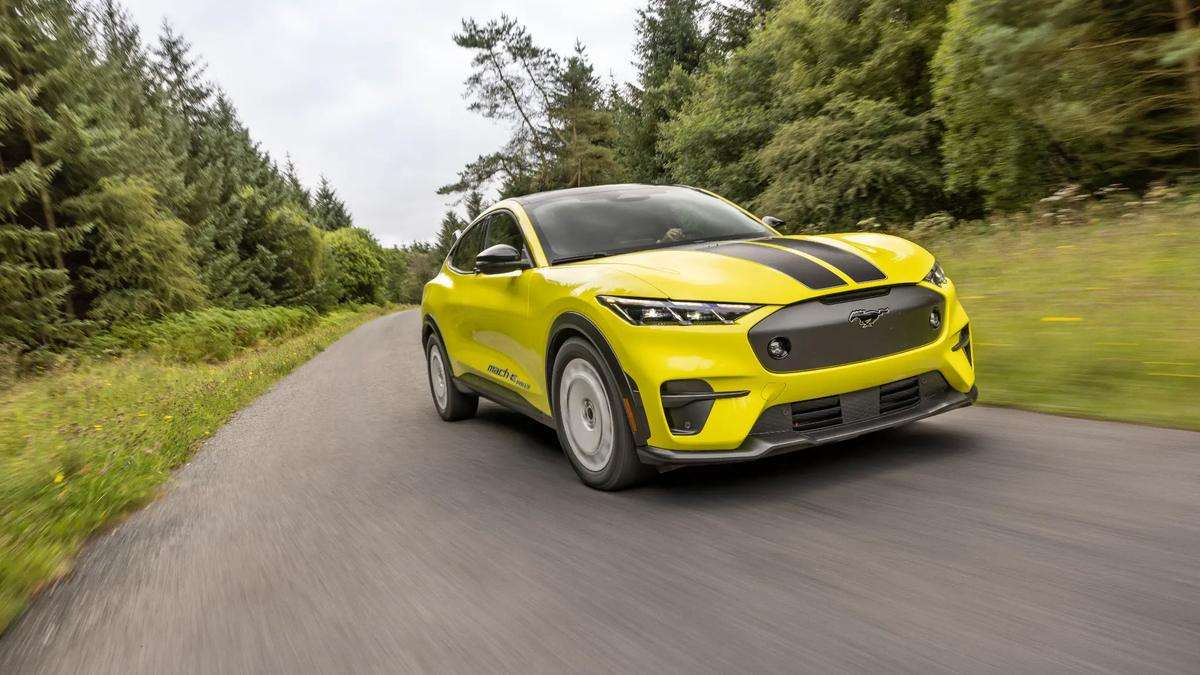

The promise of electric vehicles often hinges on reliability and longevity, yet a recent incident involving a Ford Mustang Mach-E owner has cast a stark light on potential battery degradation issues and the implications for driver safety. What began as a subtle decrease in range for Brandon Biddy's 2022 Mach-E Select RWD escalated into a frightening roadside emergency, forcing him and his family to abandon their disabled vehicle on a busy highway. This account reveals a critical area of concern for EV owners: the unpredictable nature of battery health and the manufacturer's response when it fails prematurely.
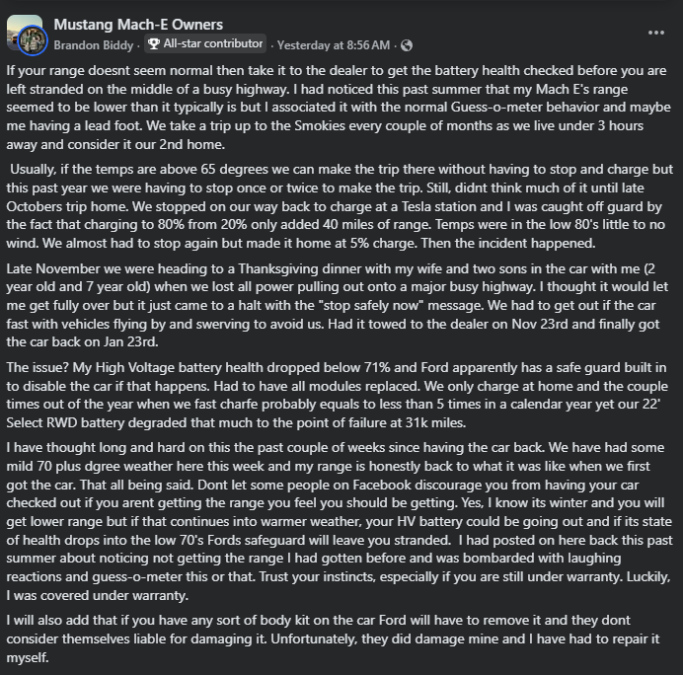
"If your range doesn't seem normal, then take it to the dealer to get the battery health checked before you are left stranded in the middle of a busy highway. I had noticed this past summer that my Mach E's range seemed to be lower than it typically is, but I associated it with the normal Guess-o-meter behavior and maybe me having a lead foot. We take a trip up to the Smokies every couple of months, as we live under 3 hours away and consider it our 2nd home.
Usually, if the temps are above 65 degrees, we can make the trip there without having to stop and charge, but this past year, we were having to stop once or twice to make the trip. Still, didnt think much of it until late October's trip home. We stopped on our way back to charge at a Tesla station, and I was caught off guard by the fact that charging to 80% from 20% only added 40 miles of range. Temps were in the low 80's, little to no wind. We almost had to stop again, but made it home at 5% charge. Then the incident happened.
Late November, we were heading to a Thanksgiving dinner with my wife and two sons in the car with me (2-year-old and 7-year-old) when we lost all power pulling out onto a major, busy highway. I thought it would let me get fully over, but it just came to a halt with the "stop safely now" message. We had to get out of the car fast, with vehicles flying by and swerving to avoid us. Had it towed to the dealer on Nov 23rd and finally got the car back on Jan 23rd.
The issue? My high-voltage battery health dropped below 71%, and Ford apparently has a safeguard built in to disable the car if that happens. Had to have all modules replaced. We only charge at home, and the couple of times out of the year when we fast charge probably equals less than 5 times in a calendar year, yet our 22' Select RWD battery degraded that much to the point of failure at 31k miles.
I have thought long and hard on this the past couple of weeks since having the car back. We have had some mild 70 plus dgree weather here this week, and my range is honestly back to what it was like when we first got the car. That all being said. Don't let some people on Facebook discourage you from having your car checked out if you aren't getting the range you feel you should be getting. Yes, I know it's winter, and you will get a lower range, but if that continues into warmer weather, your HV battery could be going out, and if its state of health drops into the low 70's, safeguard will leave you stranded. I had posted on here back this past summer about noticing not getting the range I had gotten before, and was bombarded with laughing reactions and guess-o-meter this or that. Trust your instincts, especially if you are still under warranty. Thankfully, I was covered under warranty.
I will also add that if you have any sort of body kit on the car, Ford will have to remove it, and they don't consider themselves liable for damaging it. Sadly, they did damage mine, and I have had to repair it myself."
The owner's experience shows a critical flaw in the current EV ecosystem: the lack of transparent, user-accessible battery health diagnostics. While modern internal combustion engines provide a plethora of data through OBD-II ports, EV owners are often left guessing about the health of their most expensive component. This information asymmetry puts consumers at a distinct disadvantage, forcing them to rely on dealer visits for vital data that should be readily available.
Watch Brandon's story and Torque News Editor-in-Chief Armen Hareyan's take on it at the Torque News Youtube Channel.
Ford Mustang Mach-E: Understanding Battery Health and Longevity
- The Ford Mustang Mach-E, introduced for the 2021 model year, is a key electric crossover in Ford's expanding EV lineup. It offers various battery sizes and drivetrain configurations, aiming to blend performance with practicality.
- Battery degradation is a natural process for all lithium-ion batteries, but severe drops in health, especially at low mileage, can indicate manufacturing defects or design issues. Ford provides an 8-year/100,000-mile warranty for its EV batteries, covering significant capacity loss.
- The "Guess-o-meter" refers to the estimated range displayed in an EV, which can fluctuate significantly based on driving style, ambient temperature, and terrain. This variability often leads to confusion and range anxiety among owners.
- High-voltage battery health below 71% triggering a vehicle disablement points to a critical safety protocol designed to protect the battery and occupants. However, the abrupt nature of this shutdown without sufficient prior warning raises questions about its implementation and user notification.
One commenter, Jonah DeWaters, offered a potential workaround for this diagnostic gap:
"For anyone that’s curious and doesn’t want to go to the dealer for this, you can get a obd2 monitor on Amazon for around $20 and use an app on your phone (also CarPlay compatible so info displays on the infotainment screen) that shows your HV battery state of charge, 12v battery health and a ton of other stuff. Bonus is you can use it in other cars too."
This suggestion is a testament to the ingenuity of the enthusiast community, but it also exposes a glaring oversight by manufacturers. Why should an owner have to resort to aftermarket solutions to monitor the health of a vehicle's core component?
Ford, and indeed all EV manufacturers, should be integrating robust, user-friendly battery health monitoring directly into their infotainment systems, not hiding it behind proprietary dealer tools. The notion that an owner needs to purchase a third-party dongle to avoid being stranded is an indictment of the industry's current approach to consumer transparency and vehicle diagnostics.
Another commenter, Ozzy Arty, voiced a common sentiment among new EV buyers:
"I find this very concerning that the HV battery degraded to the point of needing replacement with so little mileage. I just picked up a 2025 GT, so now I’m like. Not to mention it took two months to fix your car."
Ozzy's concern is entirely valid, reflecting the anxiety many new EV owners feel about battery longevity and potential repair timelines. A high-voltage battery degrading to 71% health at just 31,000 miles, especially when primarily home-charged, is simply unacceptable for a modern vehicle. This level of degradation suggests either a manufacturing defect in the specific battery pack or, more troublingly, an inherent design flaw that could plague a wider range of Mach-E vehicles. The two-month repair period further compounds the issue, demonstrating a supply chain and service infrastructure that is clearly not yet ready for prime time.
Joel DeCaro provided a more technical perspective on battery health:
Advertising
"When the % drops suddenly from 17% to 0, it is telling you the cell groups are not balanced(equalized). Should always charge the AC to 100%+ before a trip where you will rely on DCFC, especially with LFP. Taking it down below 5% causes more imbalance. Sitting for long periods can cause an imbalance. Equalization is occasionally needed to get full capacity from any stack of cells, even lead acid."
While Joel's insights into cell balancing are technically sound and crucial for maximizing battery life, they also show the increasing complexity of EV ownership. The average consumer expects their vehicle to operate reliably without needing a deep understanding of battery chemistry or charging protocols. Ford's "safeguard," disabling the vehicle when battery health drops below 71%, is a blunt instrument for a nuanced problem. Instead of simply shutting down the car, the system should be designed to provide ample warning, allow for graceful degradation, and perhaps even initiate an automatic cell balancing routine to mitigate the issue before it becomes a hazard.
The Mach-E owner's experience with a damaged body kit during the repair process further illustrates the disconnect between manufacturer responsibility and customer care. Expecting a customer to bear the cost and effort of repairing damage incurred during a warranty repair is a corporate policy that borders on negligence. It erodes trust and signals a lack of accountability, which is a dangerous precedent for any automaker, especially one trying to establish itself in the competitive EV market.
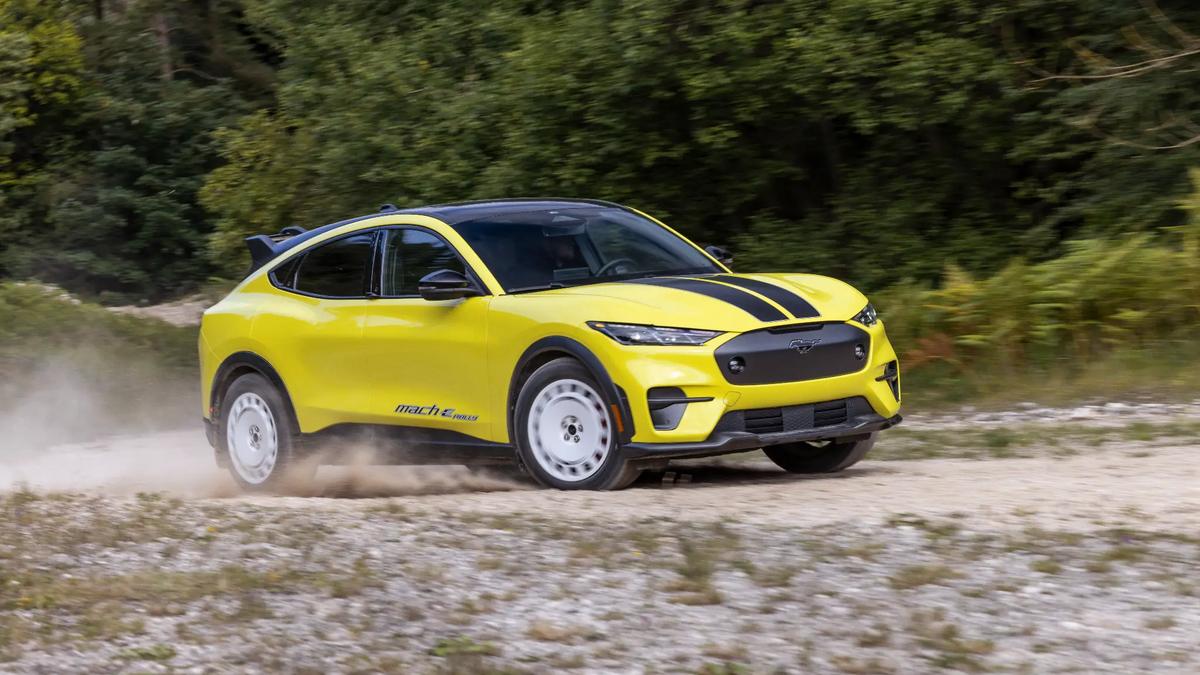
The Mach-E incident serves as a potent reminder that the transition to electric vehicles is not merely about powertrain replacement; it's about re-evaluating every aspect of vehicle ownership, from diagnostics and maintenance to repair logistics and customer support. For Ford, this particular episode should be a wake-up call. The Mach-E is a critical product in their electrification strategy, and experiences like this, where a relatively new vehicle fails dramatically and requires extensive, inconvenient repairs, can severely undermine consumer confidence. The industry must move beyond simply selling EVs and focus on delivering a truly robust, transparent, and supportive ownership experience that matches the technological leap these vehicles represent.
Recent News
This pattern of unexpected battery behavior shows a broader industry challenge in ensuring consistent EV performance and owner confidence.
While some manufacturers are focusing on enhancing the charging experience, as seen with Tesla's software update 2026.2.3 rolling out this month, which introduces features like expanded 3D Supercharger site maps and a new unlatching charge cable function.
Usability improvements, while beneficial, do not directly address the fundamental reliability concerns raised by incidents like the Mach-E's premature battery failure, revealing a divergence in industry priorities between user convenience and core component longevity.
The expansion of Tesla's Megacharger network, with over 60 sites planned and two live by February 10, 2026, for the Semi, further points to infrastructure development while the consumer EV segment still grapples with basic battery integrity.
Image Sources: Ford Media Center
Noah Washington is an automotive journalist based in Atlanta, Georgia. He enjoys covering the latest news in the automotive industry and conducting reviews on the latest cars. He has been in the automotive industry since 15 years old and has been featured in prominent automotive news sites. You can reach him on X and LinkedIn for tips and to follow his automotive coverage.
Set Torque News as Preferred Source on Google
Follow us today...