
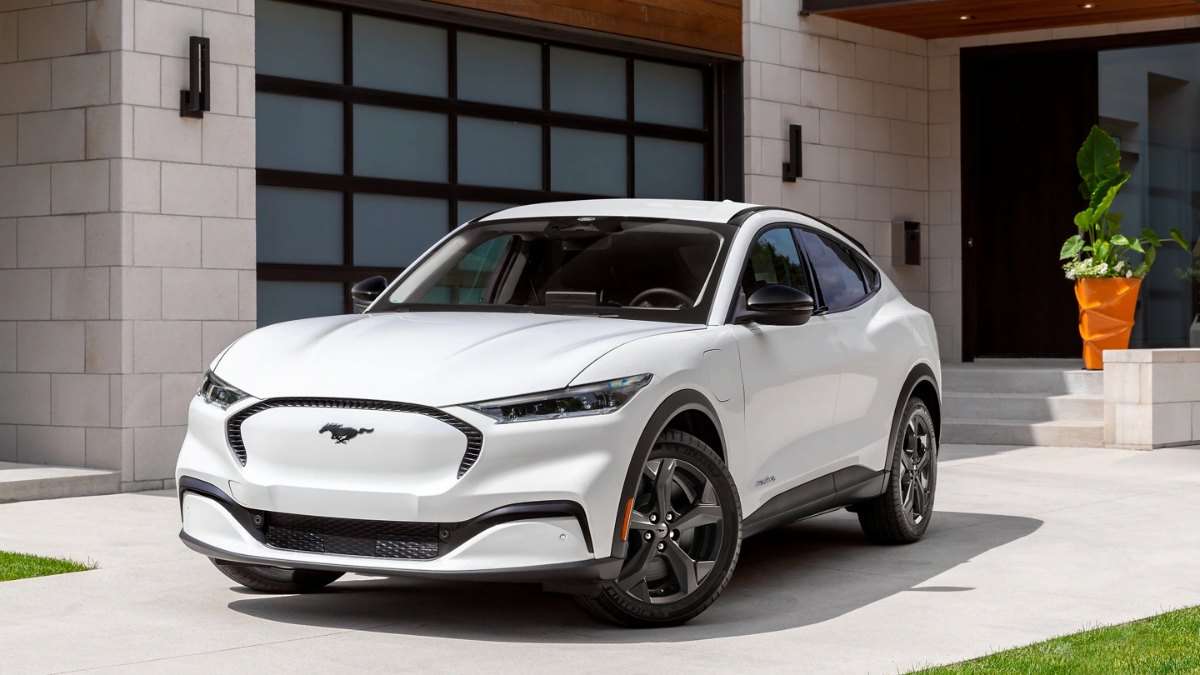

A $30,000 repair estimate has a way of stopping any owner cold, especially when it arrives attached to a vehicle barely broken in. That is the situation one 2023 Mustang Mach-E owner says he is facing after what he describes as a minor road hazard led to total coolant loss, a disabled vehicle, and a 180-mile tow across Northern California.
The post, shared in a Mustang Mach-E owners group, has quickly become a flashpoint for a larger debate about EV durability, underbody protection, and where design responsibility ends and insurance begins.
According to the owner, the incident began with what appeared to be a small rock strike. The damage was entirely underneath the car, leaving a gash in the underlayment that allowed coolant to escape. Shortly afterward, the Mach-E displayed a “park safely now” warning and shut down completely in the owner’s driveway. With no ability to limp the car to a nearby service center, the vehicle was towed roughly 180 miles from Tahoe to Walnut Creek, an inconvenience that already stretches patience before a repair estimate ever enters the picture.
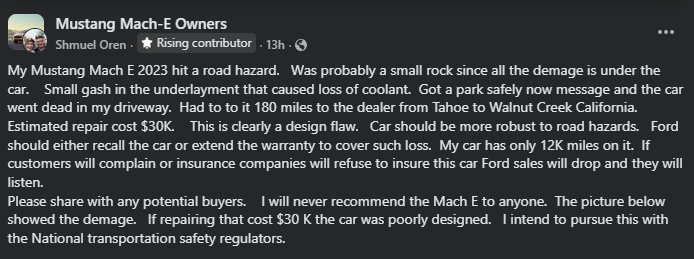
“My Mustang Mach E 2023 hit a road hazard. Was probably a small rock since all the damage is under the car. Small gash in the underlayment that caused a loss of coolant. Got a park safely now message, and the car went dead in my driveway. Had to go 180 miles to the dealer from Tahoe to Walnut Creek, California.
The estimated repair cost is $30K. This is clearly a design flaw. The car should be more robust to road hazards. Ford should either recall the car or extend the warranty to cover such a loss. My car has only 12K miles on it. If customers complain or insurance companies refuse to insure this car, Ford sales will drop, and they will listen.
Please share with any potential buyers. I will never recommend the Mach E to anyone. The picture below shows the damage. If repairing that cost $30 K, the car was poorly designed. I intend to pursue this with the National Transportation Safety Regulators.”
The estimate did enter the picture, and it landed hard. Roughly $30,000 to repair a car with just 12,000 miles. At that point, frustration turned into accusation. The owner called the situation a design flaw, arguing that a modern vehicle, especially one marketed for everyday use, should be robust enough to withstand common road debris without suffering catastrophic damage. In his view, either the car should be redesigned, recalled, or covered under an extended warranty to account for this type of failure.
Ford Mustang Mach-E: Interior Design & More
- The Mach-E’s crossover proportions allow for a higher seating position and improved cargo access compared with traditional coupes, broadening its everyday usability.
- Electric torque provides immediate acceleration, though drive modes significantly alter throttle sensitivity and steering weight, changing how the vehicle feels in routine driving.
- The cabin relies heavily on a large central touchscreen, streamlining the dashboard while increasing dependence on software menus for basic adjustments.
- Chassis tuning balances comfort with control, delivering a settled highway ride while revealing firmness over sharp impacts and uneven pavement.
That framing immediately drew pushback from other owners. Several pointed out that warranty coverage has never applied to impact damage, regardless of drivetrain. A punctured oil pan on an internal combustion vehicle would not be covered either. This, they argued, is precisely why comprehensive insurance exists. From that perspective, the Mach-E is not uniquely flawed, but rather subject to the same rules that have governed cars for decades.
Others questioned the characterization of the incident itself. One commenter noted visible dents and a puncture significant enough to penetrate metal, suggesting the impact may have been more severe than a “small rock.” Another cut straight to the practical outcome, suggesting the owner involve insurance and consider totaling the vehicle if the battery pack itself was compromised. At that level of damage, the financial logic often overtakes the emotional one.
Still, the underlying concern resonates. EVs package expensive, mission-critical components low in the chassis. Coolant lines, battery enclosures, and thermal management systems live closer to the road than fuel tanks and exhaust systems once did. When those systems are breached, the consequences escalate quickly. A leak that would be inconvenient in a gas car can be existential in an EV, triggering shutdown protocols designed to protect high-voltage components at all costs.
This is where the debate becomes less about blame and more about expectations. The Mach-E owner argues that if an EV can be immobilized and economically crippled by road debris common to public highways, then the design margin is too thin. Critics counter that no vehicle can be designed to shrug off every impact without unacceptable weight, cost, or efficiency penalties. Somewhere between those positions lies the uncomfortable reality of modern automotive engineering.
There is also the matter of optics. A $30,000 estimate on a relatively new vehicle is the kind of number that travels far beyond a single Facebook group. Whether or not insurance ultimately absorbs the cost, stories like this shape perception. They influence potential buyers who may not distinguish between warranty exclusions, insurance coverage, and engineering tradeoffs. To them, it simply looks like fragility.
The owner has stated an intention to pursue the matter with national transportation safety regulators and to warn potential buyers. Whether that effort gains traction remains to be seen. Regulatory action typically follows patterns, not isolated cases, and manufacturers tend to respond only when failures show consistency across a fleet.
What this episode undeniably highlights is the evolving nature of automotive risk. EVs trade mechanical complexity for electrical and thermal complexity. They are quieter, simpler in some respects, but less forgiving in others. When something goes wrong underneath, it can go very wrong very quickly.
For current and prospective Mach-E owners, the takeaway is not necessarily fear, but clarity. Understand what your warranty covers. Understand what your insurance covers. And understand that the economics of EV repair are still catching up to the realities of mass adoption. A small impact may still be a big problem, not because the car is uniquely defective, but because the stakes under the floor are higher than they used to be.
Image Sources: Ford Media Center
Noah Washington is an automotive journalist based in Atlanta, Georgia. He enjoys covering the latest news in the automotive industry and conducting reviews on the latest cars. He has been in the automotive industry since 15 years old and has been featured in prominent automotive news sites. You can reach him on X and LinkedIn for tips and to follow his automotive coverage.
Set Torque News as Preferred Source on Google
Follow us today...



Comments
That's a total bummer...and…
Permalink
That's a total bummer...and it's not even a real Mustang!
Son hit something and…
Permalink
In reply to That's a total bummer...and… by Buzz Wired (not verified)
Son hit something and punched a hole in the oil pan of one of our cars. Lost all oil - idiot light went on - he pulled over and stopped. Car towed to our house. R&R'ed the pan. Never blamed the manufacturer.
People need to learn from…
Permalink
In reply to That's a total bummer...and… by Buzz Wired (not verified)
People need to learn from their mistakes.... Do not buy EV. Period.
If a rock chip can cause a…
Permalink
In reply to That's a total bummer...and… by Buzz Wired (not verified)
If a rock chip can cause a 30k damage on a vehicle, that vehicle is not worth buying.
That's on him for buying an…
Permalink
In reply to That's a total bummer...and… by Buzz Wired (not verified)
That's on him for buying an EV and having in an area where EV's shouldn't be. A non electric car or a hybrid would of been a better choice for him. Cant expect a vehicle built for the city to perform well in the mountains with road hazards that come with being up there.
If Ford refuses to take care…
Permalink
In reply to That's a total bummer...and… by Buzz Wired (not verified)
If Ford refuses to take care of this, then they prove why EVs are not economical or ready for prime time. It doesn't matter how well you know your warranty and insurance. This is covered by neither. I hope this severely hurts Ford financially so that they learn a lesson and design the car to be durable.
Hmmm... Made by Ford, check…
Permalink
In reply to That's a total bummer...and… by Buzz Wired (not verified)
Hmmm...
Made by Ford, check.
Named a mustang, check.
So what exactly about it is not a "real" mustang?
Oh, right. One of those special types I that it. Can't be the same because it's different than what YOU expect it to be. Regardless of the originator making it and calling it that, in your (rather empty) head it is not what it is. Okay guy, you stay right where you are. We don't need you to continue to progress towards a better tomorrow. Cavemen should remain in the past to be forever forgotten.....................
The issue isn't fear...nor …
Permalink
In reply to That's a total bummer...and… by Buzz Wired (not verified)
The issue isn't fear...nor 'clarity' as the author postulates. It's caution. I'd like to know where in Tahoe this owner was driving? A paved road, gravel or dirt? What speed? EV or ICE, you need to know what your vehicle's limits are. It's good to know details before making a purchase... especially when it's a new, very expensive technology.
The big takeaway for me is…
Permalink
In reply to That's a total bummer...and… by Buzz Wired (not verified)
The big takeaway for me is that a $40-$50,000 car has a $30,000 repair bill for a single puncture? The cost seems very excessive in comparison to the vehicle itself.
For an Suv that implies…
Permalink
In reply to That's a total bummer...and… by Buzz Wired (not verified)
For an Suv that implies offroad capability, that's awfully delicate! Ford needs to redesign and harden that underbody. Thay should fix his car and warn other owners.
That's awfully delicate for…
Permalink
In reply to That's a total bummer...and… by Buzz Wired (not verified)
That's awfully delicate for a vehicle that implies at least some off road capability. Ford needs to redesign and harden that system and underbelly. They should fix his car and warn other owners!
how can that’s gay looking…
Permalink
In reply to That's a total bummer...and… by Buzz Wired (not verified)
how can that’s gay looking piece of ev shit be called a mustang in the first place ? Broke back mountain mustang ??
⛔The manufacturer can't walk…
Permalink
In reply to That's a total bummer...and… by Buzz Wired (not verified)
⛔The manufacturer can't walk away from core responsibility to build a vehicle that can withstand damage of normal wear & tear that being open to interpretation. In THIS case it could fall on either side depending on severity & would need opinions from 2 engineers to determine. Seems to me "beyond minimum" damage has occured in impact area thereby
exempting manufacturer. Recourse through insurance only option. If independently examined & found minimum damage then manufacturer should liable. Best of luck whichever SupershopperNz/ROD🇦🇺
Where the hell is the…
Permalink
In reply to That's a total bummer...and… by Buzz Wired (not verified)
Where the hell is the picture of the damage mentioned in the article?
Super-poor Ford-engineering…
Permalink
Super-poor Ford-engineering design to have a damage-prone cooling system which should have otherwise been completely obviated as a necessary support system when on an ELECTRIC VEHICLE! Are you listening, Ford.
? This, combined with your disastrous F-150 Lightening, and it's clear that Ford still doesn't 'get it', having been asleep at the engineering and design switch. What a colossal joke Ford has been.
For an automotive writer…
Permalink
For an automotive writer that has been in the automotive industry since he was 15, there is far more missing from this story than what is included. How many other Mach E's have had similar issues. I suspect small stones hit the underside of every car on the road daily with no issues, including thousands of Mac E's yet the writer failed to mention even one other case. An impact to the underside of any car could easily puncture an oil pan, a brake line, a fuel tank or many other components that could also cause catastrophic damage if the impact was great enough. There was no photograph of the damage so we really have no idea how extensive it was. Did the author think of talking to the insurance company or an insurance adjuster to get the real story of the kind of damage or the cause of the damage. The owner sounds more like a teenager making excuses for damaging their parents car than a victim of an EV deficiency. The warning here shouldn't be about the fragility of EVs, but poor driving and not paying attention to large hazards in the road way. If the driver had hit a tree as opposed to a large road hazard would they want that covered under the warranty also? This is a non-story that calls into question the honesty of the driver and the ability of the author more than it calls in the reliability of EVs. And this is from someone that doesn't own an EV, has no desire to own an EV and refuses to refer to the Mach E as a Mustang. So if you couldn't convince me that this is an EV issue you can't convince anyone.
IDK...it seems to me that…
Permalink
IDK...it seems to me that much of the article is trying to make excuses. I'm no advocate of EVs. EVs should *never* be bought by owners that live that far away from qualified logistical-support facilities, just because of the vulnerability. That said, I do find it curious how a Ford suffers such a disabling failure, while Teslas have not to my knowledge...unless somebody knows something I don't.
I certainly don't abide what I inferred as trivial condescension of F-F cars and their durability. Texas, where I live, is not exactly known for perfect roads. Yet both my cars (incidentally, both F-F Ford products) have sustained those roads and all their hazards with hardly any such disabling or catastrophic consequences. And it's not because I barely drive; quite the contrary. Certain reasonable expectations for vehicle durability must be upheld, profit or lack thereof be damned.
What kind of damage, would…
Permalink
What kind of damage, would cost that much? Replacing the battery would not even cost that much.
Umm. Sorry. I have a mach…
Permalink
Umm. Sorry. I have a mach e. Coolant loss really? The bottom houses the battery. What coolant? Engine ? Fabricated. Small rock? Lmao. You did something to your car. It has no coolant. Nice story.
Actually EVs have coolant,…
Permalink
In reply to Umm. Sorry. I have a mach… by John (not verified)
Actually EVs have coolant, the original Nissan leaf didn't and that's why they had the issues with battery degradation they had. Air cooling isn't sufficient.
Someone actually bought…
Permalink
Someone actually bought something with mustang banging that doesn't even have an engine, and looks like a cheap pos mid-size suv, and then expects sympathy when karma bites him in the behind?
Hahahahahaha
If you buy these for…
Permalink
If you buy these for ecological reasons you are misinformed. The production and disposal at the end of service far outweigh any benefits.
You are very misinformed…
Permalink
In reply to If you buy these for… by Charles Lombardo (not verified)
You are very misinformed. Stop getting your news off Facebook. Even with manufacturing of the battery EVs are several fold ecologically superior to ice vehicles.
Also at end of life that battery can be reused for grid storage. And then after years it can be recycled at over 95% efficiency reclaiming the minerals.
EVs are the much better choice for environmental concerns. Too bad he chose ford though
This seems like an insurance…
Permalink
This seems like an insurance claim to me. What did he hit? I imagine it was more than a rock. If it is from a "small rock" (which I sorta doubt) this kind of flaw could cause insurance rates to increase and necessitate Ford to redesign.
Ford = Found On Road Dead,…
Permalink
Ford = Found On Road Dead, Fix Or Repair Daily.
Very well written article…
Permalink
Very well written article and there's no way I'm going to purchase this vehicle now.
A picture would have been…
Permalink
A picture would have been nice. Was it caused by a small rock or did he hit something bigger? And what is the dealer doing to charge 30k for the repair? That sounds like a complete battery and coolant system change out to me. Did the safety systems not protect the battery? We need more info.
The author of this post…
Permalink
The author of this post obviously doesn't like this vehicle. The guy who hit this "small rock" must of hit a cinder block in the road or something from the look of the picture. The driver needs to go through his insurance to make a claim as this was definitely not a defect in the vehicle. It also wasn't just a coolant line it was the battery case punctured all the way to the point coolant is leaking 🤦🏻🤦🏻🤦🏻. Author needs to learn more before posting crap or he hates the vehicle.
His mustang hit a road…
Permalink
His mustang hit a road hazard??? Obviously the owner should not have allowed his Mustang to go on a road trip on its' own without him supervising where and how it drove itself!! Clearly this guy drove over something he shouldn't have and he is in denial that he caused the damage.
Any impact requires an…
Permalink
Any impact requires an immediate stop of the vehicle as soon as it's safe and full inspection to determine the damage and potential consequences. If there's any question at all the vehicle must be put out of service until the issue is resolved.
I do fault the owner for not doing that - it could have saved a lot of money on the repair bill. A little foresight goes a long way in life.