


The modern electric pickup has a way of dragging private math into public view. When an owner posts screenshots of an electric bill alongside a new Ford F-150 Lightning, the conversation quickly expands beyond trucks and into the murky realities of energy pricing, climate, and household habits. What looks at first glance like a simple question about charging costs becomes something more revealing: a snapshot of how electrification actually intersects with daily life, not in theory, but on a monthly statement.
In this case, a Lightning owner from Michigan shared two utility bills that tell a striking story. One month totaled roughly $47 in electric charges. A later bill climbed to more than $330. On its face, that delta is dramatic enough to trigger alarm bells, especially when paired with the arrival of a large electric truck in the driveway. The post, however, comes with an important qualifier. The owner also added a hot tub around the same time and lives in a cold climate where winter punishes both batteries and heaters with equal enthusiasm.
“So this is a smidge misleading because I also got a Hot tub around the same time as my lightning. But I can say that I charge it roughly 20% each day and run the hot tub constantly. (It gets cold up here in MI)
So let’s say I charge 27 kWh a day. With these bills, I show roughly .20 per kWh, which is high, isn’t it? So maybe $5.50 a day for charging. I drive about 25 miles a day on average, so I’m sure the cold weather is a huge factor in power consumption.
I don’t think this is a question, more of a psa to see how much it can cost if you’re curious.
Or if a question is necessary, how much have your electricity bills changed?
Advertising
It still seems cheaper than paying for gas/all that other maintenance.”
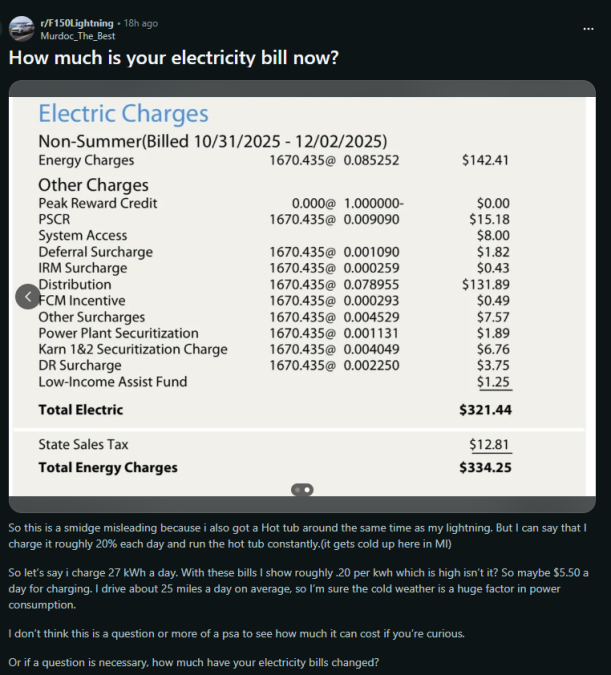
The owner’s own math is refreshingly straightforward. Charging roughly 20 percent per day works out to about 27 kilowatt-hours daily. At an estimated twenty cents per kilowatt-hour, that lands around $5.50 per day for charging. With an average of 25 miles driven per day, the numbers do not suggest runaway costs so much as the predictable physics of cold weather, heavy vehicles, and resistive heating. The post is framed less as a complaint and more as a public service announcement, a reality check for those expecting miracles.
Ford F-150 Lightning: Electric Drivetrain, Enhanced Utility, and Ride Quality
- The Lightning preserves the conventional F-150 layout and proportions, helping it feel familiar to pickup owners while integrating an electric drivetrain beneath a largely unchanged exterior.
- Electric torque delivery supports strong low-speed pulling and smooth acceleration, though overall efficiency varies noticeably with load, speed, and ambient conditions.
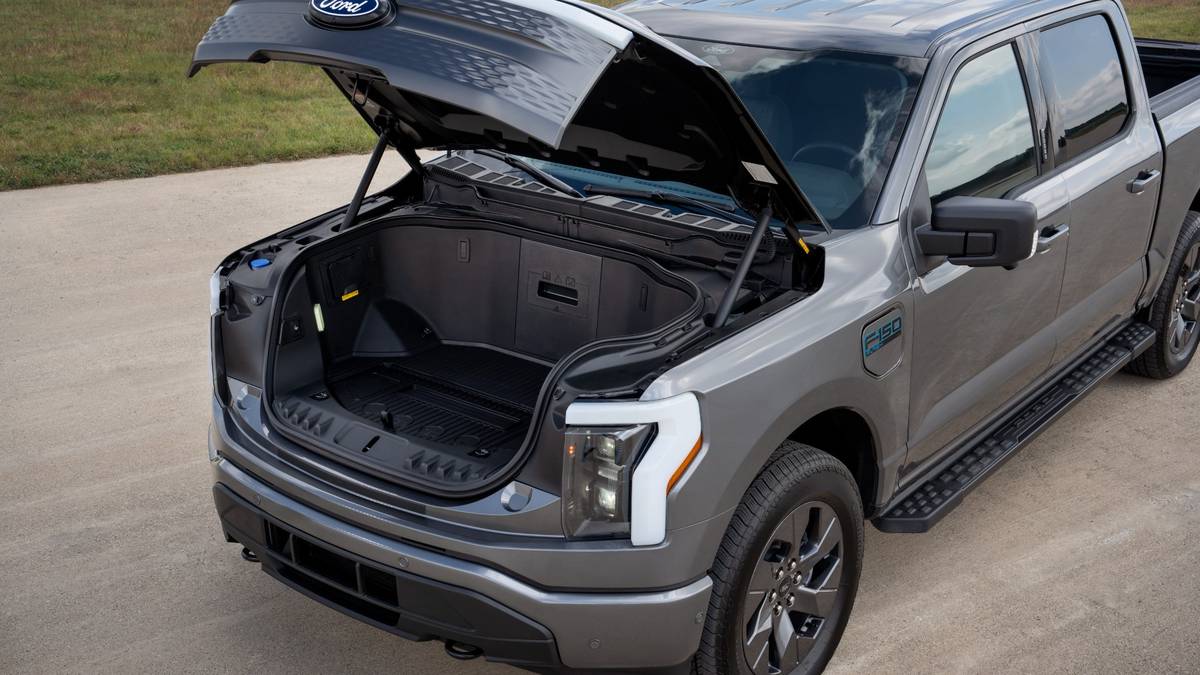
- The front trunk adds enclosed storage and doubles as a functional workspace, reinforcing the truck’s emphasis on utility beyond traditional bed use.
- Ride quality benefits from the absence of a combustion engine, reducing vibration and noise, though the vehicle’s mass remains apparent over uneven surfaces.
The comments quickly add needed context. One Lightning owner reports paying about eight cents per kilowatt-hour on a dedicated off-peak EV meter and spending roughly $80 a month while driving 3,000 miles. That contrast alone explains more than any debate ever could. Electricity pricing is intensely local. Rate structures, time-of-use plans, and utility incentives matter as much as the vehicle itself. Two identical trucks can live wildly different financial lives depending on where they are plugged in.
Then there is the hot tub, the quiet co-star in this drama. Multiple commenters point out that hot tubs are notoriously inefficient, especially in cold climates where heat loss is relentless. One former owner notes that their electric bill dropped “like a brick” after getting rid of theirs. Another urges the original poster to meter the hot tub separately before drawing conclusions about the truck. This is not deflection. It is basic load analysis, the kind that rarely shows up in glossy EV marketing but dominates real-world ownership.
Solar owners, predictably, enter the conversation with a different kind of silence. When your roof is doing the work, the math changes so radically that comparisons almost feel unfair. Paying an electric bill only a few months a year is not an argument against EVs or for them. It is simply another reminder that infrastructure shapes outcomes as much as technology does.
What emerges from the thread is not a condemnation of the electric pickup, nor a universal endorsement. It is a lesson in systems thinking. An EV does not exist in isolation. It is part of a household energy ecosystem that includes climate, insulation, appliances, rate plans, and driving patterns. Blaming or praising the vehicle alone misses the point entirely.
In that sense, the Lightning owner’s post succeeds precisely because it resists easy conclusions. Yes, electricity can be expensive. Yes, winter hurts efficiency. Yes, adding a high-draw luxury appliance will move the needle far more than most daily commutes. And still, even with those caveats, the owner notes that charging remains cheaper than gasoline and routine maintenance. That quiet observation may be the most important data point of all.
The transition to electric vehicles was never going to be tidy. It was always going to involve spreadsheets, screenshots, and uncomfortable realizations about how much energy we already consume. Threads like this do not undermine the case for EVs. They strengthen it by replacing slogans with numbers and by reminding prospective owners that understanding your electric bill may be just as important as choosing the truck itself.
Image Sources: Ford Media Center
Noah Washington is an automotive journalist based in Atlanta, Georgia. He enjoys covering the latest news in the automotive industry and conducting reviews on the latest cars. He has been in the automotive industry since 15 years old and has been featured in prominent automotive news sites. You can reach him on X and LinkedIn for tips and to follow his automotive coverage.
Set Torque News as Preferred Source on Google
Follow us today...







Comments
It's OK. Ford axed the…
Permalink
It's OK. Ford axed the Lightning. Turns out no one wanted an electric truck. What can we do, right?
Did the owner think charging…
Permalink
In reply to It's OK. Ford axed the… by The bloke knows EVs (not verified)
Did the owner think charging was free?
The chatter around the this…
Permalink
The chatter around the this so-called "winter charging bill" highlights the total failure of the democratisation of media: it doesn't inform, it just fuels ignorance & debate. Here's some real information:
* my F-150 Lighting Flash's daily average usage in September was 16.993 kWh (excluding days when I made long drives; that is, the day's usage <=15 kWh – 13 days in Sep)
* daily average usage so far in December is 29.292 kWh (excluding days when I made long drives; that is, the day’s usage <=50 kWh – 24 days in Dec)
So, the difference I see (as directly measured by my ChargePoint charger) is 12.300 kWh; which is the energy attributable to the cold weather (battery conditioning and cabin heating) I pay $0.183 / kWh; which means the additional cost is $2.26 / day; which is a material cost, but not overwhelming.
Note: here in Moose Jaw, SK, where I live, the average temperature in Sep was 16C and for Dec (as of 30 Dec) it’s -13C.
Maybe I missed something…
Permalink
Maybe I missed something...How can $5.50/day for 25 miles driven be cheaper than gas in Michigan? I live in S.E. Michigan and my Ford Bronco Sport Badlands edition with 2.0L EcoBoost engine gets a consistent 25mpg. Gas has ranged from $2.29 to $3.09 per gallon for the past handful of months in the area. I am at the low end of that price range. I'm paying about half of what he is for 25 miles of use.