
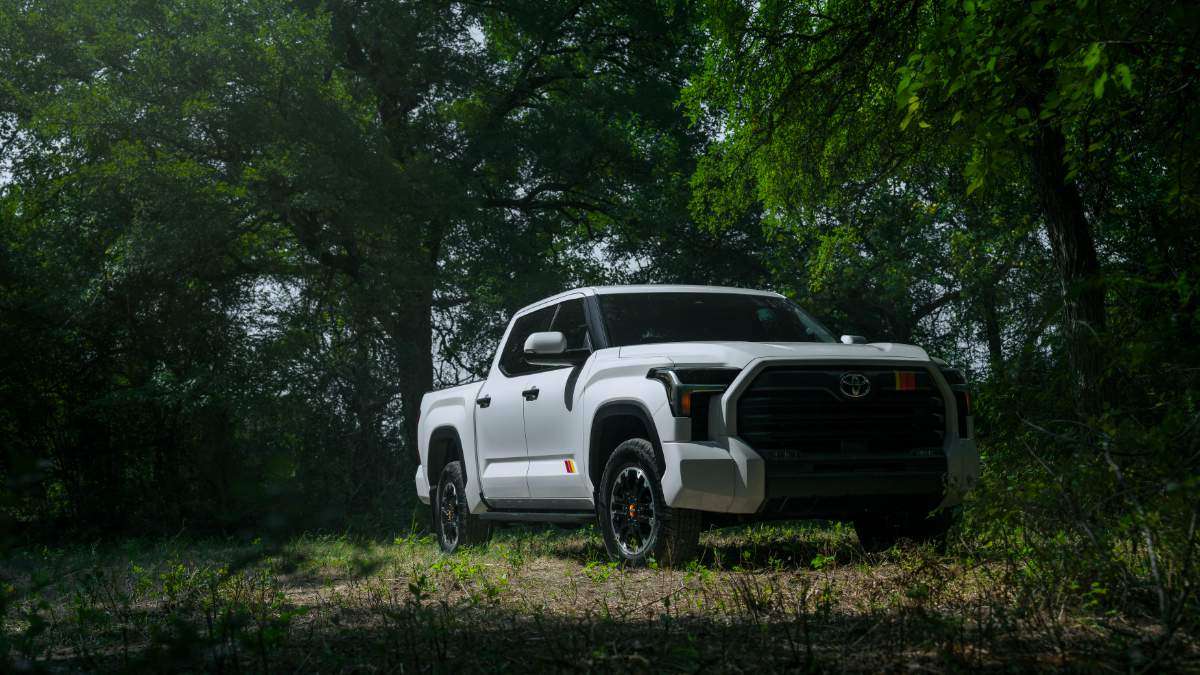

Reputations in the truck world are earned through decades of unshakable performance, but they can become vulnerable when layers of modern electronics begin to complicate once straightforward machinery. The current Toyota Tundra generation has encountered its share of difficult moments in the past two years, including recalls involving fuel systems, bed structures, and wiring concerns. Nothing on its own rises to the level of a crisis, yet together these issues create an atmosphere that leaves owners alert for the next warning light.
It is within this atmosphere that one Tundra Platinum Hybrid owner found himself thrust into a far more complicated situation than any new vehicle should deliver.
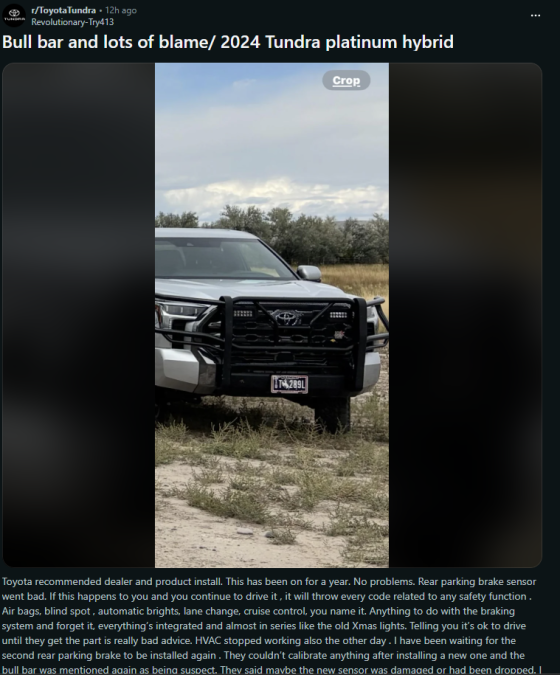
His account, shared on r/ToyotaTundra, captures the moment where confidence gave way to disbelief:
“Toyota recommended dealer and product install. This has been on for a year. No problems. The rear parking brake sensor went bad. If this happens to you and you continue to drive it, it will throw every code related to any safety function. Airbags, blind spot, automatic brights, lane change, cruise control, you name it. Anything to do with the braking system and forget it, everything’s integrated and almost in series like the old Xmas lights. Telling you it’s ok to drive until they get the part is really bad advice. HVAC stopped working, also the other day. I have been waiting for the second rear parking brake to be installed again. They couldn’t calibrate anything after installing a new one, and the bull bar was mentioned again as being suspect. They said maybe the new sensor was damaged or had been dropped. I had the radiator grill louver go bad months ago, which lets a certain amount of air pass over your radiator to maintain coolant temp, which Toyota says improves gas mileage. They mentioned the bull bar as being suspect again with that. Needless to say, I’m tired of the accusations. If Toyota is selling a massive truck that you can’t put a bull bar on, they need to inform the public. Right now it’s on the road, and I had my girlfriend get it to a different dealer in California. I live in Wyoming, where you NEED a bull bar to protect your investment and your effing life. As of yesterday, they said the cruise control speed sensor is bad in the front bumper, and they are going to have to charge $300 to take off the bull bar to get to the sensor. They said it may have to stay off. There is nothing wrong with that sensor in the front bumper, guys. I’m an electrician. I know the process of elimination, and they are way off track. I don’t have their plug-and-play BS to try to steer me in the wrong direction. I explained there has never been an issue with the cruise control or the adaptive part of it until that rear parking brake sensor went bad and threw codes for almost everything in this god forsaken truck. If they tell me this bull bar is interfering and can prove it to me, then the installer I took it to, that they recommended, effed up. But how do you explain no problems with anything until your rear parking brake sensor goes bad? I will make a huge deal out of this for everyone, and it will make it to corporate and plenty of social media to warn potential buyers about this BS if they claim it has to stay off. And if that’s what they want, now I’ve got a modified bumper with cutouts for the standards to mount to the frame. I have never had to spend so much time fixing a brand-new truck with a grenade under the hood. I was misled. Shame on me. I think it’s time to pull the plug soon and ditch this truck.”
Stories like this are reminders of how thoroughly today’s trucks rely on tight coupling between sensors and systems. A parking brake sensor used to be a discreet component that either worked or did not. In this case, a single failure triggered warnings for airbag systems, blind spot monitoring, adaptive cruise, lane assistance, and even climate control. That level of interdependence adds capability when everything is functioning properly, but it also magnifies the consequences of one component going quiet. When a dealer tells an owner it is fine to keep driving, and the truck immediately responds by illuminating nearly every warning light in the cluster, trust becomes the first casualty.
Early in the discussion, one commenter observed that the brush guard in question is largely cosmetic and suggested a full replacement bumper for genuine wildlife protection in Wyoming. The owner acknowledged the point and added that he had not weighed the benefits of a more robust option before this trouble began. It set the tone for a thread where practicality mixed with sympathy, as several users recognized how quickly a simple accessory can become the focus of suspicion once the diagnostic process loses its bearings.
Toyota Tundra: The Capabilities
- The Tundra’s handling is surprisingly composed for a full-size truck: its coil-spring rear suspension and modern chassis provide a ride that balances comfort with truck capability.
- In recent testing, a Tundra Limited 4×4 with the twin-turbo V6 managed a 0-60 mph time of around 6.1 seconds.
- The maximum towing capacity for configured models reaches up to 12,000 pounds, depending on equipment and setup.
- Although it has serious capability, some reviewers note that the Tundra’s payload and towing figures still trail some rivals, meaning that while it handles well, it isn’t always class-leading in every metric.
The situation grew more puzzling when the vehicle reached a second dealership in California. After removing the bull bar to access a front speed sensor, technicians installed new components, but were met with another immediate error message when the owner’s girlfriend started the truck on their lot. The crucible of automotive troubleshooting can be a humbling place, and the owner’s insistence that the sensors had clear sight lines adds a fair question about whether the underlying problem had been isolated at all. His candid reflection about wanting his old slant six back captured a sentiment many enthusiasts understand, even if modern trucks offer far more capability than the machines of decades past.
Other Tundra owners contributed their own examples, including one who reported that a loose air box clip brought on a cascade of warning lights that had nothing to do with intake plumbing. Another described automatic emergency braking so sensitive that it triggered over minor debris. These anecdotes are not scientific data, yet they reflect a pattern of owners adapting to the realities of interconnected systems that can at times seem overeager or indirect in their diagnostics.
Longtime owners of earlier Tundras also weighed in, with some expressing reservations about upgrading to the current generation. One commenter remarked that after hearing about numerous issues, he planned to stick with his 2019 truck or consider another brand altogether. That type of feedback carries weight, not as a broad condemnation but as a signal that Toyota’s once unassailable reputation in the truck segment now has to contend with the complexities of bringing a new platform and hybrid system to market.
By the end of the saga, the owner had reached his limit. Four repair attempts, two dealerships, and repeated accusations that an accessory recommended through official channels had caused the problems left him ready to return the truck entirely. Toyota will address these challenges as manufacturers always do, through continued updates and refinement. Yet this case illustrates the delicate balance modern trucks must strike. Buyers want advanced capability, but they also expect resilience and clarity when something goes wrong. When a single sensor failure creates a domino effect that confounds both owners and technicians, it highlights the importance of consistency, communication, and steady diagnostic work. For one Tundra owner, that realization came too late, and his story now joins the growing conversation about what the latest generation gets right and what still needs attention.
Image Sources: Toyota Media Center
Noah Washington is an automotive journalist based in Atlanta, Georgia. He enjoys covering the latest news in the automotive industry and conducting reviews on the latest cars. He has been in the automotive industry since 15 years old and has been featured in prominent automotive news sites. You can reach him on X and LinkedIn for tips and to follow his automotive coverage.
Set Torque News as Preferred Source on Google
Follow us today...


Comments
Thanks Noah for picking this…
Permalink
Thanks Noah for picking this up. You may help me. Appreciate it and I was suprised!
Unbelievable how frail and…
Permalink
Unbelievable how frail and undependable these new vehicles have become.
Had a situation when my…
Permalink
Had a situation when my Toyota original factory installed Bilstein shocks needed to be replaced. It had about 120,000 miles on it then and that makes sense to me shocks don't last forever. So I opted to upgrade to the 8000s so I could level out the front end of the truck with the new warranty recall Springs they put in the back. Just a little while after that my tire sensors went off. I know they don't last forever so I had new ones put on. They lasted like 3 months. The dealer blamed the shock absorbers leveling out the truck. I finally got some from Amazon and had Pep Boys put them on. I now have 240,000 Mi on the truck zero issues.
Tundras are crap get a new…
Permalink
Tundras are crap get a new truck! Too many problems with the new models.
If the bull bar is the…
Permalink
If the bull bar is the problem, then the Tundra could not be used as a snow plow. And snow and dirt could foul the system also, it sounds more like an excuse than a solution.
I own a 2020 4Runner and…
Permalink
I own a 2020 4Runner and even though it is older it does the same sort od thing. Gas cap wasn't tightened correctly and it threw an evap P code. In the time that it threw the code and I cleared it, cruise control was disabled, off road modes were unavailable, and the Dash kept telling me to see the dealer immediately. For an evap code. I read and cleared rhe code at home and it went about its merry way but the level of panic it presents for a simple issue is over the top.
My 2024 hybrid tundra has…
Permalink
My 2024 hybrid tundra has had the Christmas light issues twice in 1 year. Both brake issues fixed by warranty with days wasted going back to the dealer