
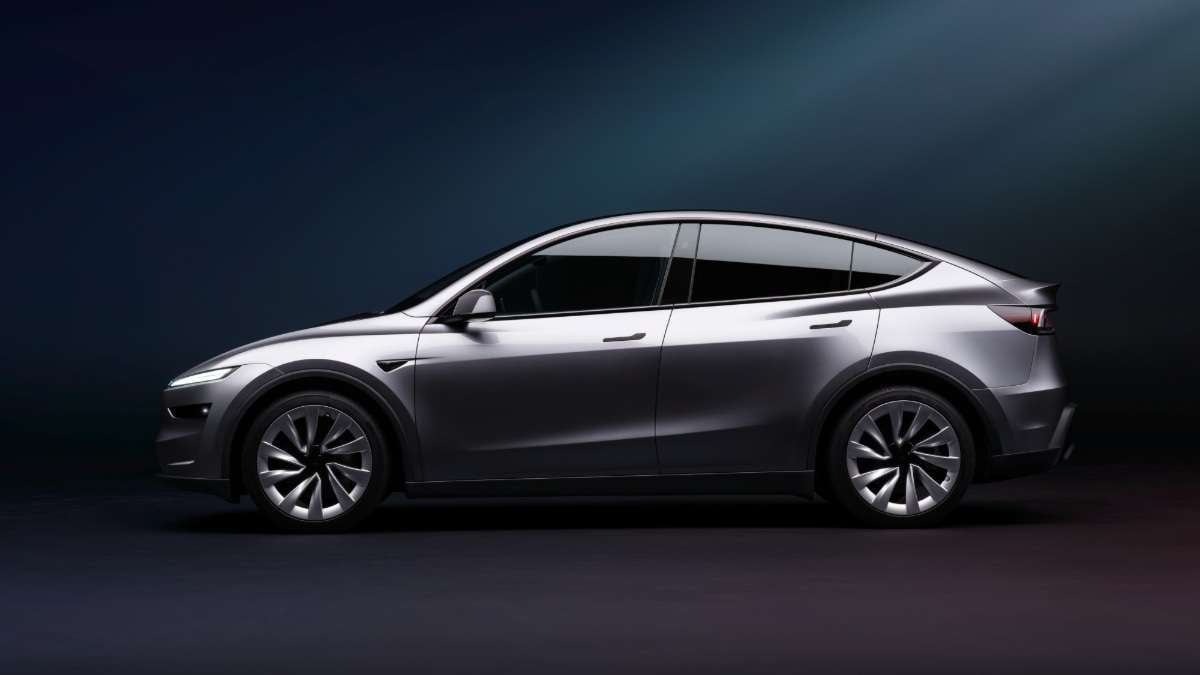

A long road trip has always been a great examiner of cars and drivers. The highway strips away marketing polish and hands you the truth about machinery, infrastructure, and your own patience. Tesla owner Glenn Bishop-Smith recently put his 2023 Model Y Long Range through this classic American proving ground on a 2,200-mile loop from Washington to Arizona and back. What he returned with was not a hit piece or a sermon. It was a sober field report on the state of EV road tripping in 2025, written by someone who enjoyed the car yet found the journey more complicated than expected.
Here is Glenn’s full post, provided exactly as written:
“Did 2200+ miles round trip from Washington to Arizona and back earlier this month in my ‘23 YLR. Some observations…
I let the car navigate me the whole way, so it would precondition the battery pack prior to charging stops. It pretty much kept me off of interstates, taking me through eastern Oregon and western Nevada. It had me stop 11 times (!) to charge for the 1100+ miles each way, and every stop was planned by the car’s navigation before I ever hit the road. This was definitely affected by all of the mountainous terrain.
First off, I would have saved 2 or 3 hours each direction had I taken my wife’s Highlander hybrid. With that car, I probably would have stopped 3 times for gas. Fuel for that may have been slightly more than juice for the Tesla; gas was typically in the mid-3-dollar range, and superchargers ranged from 38 cents to 49 cents per kilowatt-hour. The Toyota gets 27 mpg.
Obviously, though, the Tesla is more fun to drive.
Advertising
I also discovered a definite law of diminishing returns related to how fast one drives. The watt-hours per mile go up quite a bit as you cruise faster. Trying to keep up with traffic doing 75+ gets you to the next supercharger faster, but you have to have left the last supercharger with more charge than the navigation has said you’ll need in order to do that, and you arrive with less battery that planned, and you have to stay longer at the charger to take on extra juice for your next leg. This extra time spent charging pretty much makes up for any time you gained by going, say, 77 mph versus just staying at 72 and being a roadblock. Kind of frustrating.
I don’t have FSD on this car, but jeez, the cruise control! Argh! Bombing along, cruise control set at 73, on empty two-lane highways, and a half-dozen times on this trip, the car suddenly slams on the brakes. WTF? Sometimes the screen would say “curvature assist activated”. Huh? There were no turns! Sometimes the screen said nothing at all. Once, when the curvature assist message flashed, I let the car just do its thing. It slowed to about 25 mph and just stayed at that speed. On a straight road. With a 65 mph speed limit.
They can’t fix this???
This car is a hoot to drive, but for me it’s not ready for road-trip prime time.”
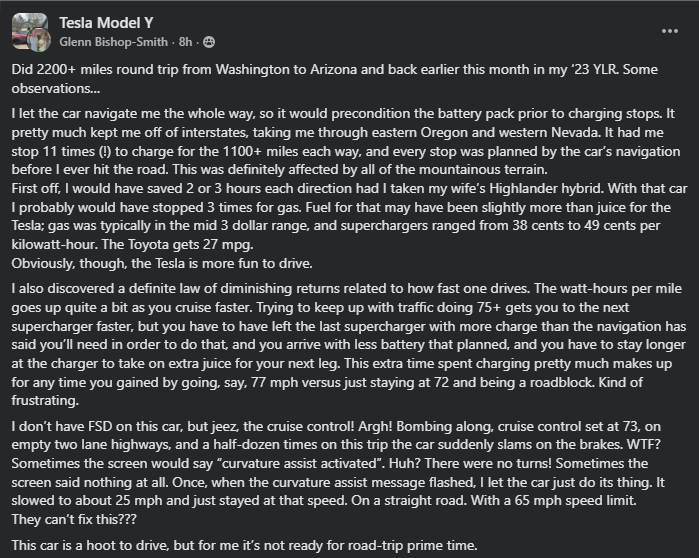
What Glenn described resonated instantly with other Tesla owners. Sam Bierster noted that the energy app can reveal a driver’s real tendencies, often recommending that drivers slow down a few miles per hour to save range, something Glenn confirmed through his mountain-state legs. It is a delicate ballet between speed, elevation, and the next available charger. The eleven stops for each 1,100-mile direction were not the result of poor planning or fear of range. They were the product of physics, geography, and a navigation system designed to protect the battery first and conserve time second.
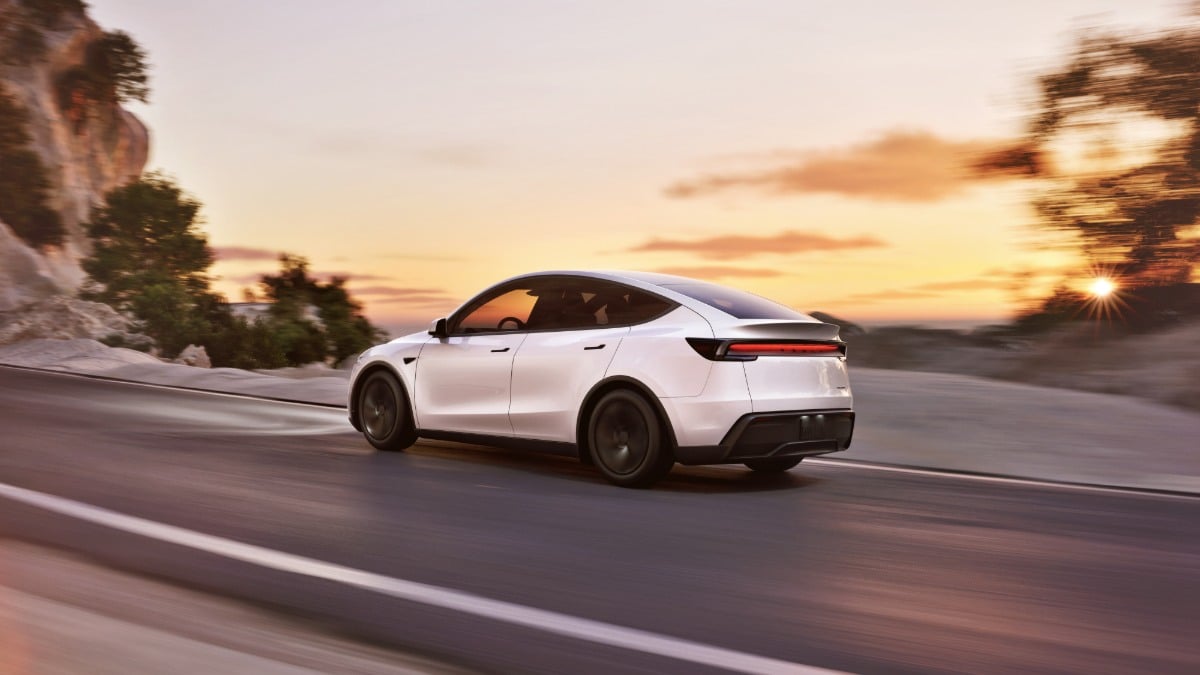
The comparison to the Highlander Hybrid gave the story its grounding. Glenn never criticized Tesla’s capability. He simply observed that the Toyota would have made the same journey with three fuel stops and arrived hours sooner. HL Lovell responded that the stops every few hours suit many drivers just fine, and in fairness, the Tesla route did ensure consistent preconditioning and predictable charge times. Nevertheless, the rhythm of the trip became a central theme.
The most striking part of the trip was not the charging schedule but the behavior of the cruise control. Phantom braking is not a new term in the EV community, yet Glenn’s account of sudden, unexplained slowdowns on straight, empty highways raises legitimate questions about software calibration. Rob Pettigrew backed this up with his own experience in a Model 3, noting that recent updates seemed to introduce more erratic steering and braking inputs. Glenn’s description of his car dropping to 25 mph and staying there on a 65 mph straightaway stands out as a moment no driver wants to experience while sharing the road with others who expect steady behavior.
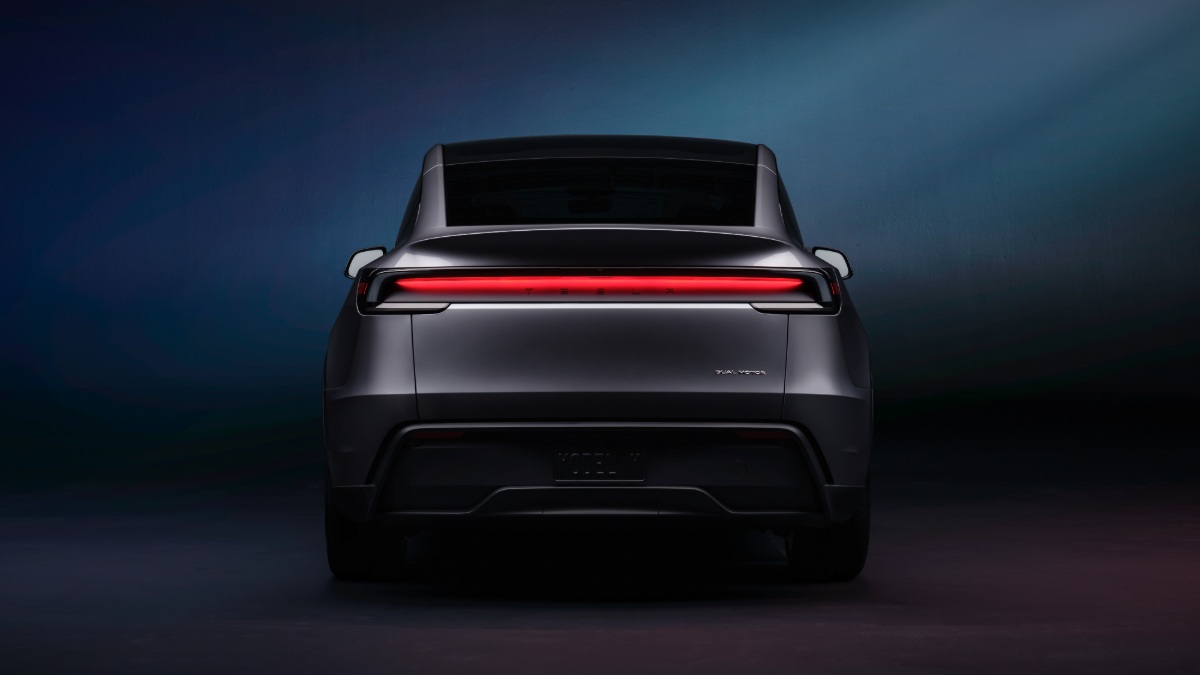
The broader narrative that emerges is one of a technology still in transition. The Model Y handled the terrain and delivered the expected driving enjoyment. The Supercharger network remains the most reliable EV charging system available in North America. But long-distance driving still demands a different kind of planning and a different kind of patience. That theme reappears in Todd Wollman’s comment that EV road trips are perfectly workable so long as time is not a constraint. For retired drivers or leisurely travelers, these pauses are simply part of the adventure. For those on tighter schedules, the equation shifts in favor of efficient gas hybrids.
Glenn did not end his post with frustration but with clarity. The car is enjoyable. The technology is capable. The road trip was successful. Yet the experience revealed where EV road tripping stands today. It works with conditions. It rewards deliberate pacing and flexible time. It asks the driver to trust both the software and the topography. As Glenn put it, the Model Y is a hoot to drive, but today it remains a better companion for local and regional travel than for a time-sensitive interstate haul.
Noah Washington is an automotive journalist based in Atlanta, Georgia. He enjoys covering the latest news in the automotive industry and conducting reviews on the latest cars. He has been in the automotive industry since 15 years old and has been featured in prominent automotive news sites. You can reach him on X and LinkedIn for tips and to follow his automotive coverage.
Set Torque News as Preferred Source on Google
Follow us today...


Comments
My 25 Ram would have made it…
Permalink
My 25 Ram would have made it in two fuel stops. Will never buy Tesla, due to the fact that they are poorly built and Electric only. Will never buy any EV.
Curve Assist, and Emergency…
Permalink
Curve Assist, and Emergency Vehicle Detected: I experienced many false alarms on my most recent road trip. Minimal curves, and no emergency vehicles in site. Tesla, please fix your phantom breaking issues, or give us a good old dumb cruise control option!