
The fifth-generation Toyota Prius has earned a reputation for being calm, efficient, and reassuringly well engineered, which is why stories that unsettle that expectation tend to ripple quickly through owner communities. One such account surfaced recently in the Toyota Prius 5th Gen Club, where a 2025 Prius LE owner described an experience that would alarm anyone. After a routine 5,000-mile dealer checkup, the owner returned to the car days later to find a strong gasoline odor, both inside the cabin and around the rear of the vehicle, accompanied by a visible puddle forming behind the driver’s side rear tire.
“Has anyone else had this happen? 2025 Prius LE owner. I took it to the dealer for the 5000-mile checkup four days ago. This afternoon, I smelled gas when I went to my car. I find a puddle behind the driver's side rear tire. There was a strong smell of gas inside the car, especially in the back seat area. I put a pan under it to catch the gas, but luckily found later that it is not dripping anymore. I am taking it to the dealer first thing Monday. The first picture is when I first found it, and the second is when I went out later after it had stopped leaking.”
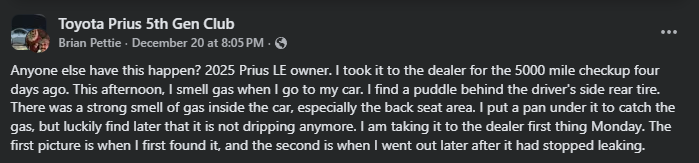
The details of the post were measured rather than panicked, which made the situation more unsettling. Gasoline fumes were strongest near the back seat area, and the owner initially placed a pan under the car to catch what appeared to be an active leak. By the time they returned later, the dripping had stopped, but the smell remained pronounced enough to raise real concern. A visit back to the dealer was planned immediately, a sensible move given that fuel leaks, even intermittent ones, demand professional inspection rather than driveway speculation.
Toyota Prius: Fuel Economy, Ride Comfort, and Practical Interior Controls
- The Prius emphasizes aerodynamic efficiency through its low, sloping profile, which supports fuel economy but slightly constrains rear visibility and headroom.
- Its hybrid powertrain favors smooth, steady operation, delivering predictable acceleration suited to urban and highway driving rather than performance-oriented use.
- Cabin layout focuses on usability, combining digital displays with physical controls to reduce reliance on touchscreen navigation for basic functions.
- Ride tuning prioritizes comfort and composure, filtering most road imperfections while maintaining stable behavior during everyday driving situations.
Responses from other owners suggested this was not an isolated experience. One commenter noted that the same issue had occurred on their Prius several times and speculated about a possible evaporative emissions component or rollover check valve before ultimately selling the car. Another suggested something far simpler, wondering whether the filler neck might not have been properly tightened at the factory. These replies underline a recurring reality of modern cars: even with advanced systems and tight tolerances, small assembly or sealing issues can manifest in dramatic ways.
More troubling was a separate account from an owner who described pervasive gasoline fumes affecting not just the vehicle, but their entire home. In that case, the pets were sneezing, and family members experienced headaches, prompting the owner to park the car outdoors and stop driving it altogether. A dealer reportedly attributed the smell to overfilling the fuel tank, an explanation the owner rejected, especially after being told no leaks were found. The decision to seek a second dealer reflected a growing frustration and a reasonable unwillingness to accept vague assurances when safety feels compromised.
Not all responses pointed to mechanical failure. One commenter suggested that rapid temperature changes between day and night could play a role, citing similar behavior observed on a motorcycle. While thermal expansion can indeed affect fuel vapor behavior, it is unlikely to fully explain liquid fuel pooling beneath a parked car. That contrast between benign theory and alarming evidence is what makes these reports difficult to dismiss casually.
It is important to note that none of these accounts amount to a confirmed defect, nor do they indict the Prius as a whole. Modern fuel systems are complex, integrating sealed tanks, vapor recovery, and evaporative emissions controls designed to prevent exactly this sort of occurrence. When something does go wrong, it can be intermittent, elusive, and difficult to diagnose without time and careful inspection, especially if the leak stops on its own.
What these stories do highlight is the value of owner communities as early warning systems. Long before technical service bulletins or recalls appear, patterns often emerge in forums and social groups where drivers compare notes. A single post may be anecdotal, but several similar experiences begin to suggest a shared vulnerability, even if the root cause remains unclear.
For now, the responsible path is the one these owners are taking: documenting symptoms, avoiding unnecessary risk, and pressing dealers for clear answers rather than easy dismissals. The Prius has built its reputation on trust, and maintaining that trust means taking concerns like these seriously. Whether the issue proves to be a loose connection, a faulty valve, or something more mundane, owners deserve transparency and resolution, especially when the smell of gasoline replaces the quiet reassurance the Prius is known for.
Image Sources: Toyota Media Center
Noah Washington is an automotive journalist based in Atlanta, Georgia. He enjoys covering the latest news in the automotive industry and conducting reviews on the latest cars. He has been in the automotive industry since 15 years old and has been featured in prominent automotive news sites. You can reach him on X and LinkedIn for tips and to follow his automotive coverage.
Set Torque News as Preferred Source on Google
Follow us today...