
In the technology industry, we have a long, storied history of "silver bullets" - technologies promised to solve every fundamental flaw of a current generation overnight. In the automotive world, that silver bullet is the solid-state battery (SSB). If you listen to the marketing departments at major OEMs, we are moments away from EVs that charge in five minutes, never catch fire, and travel 800 miles on a single charge.
But last week, the industry received a cold bucket of water over its collective head from the place where the most aggressive EV development is actually happening: China. Ouyang Minggao, a prestigious academician at the Chinese Academy of Sciences, dropped a truth bomb that should make every automotive CEO lose sleep. He noted that despite the breathless press releases, solid-state batteries may need another 5 to 10 years just to reach a measly 1% market share.
When the people building the most batteries in the world tell you they can’t scale the tech, you should listen. We are looking at a "Solid-State Reality Check," and the gap between the haves and the have-nots is about to become a chasm.
The Technology: Why We Are Obsessed with Solid-State
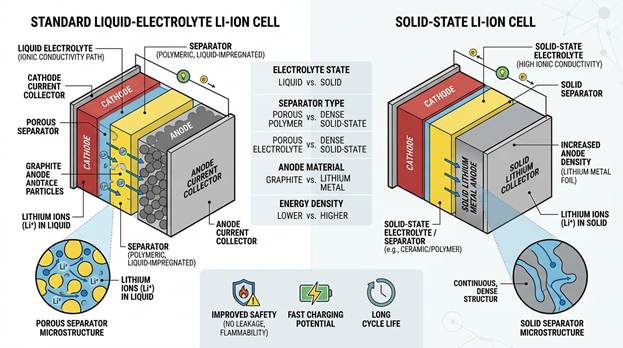
To understand why the industry is so desperate for this technology, we have to look at the limitations of our current workhorse: the Lithium-Ion battery with liquid electrolytes.
Current EV batteries are essentially chemical sandwiches with a liquid center. This liquid electrolyte is flammable, sensitive to temperature, and limits how fast you can shove energy into the cells without causing "dendrites" - tiny needle-like structures that can short-circuit the battery and cause a thermal runaway event.
Solid-state batteries replace that liquid with a solid ceramic, glass, or polymer material. The advantages are transformative:
- Energy Density: You can pack far more energy into the same footprint, potentially doubling the range of existing vehicles.
- Safety: Solid electrolytes are non-flammable. You could drive a nail through a solid-state cell, and it wouldn't explode.
- Charging Speed: Because they handle heat better, they can support ultra-fast charging rates that mimic the gas-station experience.
The Chinese Academic Warning: A 1% Problem
The report from the Chinese Academy of Sciences underscores a fundamental law of tech: "Innovation is easy; manufacturing at scale is hard."
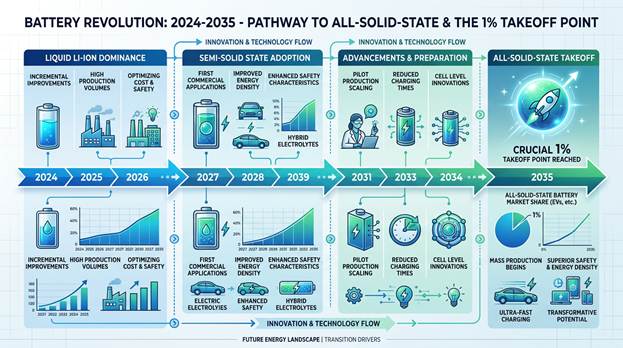
The 1% market share prediction is a devastating blow to the narrative that SSBs will save the legacy automakers from their current slump. If only 1% of cars have this tech by 2035, it means SSBs will remain a luxury "halo" feature, much like carbon-ceramic brakes or V12 engines were in the past. The cost of manufacturing these solid ceramic layers without defects is currently astronomical. We aren't just changing a recipe; we are changing the entire kitchen.
The Front-Runners: Who is Beating the Curve?
While the academics are cautious about mass adoption, a few companies are positioning themselves to dominate that exclusive 1% early.
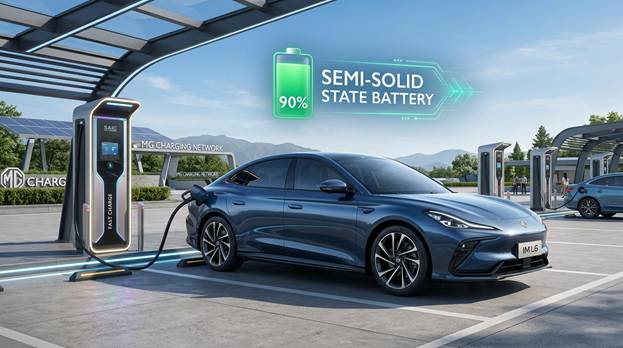
MG and SAIC: MG’s parent company, SAIC, has been surprisingly aggressive. They have already begun integrating "semi-solid-state" batteries into production vehicles like the IM L6. By using a hybrid approach—a solid electrolyte with a small amount of liquid to ensure conductivity—MG is essentially "cheating" the timeline to get a superior product to market before Toyota or Volkswagen can get their fully solid versions out of the lab.
Toyota: Toyota has the most patents in the SSB space, but they have a history of "over-engineering" and then waiting too long to launch. They claim a 2027-2028 window for their SSB vehicles, but given the Chinese warnings, I expect those to be extremely low-volume, high-priced Lexus models.
QuantumScape and Volkswagen: VW has bet big on the US-based QuantumScape. Their recent endurance tests showed 95% capacity retention after 1,000 charging cycles, which is incredible. However, moving from a lab-tested cell to a production line that spits out millions of cells is where VW is currently struggling.
The Market Impact: A Two-Tiered EV World
The disparity in SSB availability will create a "Digital Divide" in the automotive market. If MG and a handful of Chinese manufacturers can provide 600-mile ranges while Ford, GM, and Stellantis are stuck at 300 miles using older liquid-tech, the competitive advantage shifts entirely to the East.
Car companies that lack a solid-state roadmap will find their resale values cratering. Why would you buy a used EV with "old" battery tech that degrades and charges slowly when the new standard is just around the corner? This creates a "Osborne Effect," where customers stop buying current EVs in anticipation of the next big thing, potentially bankrupting legacy players who can’t bridge the gap.
Strategy for Survival: What Car Companies Must Do
If I were advising a CEO today, my message would be simple: Don't wait for the "Perfect" Solid-State.
- Iterate with Semi-Solid: Do what SAIC/MG is doing. Don't wait for a 100% solid electrolyte. Get a hybrid cell into your cars now to improve safety and density.
- Modular Platforms: Design your cars so the battery pack is "hot-swappable" at the factory level. If a solid-state breakthrough happens in three years, you should be able to drop that pack into your existing chassis without a total redesign.
- Vertical Integration: You cannot rely on third-party suppliers who are selling to everyone. If you don’t own the IP of your solid-state chemistry, you are just a "body-shop" for battery companies like CATL.
The Buyer’s Dilemma: When Should You Jump?
For the average consumer, the "Reality Check" is actually a bit of a relief. If the tech is 10 years away from 1% market share, you don't need to worry about your new Tesla or Hyundai being "obsolete" next year.
Who should prioritize SSBs? Only the ultra-high-mileage road warrior or the luxury buyer who demands the absolute bleeding edge. If you have a garage and can charge overnight, the current LFP (Lithium Iron Phosphate) batteries are more than sufficient.
The Purchase Window: If you want a "true" solid-state battery, wait until 2029. Anything sold before then is likely a semi-solid hybrid or a very expensive prototype. For everyone else, the best time to buy is now—the current generation of batteries has matured, and the "perfect" battery is still a decade away from being affordable.
[Image Prompt 3: A timeline infographic from 2024 to 2035, showing the slow transition from Liquid Li-ion to Semi-Solid, and finally the 1% "Takeoff Point" for All-Solid-State batteries in the mid-2030s.]
Wrapping Up
The solid-state battery is the future, but as the Chinese Academy of Sciences has pointed out, the future is taking its time getting here. We are entering a decade of incrementalism, not revolution.
While MG and other Chinese firms are successfully "faking it" with semi-solid tech to gain a market lead, the rest of the industry is caught in a dangerous waiting game. The companies that will survive are those that realize solid-state is a marathon, not a sprint, and stop promising "silver bullets" when they haven't even finished the "lead" ones.
Disclosure: Images rendered by Artlist.io
Rob Enderle is a technology analyst at Torque News who covers automotive technology and battery developments. You can learn more about Rob on Wikipedia and follow his articles on TechNewsWord, TGDaily, and TechSpective.
Set Torque News as Preferred Source on Google
Follow us today...