


Toyota RAV4 Hybrid vs. Honda CR-V Hybrid: Which One Is Better?
We have already established that the 2026 Honda CR-V drives better than the Toyota RAV4, offering a smoother, more refined experience. But for the pragmatic buyer planning to drive their SUV until the wheels fall off, comfort takes a backseat to mechanical survival.
When you strip away the branding and analyze the engineering failure points, specifically Toyota's potential $6,000 'Cablegate' risk versus Honda's simplified electric drive, it becomes clear that, despite Toyota's legendary reputation, there might be only one of these hybrids truly built to survive the 300,000-mile war without a catastrophic, wallet-draining repair.
Does the RAV4's "Cablegate" scandal make the CR-V the safer 10-year bet?
In our previous report, Honda CR-V Hybrid vs. Toyota RAV4 Hybrid: The Fuel Economy Test That Surprised Us, we highlighted why some buyers are choosing the 2026 Honda CR-V over the 2026 Toyota RAV4: it simply drives better. The cabin is airier, the suspension is more compliant, and the experience is more refined. But for the pragmatic buyer, the person who plans to drive their SUV until the wheels fall off, ride quality is only half the equation. The other half is mechanical longevity.
When you spend $40,000 on a hybrid SUV, you are effectively marrying a complex powertrain. You aren't just buying an engine; you are buying high-voltage inverters, traction batteries, and electric motors.
Toyota invented the modern hybrid game. The Toyota Hybrid System (THS) is widely considered the gold standard for reliability. However, Honda has spent the last decade perfecting its own "Two-Motor" hybrid system, which engineers argue is actually superior due to its simplicity.
So, which system is built to survive the 300,000-mile war? To find out, we have to look beyond the spec sheets and examine the "failure points."
The Engineering: Toyota's "Power Split" vs. Honda's "Direct Drive"
To understand reliability, you must understand how these cars move, because they do it very differently.
The Toyota Way (RAV4 Hybrid)
The Planetary Gear Masterpiece. Toyota uses a setup called a "Series-Parallel" hybrid. At its heart is the Power Split Device, a planetary gear set that seamlessly blends power from the 2.5L gas engine and two electric motors (MG1 and MG2).
The Genius: There are no belts, no pulleys, no clutches, and no torque converter. It is a permanently engaged gear set. Mechanically, it is arguably the most robust transmission design in automotive history. There are almost no "wear items" inside the transmission case.
The Result: This system is why you see NYC taxi cabs (Camry Hybrids) with 500,000 miles on the original transmission.
The Honda Way (CR-V Hybrid)
The Electric Illusion Honda takes a radically different approach. The CR-V Hybrid operates mainly as a Series Hybrid (like a diesel locomotive).
The Genius: For most city driving, the 2.0L gas engine does not connect to the wheels. Instead, it acts solely as a generator, creating electricity to power the big electric traction motor that turns the wheels.
The Lock-Up: Only at steady highway speeds (typically above 45 mph) does a simple wet clutch engage, locking the gas engine directly to the wheels.
The Result: This system feels more like an EV because it is an EV most of the time. It eliminates the "rubber band" effect of Toyota's e-CVT, offering a more linear driving feel.
The Achilles Heel: Toyota's "Cablegate"
If the Toyota transmission is bulletproof, why are some mechanics warning buyers away from used RAV4 Hybrids? The answer lies in a single, glaring design flaw known as "Cablegate."
We covered the specifics of this issue in our detailed breakdown, Toyota RAV4 Hybrid High Voltage Cable Corrosion: What Owners Need To Know, but here is the summary:
On Toyota RAV4 Hybrids (and Highlander Hybrids), the high-voltage cable that runs from the battery to the rear electric motor (for All-Wheel Drive) is exposed to the elements. On 2019-2022 models, the connector for this cable was designed in a way that trapped water, road salt, and debris.
- The Failure: Over time, the connector's shielding corrodes. When the corrosion breaches the seal, the hybrid system detects a voltage leak and shuts down the entire vehicle.
- The Cost: This is not a cheap fix. Replacing the high-voltage wire harness requires dropping the rear subframe and fuel tank. Out-of-pocket costs often range from $4,000 to $6,000.
- The "Fix": Toyota has updated the part number with an "open" connector design (allowing water to drain) for newer models and extended the warranty on older ones. However, for a buyer aiming for 300,000 miles, this exposed cable remains a vulnerability that Honda's design does not share (Honda's cables are routed differently and haven't suffered widespread corrosion issues).
The Engine Battle: Naturally Aspirated vs. The Turbo Ghost
Honda has suffered a hit to its reputation recently due to "Oil Dilution" issues in its 1.5L Turbo engines (found in the gas-only CR-V and Civic). In cold climates, gas would seep past the piston rings into the oil pan, causing premature wear.
The Hybrid Advantage: Crucially, the Honda CR-V Hybrid does NOT use the 1.5L Turbo. It uses a naturally aspirated 2.0L Atkinson cycle engine (LFA1/LFB1 series).
This engine is straightforward, which is why I recommend the Hybrid CR-V over the turbo gas model every time. Because the hybrid system handles the heavy lifting of acceleration, the gas engine is under far less stress than a turbo engine.
Toyota's 2.5L: The RAV4 Hybrid uses the A25A-FXS 2.5L engine is a "Dynamic Force" engine with both port and direct injection (D-4S). This dual-injection system prevents carbon buildup on the intake valves, a common issue with modern direct-injection engines. It is loud and sounds agricultural when pushed, but it is practically unkillable.
Battery Longevity: The 15-Year Question
Both the 2026 RAV4 and CR-V Hybrids use Lithium-Ion battery packs. (Toyota transitioned away from the older Nickel-Metal Hydride tech for most RAV4 trims recently.)
Replacement Costs: If you keep a car for 300,000 miles, you will replace the battery. Currently, a replacement pack for either vehicle costs between $2,500 and $4,500 installed.
The Cooling Factor: Both manufacturers use air-cooled battery packs (drawing cabin air to cool the cells). It's simpler than liquid cooling but requires owners to keep the air intake vents (usually under the rear seat) clean. If you have a dog that sheds, both cars are susceptible to battery overheating if those vents get clogged with fur.
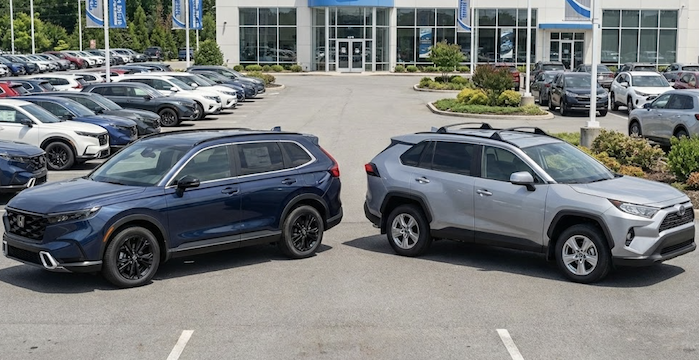
So, which one wins the 300,000-mile war?
The Winner for Pure Mechanical Durability: Toyota RAV4 Hybrid Despite the "Cablegate" issue, the Toyota Hybrid System remains the endurance champion. The planetary gear transmission is a marvel of low-friction engineering. The dual-injection engine solves the carbon buildup problem. If you live in a salt-free state (Arizona, Florida, California), the cable corrosion issue is moot, and the Toyota is arguably the 300,000-mile machine.
The Winner for "No Headaches" Ownership: Honda CR-V Hybrid. For buyers in the Rust Belt or snowy climates, the Honda CR-V Hybrid is currently the safer bet. It lacks the catastrophic corrosion vulnerability of the RAV4's rear cable. Its hybrid transmission is mechanically simpler with fewer moving parts engaging at any given time. While Honda hasn't been building hybrids as long as Toyota, this specific two-motor generation has proven to be incredibly stout.
Key Takeaways
- Toyota's Transmission is Stronger: The planetary gear set is invincible.
- Toyota's Wiring is Weaker: The high-voltage cable corrosion issue is a legitimate, expensive risk for northern owners.
- Honda is Simpler: The CR-V Hybrid avoids turbo headaches and uses a transmission that acts like an EV, reducing mechanical wear on the gas engine.
- The "Toyota Tax": You will pay more for a used RAV4 Hybrid, but that premium might be negated if you have to pay $5,000 out of warranty for a wire harness repair.
Which Hybrid Would You Buy?
Does Toyota's history of reliability outweigh the risk of the "Cablegate" repair bill? Or does Honda's simpler, EV-like design make it the modern reliability king? If you were buying a car to keep for 15 years, which key would you want in your pocket? Let us know in the comments below.
With over 30 years of industry experience, Denis Flierl brings an insider’s perspective to Torque News, where he has been a Senior Reporter since 2012. Before picking up the pen, Denis consulted for the automotive industry's biggest brands and honed his skills as a test driver. He cuts through the noise to deliver the latest auto news, compelling owner stories, and the expert analysis necessary to navigate today's automotive landscape.
Have a tip or question? Follow me on X @DenisFlierl and @WorldsCoolestRides, or connect with me on Facebook, Instagram, and LinkedIn.
Photo credit: Denis Flierl
Set Torque News as Preferred Source on Google
Follow us today...







Comments
The CRV does not have a…
Permalink
The CRV does not have a spare tire. The reliability of Toyota plus the fact that it has a spare tire are clear decisive advantages over a CRV and it's smoother riding.
The redesigned 2026 Rav4…
Permalink
The redesigned 2026 Rav4 hybrid makes buying based on reliability a no-brainer. Plus the fact that the rav4 has a spare.
I own a 2025 CR-V Hybrid…
Permalink
I own a 2025 CR-V Hybrid Sport,
couldn’t be happier, as it’s a comfortable, dependable, fuel efficient, daily commuter.
Family trips are very accommodating, with a cozy cabin and good technology.
Thanks for this very…
Permalink
Thanks for this very insightful article . I keep my cars for the long term. I don't put lots of miles on, but my purchase decisions are based on trouble free long term motoring. You have given lots to think about. 👍🏼
Last May I traded my 23…
Permalink
Last May I traded my 23 Accord hybrid for the 26 CRV Hybrid. The Accord sat too low for seniors. The CRV has been great. I find it more fun to drive and much more practical. It handles well and the gas mileage has been over 40mpg. I’ve been driving Hondas since 1982. That says it all.
This article is straight AI…
Permalink
This article is straight AI garbage. The formatting, the language, all of it screams AI. Also, it's factually incorrect. Does the toyota ecvt have a rubber band effect? It is not known to. Why are you even talking about the CRV Turbo? The article claims that the CRV is simpler because it doesn't have a turbo. Neither does the toyota.
I have no idea who you are Denis, but if you are a real person with someone that claims to have over 30 years of experience then you know you should do better. Use your own brain and stop being lazy.
I have driven both. I prefer…
Permalink
I have driven both. I prefer the Honda CRV. It's much more refined ride, interior comfort, quieter cabin etc. Toyota lost me as a customer this year as they could not supply a Rav 4 PHEV for 18 months! I loved the Honda CRV however no PHEV was a deal breaker. I ended up buying a Hyundai Tucson Ultimate PHEV which now has over 22000km on it. Average fuel economy since new is 3.3 litres/100km and I picked it up January 21st 2025. The ride and comfort level is far better than the RAV4 and similar to the CRV. I was able to get a seven grand discount including five grand EV rebate, the financing was cheaper than Toyota's and the price was much lower than the unavailable RAV4. Also the warranty on the Tucson with some extra added on is eight years! The software, driving assists, collision avoidance, technology etc. are fantastic on the Tucson and the Bluelink software App interface is now subscription free for as long as we own the vehicle!
The Toyota RAV4 Hybrid will…
Permalink
The Toyota RAV4 Hybrid will outlast the CR-V Hybrid. Despite the cable gate issue, there’s a fix from a third party aftermarket called a Cable Warden. It prevents corrosion from happening. Since the Mazda CX-50 Hybrid uses the same drivetrain, it too would outlast the CR-V Hybrid. Toyota and Lexus hybrids as well as the Mazda CX-50 Hybrid regardless of model for the most part uses a fan filter while Honda and other manufacturers does not have one. If you want more of a sport oriented handling with Toyota reliability, go with the Mazda CX-50 Hybrid.
Congrats, Engineer Dude!…
Permalink
Congrats, Engineer Dude!
This is a well thought out and succintly written article. As it's entitled, it only addresses longevity.
I don't know what % of new buyers would actually keep eilther SUV for 15 years, 300,000 miles or let the 2nd, 3rd, 4th, 5th owner achieve that; but it's got to be way less than 1 out of 10,000. Nevertheless this article is relevant to the average new SUV buyer.
I'l take the 2027 CR-V promised upgraded drivetrain, with more room, better ride, better upscale interior and keep it for a reasonable 2 - 5 years and 20,000 -50,000 miles.
Engineer Dude, Very accurate…
Permalink
Engineer Dude,
Very accurate, enjoyable, and succinct article. You obviously spent considerable time and thought in this comparison. I wonder though how many owners will actually keep either vehicle for 15 years and 300,000 miles - I'd guess less than 1 out of 10,000.
My money will be spent on the 2027 CR-V promised to introduce next generation hybrid drive system, and along with better ride, more upscale & larger interior and evolved body design should make it more than competitive with the acknowledged excellent RAV4.