
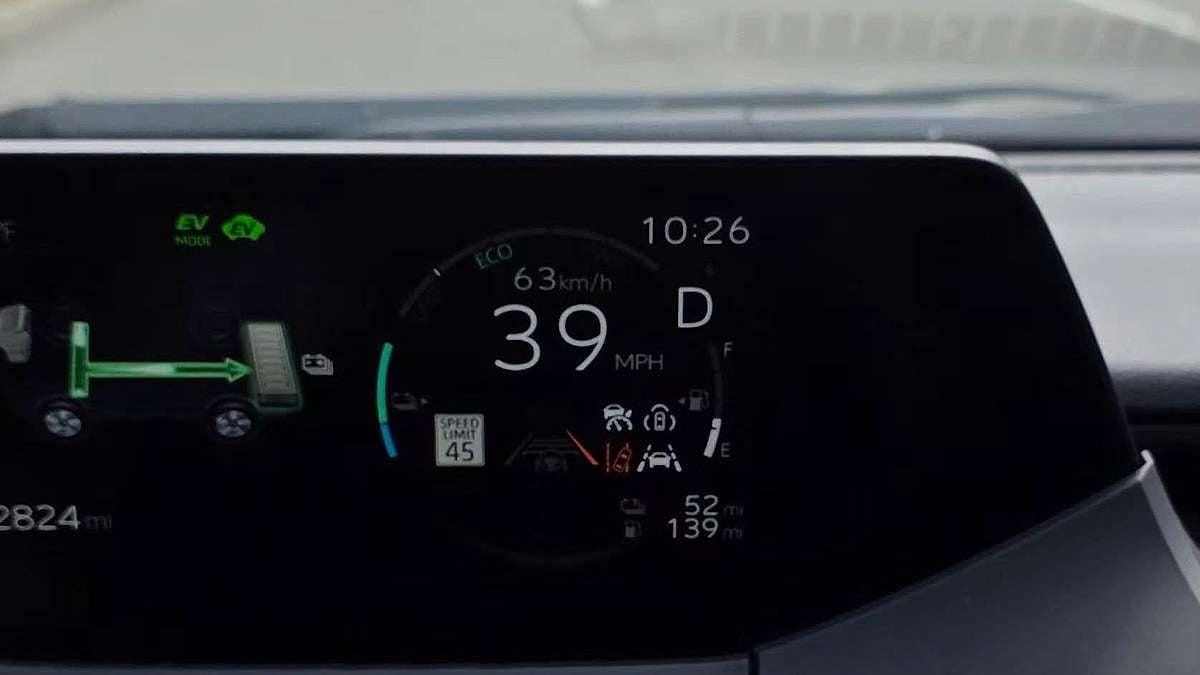

This investigative report analyzes a significant real-world range discovery by a 2025 Toyota Prius Plug-In (Prime) owner in Los Angeles. By reducing highway speed from 75 mph to 65 mph, the driver realized a range increase from the high 40s to a consistent 52 miles, nearly a 10 percent efficiency gain at a cost of only 3 minutes and 42 seconds for a 30-mile commute. These findings challenge standard driving habits and provide a specific, actionable benchmark for 5th Gen Prius owners seeking to maximize EV-only operation in high-traffic urban corridors.
The Three-Minute Trade-Off That Unlocks 52 Miles of Range
If there is one thing I have learned after decades in the automotive industry, it is that the gap between a manufacturer’s laboratory claims and your actual driveway is often wider than a Colorado canyon. For the 2025 Toyota Prius Plug-In Hybrid (PHEV), the official numbers look great on a window sticker, but real-world variables like the heavy foot of a California commuter can change the math instantly. Recently, a breakthrough surfaced from a dedicated owner in Los Angeles that every Prius driver needs to hear.
The "answer" to the range anxiety many of you feel isn’t found in a software update or a specialized tire; it is found in the speedometer. By dropping just 10 miles per hour, from 75 mph to 65 mph, an owner discovered he could extend his EV range from the high 40s to a steady 52 miles. The most shocking part of this investigative discovery is the time cost. For a standard 30-mile commute, driving faster only saved him 3 minutes and 42 seconds. We are talking about sacrificing less time than it takes to brew a cup of coffee to gain enough electric range to potentially eliminate gasoline usage entirely for the day.

As an active investigator who has tracked drivetrain failures and efficiency gaps for decades, I find this specific data point fascinating because it highlights the physics of aerodynamic drag that manufacturers rarely discuss in plain English. When we push these sleek 5th Gen Prius models past 70 mph, the energy required to cut through the air increases exponentially rather than linearly. I have seen similar patterns in my own technical consultations where high-speed commuting guts the battery before the regenerative braking even has a chance to help. This owner’s experience proves that the "sweet spot" for the 2025 Prius battery isn't just about how you stop, but how fast you go when you are moving.
The Evidence From the Front Lines of the Prius Owners Club
This entire investigation started when Jeff Lloyd from Los Angeles, California, shared his findings on the Toyota Prius 5th Gen Owners Club Facebook page. Jeff noted: “Well, I've had the car almost a year and I finally figured out my 2025 Toyota Prius Plug-In. I think one other time I saw my range was 52, but it is usually in the upper 40s. The lowest I've seen is 47. Recently, on a drive home, I asked Gemini if I would drive 65 mph compared to 75 miles an hour, the time difference getting home for a 30-mile drive. It is 3 minutes 42 seconds faster driving 75. Unbelievable. So I started driving 65 mph about 2 weeks ago and lo and behold my range is up to 52 and staying there!”
I say, “Go figure.”

It really is that simple, yet so many drivers ignore the math. In my previous reporting on the current Prius AWD efficiency gaps, I noted how modern hybrids are increasingly sensitive to driver behavior, a sentiment I explored when I found that EPA-estimated range often fails to account for the aggressive inclines and high-speed flow of Western highways. Outside experts agree that speed is the silent killer of EV range. For instance, Car and Driver’s long-term testing of high-efficiency vehicles confirms that "aerodynamic drag at 75 mph is significantly higher than at 65 mph, often resulting in a 10 to 15 percent drop in fuel or energy economy," which you can read in their detailed range analysis here.
Why Aerodynamics and Drivetrain Loads Matter at 65 MPH
We have to look at the reality of how the 2025 Prius manages its power. When you are cruising at 75 mph, the electric motor is under a constant, high-torque load to overcome wind resistance. I’ve seen technical reports from the Society of Automotive Engineers (SAE) indicating that atmospheric drag becomes the dominant energy consumer once a vehicle exceeds 50 mph. A report by energy-efficiency experts at the Department of Energy (DOE) highlights that "it takes much more energy to move a vehicle through the air at 75 mph than at 65 mph," as explored in their official fuel-economy and speed analysis.
From my 30 years of experience, I can tell you that the 5th Gen Prius is a masterpiece of engineering, but it cannot outrun physics. If you are driving in a region like Southern California or Colorado, where the "natural" flow of traffic is 75 or 80 mph, you are essentially fighting the car’s design. We have to be smarter than the traffic flow. I always tell my readers to treat their battery like a bank account. Every 5 mph over 65 is like an extra "convenience fee" you are paying to the wind. Is three minutes of your afternoon worth the extra gas you will have to buy when the battery runs dry? For most of us, the answer is a resounding no.
Technical Observations From Owner Communities
The feedback from the broader community supports this "slow down to go further" methodology. In a recent technical discussion on r/Prius, several owners noted that the predicted range on the dash, often called the "Guess-O-Meter," reacts violently to sustained high-speed driving. From my years of experience, this aligns with how Toyota’s Power Management Control Module prioritizes safety and component longevity over optimistic range displays. One owner shared their frustration, stating, "I noticed my EV range dropped by 5 miles the morning I decided to keep up with the fast lane at 80 mph," which you can read in the full Reddit discussion here.
Another owner highlighted the vulnerability of the new battery chemistry to heat buildup during high-discharge states, noting, "The battery cooling fans kick in way more often when I'm pinning it at 75 plus... that's energy wasted just to keep the car from melting," as found in this Reddit thread.
I'm guessing this user feels this way because the thermal management system in the 2025 model is highly active; when you drive 75 mph, you aren't just using energy for forward motion, you are using energy to cool the battery that is working too hard. It is a double-whammy of inefficiency.
Does Temperature Matter More Than Speed?
The next question most of you will have is whether this 65 mph "sweet spot" holds up when the weather turns cold. It is a smart question. The reality is that while speed is the biggest factor in the summer, cold temperatures can reduce battery efficiency by up to 30 percent due to cabin heating and chemical sluggishness. However, the speed rule actually becomes more important in the winter. Because the battery is already struggling in the cold, adding the massive load of 75-mph wind resistance can cause the engine to kick in much earlier than expected. If you want to keep that 50-mile range in the winter, staying at 65 mph is no longer a suggestion; it becomes a requirement.

Advice for the 5th Gen Prius Owner
- Monitor your "Energy Monitor" screen for one week while maintaining a strict 65 mph limit on the highway.
- Calculate your actual time loss using a navigation app; you will likely find that traffic lights and surface streets matter more than highway speed.
- Adjust your departure time by a mere five minutes to accommodate the slower pace, ensuring you arrive on time while keeping the gasoline engine dormant.
- Use the "Eco" drive mode at cruising speeds to dampen aggressive throttle responses that can spike energy consumption.
Key Takeaways for Maximizing Efficiency
- Reduce cruising speed to 65 mph to unlock the full 52-mile EV potential of the 2025 Prius Plug-In.
- Acknowledge that driving 75 mph saves only about 3.7 minutes per 30 miles of travel.
- Observe how aerodynamic drag at high speeds creates a disproportionate load on the battery.
- Ignore the flow of faster traffic to prioritize personal fuel savings. Know that you'll get plenty of dirty looks.
Final Conclusion on Prius Range
The 2025 Toyota Prius Plug-In is a vehicle that rewards patience and technical understanding. Through the lens of Jeff Lloyd’s experience and my years in the trenches of automotive reporting, it is clear that the path to 52 miles of range is paved with moderation. We often feel the need to rush, but the physics of the 5th Gen platform tells a different story, one where three minutes of your time is worth the peace of mind of a full electric commute.
It’s Your Turn
What would you do? Is saving less than four minutes on your commute worth losing 10-15% of your electric range, or are you ready to join the "65 MPH Club" to see those 52-mile numbers on your dash? Tell us what you think and share your own real-world range discoveries using the red "Add new comment" link below.
About The Author
Denis Flierl is a 14-year Senior Reporter at Torque News and a member of the Rocky Mountain Automotive Press (RMAP) with 30+ years of industry experience. Based in Parker, Colorado, Denis leverages the Rockies' high-altitude terrain as a rigorous testing ground to provide "boots-on-the-ground" analysis for readers across the Rocky Mountain region, California EV corridors, the Northeast, Texas truck markets, and Midwest agricultural zones. A former professional test driver and consultant for Ford, GM, Ram, Toyota, and Tesla, he delivers data-backed insights on reliability and market shifts. Denis cuts through the noise to provide national audiences with the real-world reporting today’s landscape demands. Connect with Denis: Find him on LinkedIn, X @DenisFlierl, @WorldsCoolestRides, Facebook, and Instagram.
Photo credit: Denis Flierl via Jeff Lloyd
Set Torque News as Preferred Source on Google
Follow us today...







Comments
10 miles or so of bonus EV…
Permalink
10 miles or so of bonus EV range will not do you any good when someone offs you for driving 65 on a highway.
This is goofy. While the…
Permalink
In reply to 10 miles or so of bonus EV… by ExPrius (not verified)
This is goofy. While the velocity being squared is true, in this particular case it seems silly. The subject of the article states they always got high 40's, never below 47. So we're talking about 3-4 miles of range here... Hardly worth bending your behaviour around unless you really want to see 52 on that gauge for some reason.
I'll take the 4mins saved each way and pay 2 bucks in gas every month.