
This investigative report analyzes a significant pivot in the Toyota enthusiast community, in which owners are prioritizing mechanical longevity over technological novelty. By analyzing a high-profile Florida trade-in involving a $21,000 "downgrade" from a 2024 to a 2015 Highlander, I expose the underlying reliability concerns with the UA80 8-speed Direct Shift transmission. Drawing on decades of automotive field experience, I demonstrate why older V6/6-speed platforms are becoming high-demand assets in the 2026 market, offering both financial freedom and a hedge against catastrophic drivetrain failure.
The Shocking $21,000 Swap That Proves Newer Isn't Always Better
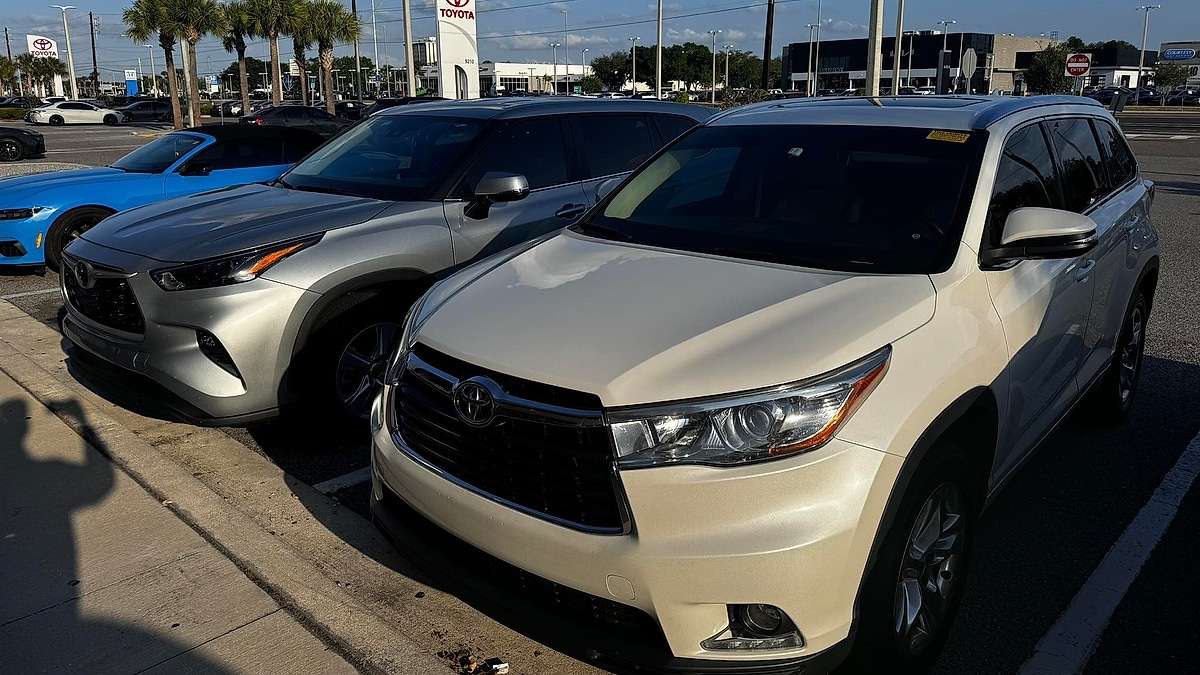
I have never seen a trend quite like this. Usually, we talk about the latest tech and "upgrading" to the newest model year. But today, the most strategic move a Toyota owner can make might just be going backward in time. A Florida owner recently shocked the community by trading his nearly brand-new 2024 Toyota Highlander LE with only 25,000 miles for a decade-old 2015 Highlander Platinum with 66,000 miles. He walked away with a paid-off car, a $21,000 lower price tag, and, most importantly, he escaped the "ticking time bomb" known as the 8-speed Direct Shift transmission. My investigation into this swap reveals a harsh truth about the 2026 automotive market: long-term reliability and financial freedom are outranking new-car smell.
For this owner, the 2024 model represented a monthly burden and a mechanical risk. By moving back to the 2015 model, he returned to the ultra-reliable 6-speed automatic transmission and the legendary 3.5L V6 engine that established Toyota's reputation in the first place. I can tell you that the mechanical simplicity of the 2015 model offers a level of "bulletproof" security that the complex 8-speed units in newer gas-powered Highlanders simply cannot match.
The information here is vital for every Toyota owner to understand. Newer models are built to meet fuel-efficiency targets, often at the expense of transmission longevity. This technical reality is why we are seeing savvy owners flee the 2020-2024 models before their 60,000-mile powertrain warranties expire. When we look at the numbers, the financial win of $21,000 is only half the story; the other half is the peace of mind that comes with a transmission that won't leave you stranded with a $9,000 repair bill.

In my three decades of experience, I have learned that when a manufacturer shifts to a new powertrain, there is always a "settling in" period. Unfortunately, the UA80 8-speed gearbox has proven to be a long-term headache for many. As documented by the Lemon Law Experts, many of these problems stem from a mix of mechanical wear and design-related weaknesses, particularly in vehicles equipped with the UA80E or UA80F 8-speed automatic transmissions. This outside expert analysis confirms exactly what I have been tracking: the Direct Shift 8-speed is failing at unacceptable rates for a brand that built its crown on durability. This is not just an isolated complaint; it is a documented trend that makes the 2015 model’s 6-speed look like a masterpiece of engineering.
"I traded in my 2024 Toyota Highlander LE with 25K miles, for a 2015 Highlander Platinum 66K miles (only 21K$) to get rid of any car payments. Very happy! The coolest car is the paid-off car. Plus, no risk of transmission issues. I know most people upgrade to a newer model; ironically, I feel that I am actually doing that and accomplishing financial freedom, too. Blessings to all of you out there on the road, Highlander friends. You really helped me make this a reality as I almost went with a 2017-2019." - John Parks, Toyota Highlander Owners Club (Facebook)
Why the 2015 Highlander is the Secret Reliability King
I have often praised the third-generation Highlander (2014-2016) as the "Sweet Spot" of the SUV's history. These years used the 6-speed transmission, widely considered one of the most durable units Toyota has ever produced. In contrast, the newer 8-speed units are facing widespread reports of whining, hesitation, and total failure at low mileage. I previously reported that a 2021 Toyota Highlander owner at 65,000 miles needs a new transmission, reinforcing the pattern in which the noise often starts subtly before the gearbox eventually fails without warning. In that story, we see the high bar Toyota set for itself, one that newer models are currently struggling to clear.

External data from Kelley Blue Book backs up my field observations perfectly. KBB researchers found that among owners who provided feedback, the 2015 Highlander maintained a high sentiment score because consumers cited its reliability and comfort as its strongest features. This is why a decade-old SUV can still command $21,000 on the used market. It is a known quantity. When I talk to my friends in the industry, we often discuss how the pursuit of MPG has led to "aggressive upshifting" software. By forcing the car into higher gears too early to save fuel, Toyota is putting immense strain on the internal clutch packs. This creates excess heat, which eventually destroys the transmission fluid's lubricating properties and leads to failure. The 2015 model doesn't have this problem because its software was written when longevity was still the primary goal.
My investigative narrative would be incomplete without mentioning the sheer "messiness" of modern dealership service departments. I have heard from owners who were charged hundreds of dollars for a "ghost diagnosis" in which the dealer claims they cannot replicate the transmission whine. This kind of runaround is driving loyal Toyota fans straight into the arms of older, simpler vehicles. When you buy a 2015 Highlander Platinum, you aren't just buying a car; you are buying a relationship with a machine that doesn't require a computer scientist to explain why it won't shift into third gear. This owner found that the best way to fix a 2024 transmission issue is to trade in the 2024 for a 2015 model before the warranty expires.
Field Observations from Owner Communities
The sentiment across the web is shifting from "Toyota for life" to "Never again," and I am seeing it every day in the forums. In a recent technical discussion on r/ToyotaHighlander, one owner highlighted the vulnerability of the new design, mentioning, "The care care nut straight up says to avoid 2017 because of the many transmission issues. Recommends the 2015-2016 models as most reliable before they went to the 8 speed transmission," which you can find in the full Reddit thread here.
This aligns perfectly with what I’ve seen in my two decades of reporting. The transition to more gears wasn't about durability; it was about meeting EPA standards. By sticking with the 2015-2016 models, you’re choosing a drivetrain designed for the long haul, not a laboratory test. The "Care Care Nut" is a respected voice, and his recommendation mirrors my own investigative findings regarding the 2017-present transition.
Another owner echoed these concerns about the newer 8-speed auto (UA80E/F) being plagued with issues, stating, "Mine failed completely at 75k... It's an all-or-nothing; they don't repair them, only full replacement," found in this Reddit discussion.

My Analysis: The "all-or-nothing" nature of modern repairs is what makes these newer Highlanders so dangerous for long-term owners. Back in my early days in the service department, we could rebuild a transmission for a fraction of the cost. Today, you are on the hook for a $9,000-$12,000 unit. This is why John Parks feels he is "ironically" upgrading by going to an older model; he is upgrading his financial safety net.
Key Takeaways
- Prioritize the 2014-2016 "Golden Era" Highlander models to secure the more reliable 6-speed automatic transmission.
- Avoid the UA80 8-speed Direct Shift gearboxes found in gas-powered 2020-2024 models if long-term durability is your goal.
- Eliminate monthly car payments by leveraging the high resale value of newer Toyotas to trade into a "paid-off" older model.
- Monitor for the "whine or grind" noise in late-model Highlanders as it often indicates a front carrier assembly failure.
Is the Highlander Hybrid a Safer Alternative?
The very next logical question many of you will have is whether the newer Highlander Hybrids share these same transmission nightmares. I can tell you that the answer is a resounding "No." The Hybrid version uses an eCVT (Electronic Continuously Variable Transmission), which avoids the planetary gears and clutch packs that fail in the 8-speed unit. If you must have a newer model, the Hybrid is the only one I would recommend from an investigative standpoint. However, even the Hybrid cannot match the $21,000 "cash in pocket" win that John Parks achieved. The Hybrid keeps you in the payment cycle, whereas the 2015 Platinum trade-down breaks the cycle entirely.
Final Assessment: Is your car serving you, or are you serving your car?
I have spent my career telling people which new cars to buy, but today my expert advice is different: sometimes, the best car for your future is the one from your past. John Parks’ story isn't just about one guy in Florida; it is a blueprint for surviving the current automotive reliability crisis. By valuing mechanical simplicity and financial independence over modern marketing, he has secured a vehicle that will likely outlast many of the 2024 models currently sitting on dealer lots. I hope this report gives you the courage to look at your own driveway and ask; Is your car serving you, or are you serving your car?
What Would You Do? Would you trade a brand-new 2024 model for a decade-old version if it meant no payments and a more reliable transmission? Leave a comment in the red Add new comment link below.
About The Author
Denis Flierl is a 14-year Senior Reporter at Torque News and a member of the Rocky Mountain Automotive Press (RMAP) with 30+ years of industry experience. Based in Parker, Colorado, Denis leverages the Rockies' high-altitude terrain as a rigorous testing ground to provide "boots-on-the-ground" analysis for readers across the Rocky Mountain region, California EV corridors, the Northeast, Texas truck markets, and Midwest agricultural zones. A former professional test driver and consultant for Ford, GM, Ram, Toyota, and Tesla, he delivers data-backed insights on reliability and market shifts. Denis cuts through the noise to provide national audiences with the real-world reporting today’s landscape demands. Connect with Denis: Find him on LinkedIn, X @DenisFlierl, @WorldsCoolestRides, Facebook, and Instagram.
Photo credit: Denis Flierl via John Parks
Set Torque News as Preferred Source on Google
Follow us today...