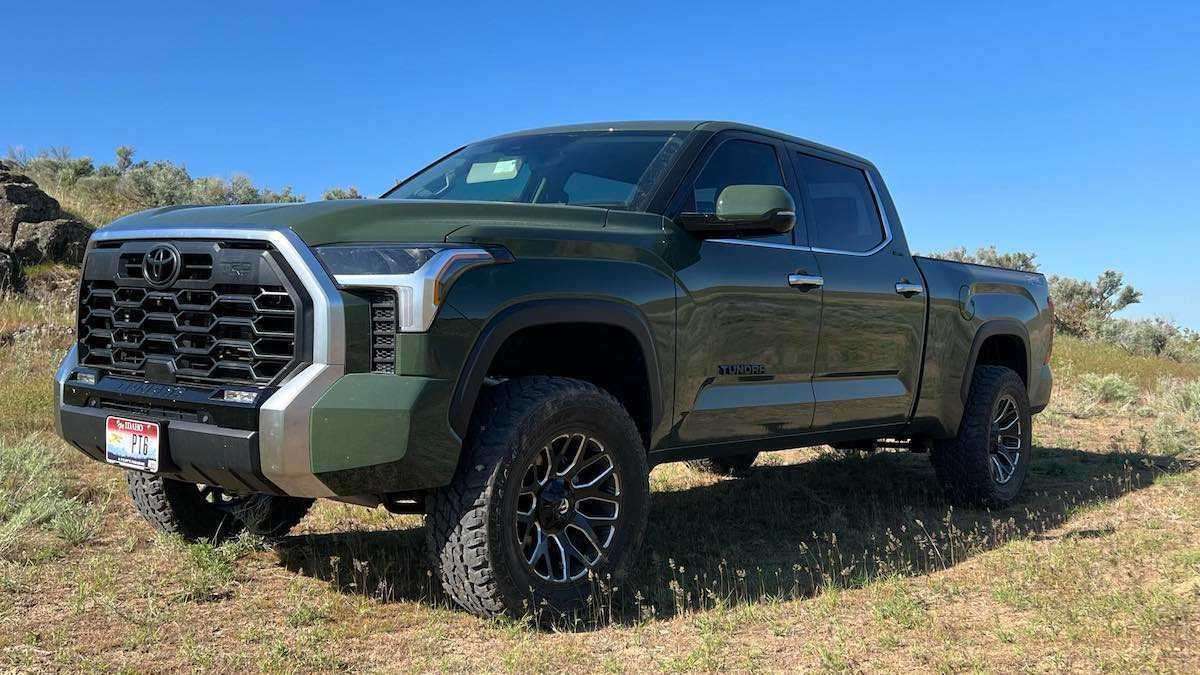

A 2023 Toyota Tundra owner is wondering if he just made the most expensive mistake of his life.
Imagine cruising through a quiet parking lot when your modern truck begins to idle erratically, only to have the entire powertrain seize violently at 35 mph just moments later. This is the harrowing reality for one owner whose Toyota Tundra journey turned into a logistical nightmare of failed roadside assistance and multiple mechanical breakdowns.
Bobby Godwin III on the 2023-2026 Toyota Tundra Owners Facebook page says,
“My 2023 Toyota Tundra Limited with 44k miles went kaboom. The only indication was that, when I started it in a parking lot, it immediately idled at 2200, then slowly calmed down before I drove it. Within a block at about 35 mph, I heard a bang and the back tires locked up for a quarter second. I coasted into a parking lot. Hit the start button, and she was locked up.”
“Toyota roadside ended up being completely useless. At first, they told me I wasn’t covered, then put me over to brand engagement. Brand engagement said yes, of course, you’re covered, and sent me back to the roadside. Waited 2.5 hours in a moderately sized city for a tow truck, only for it to be too small by about 4 feet. After another 2.5 hours, I gave up waiting and called a local tow service that came out right away.”
“Happened on a Saturday, so I had to secure a rental car until Monday, when the local dealer was gracious enough to offer a 2025 SR5 Tundra as a loaner. I live about 7 hours away, and so far, no word from Toyota. The dealership just told me what I already knew: it is part of the recall, and the engine has failed. I knew I should’ve kept my 2018 Tundra.”
Wait, There’s More:
Bobby adds, “This issue is the cherry on top. Previous or current issues include a failed left taillight assembly. Water intrusion caused failure. The plastic fitting on the top of the fuel tanks chafed and started leaking fuel. About a week before the engine failed, the driver's side window regulator failed. Heard a pop, and the window stopped moving. I can hear the motor turning, so I’m sure the cable broke. Dealer wants $700+ to fix.”
Toyota’s "Bulletproof" Reputation is Under Fire
As a Senior Reporter at Torque News, I have seen brands rise and fall on the strength of their reliability. Toyota has long been the gold standard, the "safe bet" for anyone needing a truck that survives for decades. But right now, that reputation is taking a massive hit. The story of Bobby Godwin III isn't just an isolated incident; it's a symptom of a deeper struggle within the third-generation Tundra platform.
When you hear a "loud bang" and your back tires lock up at 35 mph, you aren't just looking at a mechanical failure; you're looking at a serious safety hazard. The V35A-FTS 3.4-liter twin-turbo V6 was supposed to be the high-tech successor to the legendary 5.7-liter V8, but for many, it has become a "ticking time bomb." This specific failure, often caused by machining debris or "swarf" left in the engine during manufacturing, leads to main bearing seizure.
If you've followed my previous coverage, you know this isn't the first time we've seen this. In my report, My Toyota Tundra Suddenly Lost Power and I Need a New Engine, I've Been to the Dealer Countless Times, Now They Say My $60,000 Truck Is Only Worth $35K, I highlighted how these failures are decimating resale values and leaving owners in a financial hole.
The Problem Beyond the Bearings
What makes Bobby's case particularly frustrating is the "cascade of failures" surrounding the truck. We aren't just talking about the Toyota Tundra engine recall. We are talking about fuel tank leaks, window regulator failures, and water intrusion into taillights. For a truck that costs upwards of $60,000, this level of "un-quality" is unacceptable.
The 2023 Toyota Tundra V6 engine reliability is currently the biggest question mark in the pickup world. When the engine's internal components seize, the sudden loss of motive power can momentarily lock the drivetrain, which explains why the rear tires skid. If this happened at 70 mph on a rainy interstate, the result could be catastrophic.
For many owners, the remedy is a full engine replacement. However, even the fix is causing anxiety. As I detailed in another recent article, I Just Had My 2022 Tundra SR5 Engine Replaced With Toyota's Recall, Now 6K Miles Later Here We Are, Broken Down, Intense Knocking, Smoke, and It's DOA, the replacement process is major surgery. It often requires removing the entire cab of the truck to access the engine, and if even one fragment of debris remains in the oil cooler or turbo lines, the new engine is doomed from the start.
The Dealer Experience and Roadside Realities
Bobby’s experience with Toyota Roadside Assistance is a cautionary tale. In my three decades of experience, I’ve learned that "brand engagement" and "roadside service" are often two different worlds. One handles the PR, and the other handles the logistics. When they don't communicate, the customer is the one left on the shoulder of the road for five hours.
If you own a 2022-2025 Toyota Tundra i-FORCE engine, you need to be proactive. Do not wait for the "bang." If you notice a high idle, strange knocking, or any loss of power, get it to the dealer immediately.
The scale of this recall is immense. Dealerships are currently overwhelmed, with some shops reporting dozens of engine crates stacked in their service bays. You can read more about this bottleneck in my report, I'm at the Toyota Dealer Getting My 2025 Tundra Oil Changed, and I See Dozens of Crates With New Engines Waiting, They Can't Swap Them Out Fast Enough.
What Should You Do?
If you are a current owner or considering a used third-gen Tundra, here is my recommendation:
1. Run the VIN: Check the NHTSA website or Toyota’s owner portal specifically for the "Recall 24TA07."
2. Oil Analysis: I suggest performing a BlackStone Labs oil analysis at every change. If you see high levels of copper or lead, your bearings are wearing prematurely.
3. Document Everything: Keep a log of every "hiccup," from window motor noises to erratic idling. This documentation is vital for "Lemon Law" claims if the repair fails.
4. Demand a Loaner: As Bobby found, a gracious dealer will provide a loaner. Do not accept "we're out of cars" when your engine has suffered a safety-related failure under recall.
Key Takeaways for Tundra Owners
- Safety First: A "loud bang" followed by locking tires is a sign of total engine seizure.
- Recall Scope: The recall primarily covers 2022-2023 models, but owners of 2024 and 2025 models are reporting similar issues.
- Secondary Issues: Beyond the engine, watch for fuel tank chafing and electrical failures in the windows and lights.
- The Fix is Complex: Engine swaps are "cab-off" procedures; ensure your dealer has experienced master techs performing the work.
What Tundra Owners Are Saying
The sentiment online is a mix of heartbreak and anger. Here is what's being discussed on Reddit:
"It's becoming clear that it's an engineering issue with this engine. There are tons of reports of Tundras not affected by the recall... as well as tons of reports of 24s that are having this same issue." Reddit Quote
"The internet blows everything out of proportion... but if my engine fails tomorrow, so be it, I'll gladly go get my brand new drop-in and carry on with life." Reddit Quote
"I don't really understand this. How can my truck and this truck not be on the recall list if they were built in 2023?" Reddit Quote
In The End
The transition from the tried-and-true V8 to the high-output twin-turbo V6 has been anything but smooth for Toyota. While the manufacturer is stepping up to replace engines, the logistical failures and secondary quality issues are staining the brand’s image. For owners like Bobby, the "peace of mind" that usually comes with a Toyota badge has been replaced by the sound of a "kaboom" and a long wait for a tow truck.
How About You? Have you experienced any "red flags" with your new Tundra, or has your engine replacement gone smoothly? Let us know in the comments below.
Next Up: The Ford vs. Toyota Reliability Gamble. Is the grass actually greener on the other side? One owner recently ditched his repair-prone F-150 for a new Tundra, only to find himself asking if he made the right choice given the current recall climate. Read the full story: I Ditched My 2021 Ford F-150 For This Toyota Tundra, Now All My F-150 Repair Problems Are Fixed Forever, Goodbye, I'm Out (Now, How About That Tundra?)
With over 30 years of industry experience, Denis Flierl brings an insider’s perspective to Torque News, where he has been a Senior Reporter since 2012. Before picking up the pen, Denis consulted for the automotive industry's biggest brands and honed his skills as a test driver. He cuts through the noise to deliver the latest auto news, compelling owner stories, and the expert analysis necessary to navigate today's changing automotive market.
Have a tip or question? Follow me on X @DenisFlierl and @WorldsCoolestRides, or connect with me on Facebook, Instagram, and LinkedIn.
Photo credit: Denis Flierl via Bobby Godwin III
Set Torque News as Preferred Source on Google
Follow us today...