
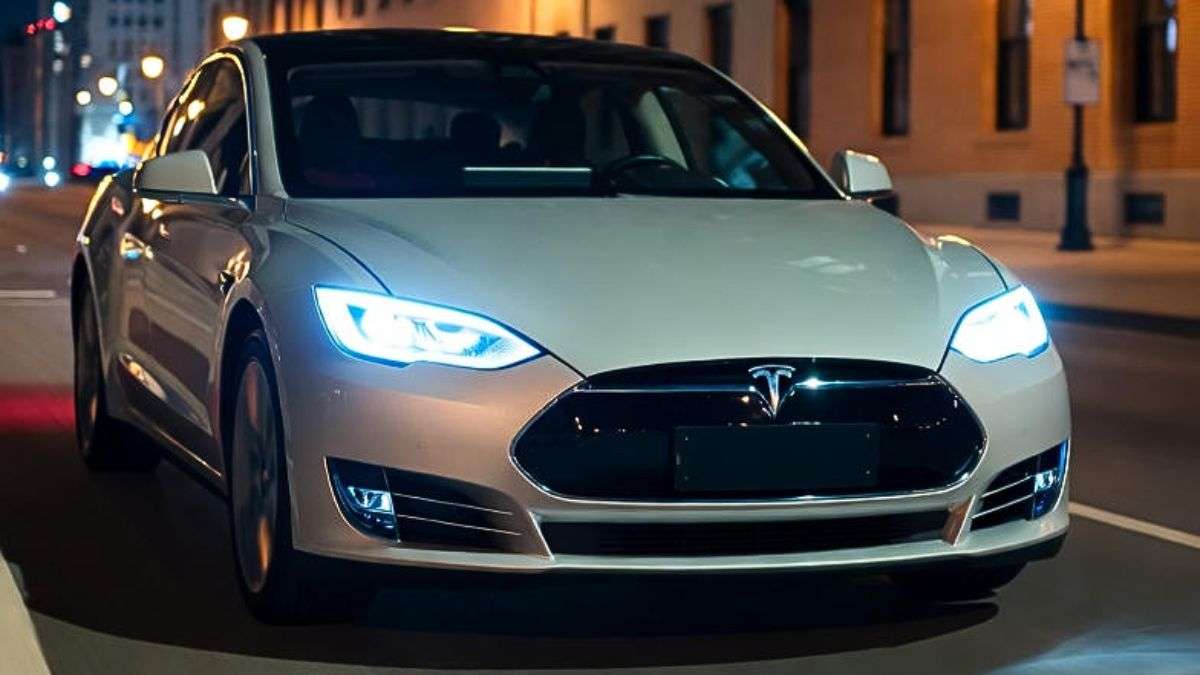

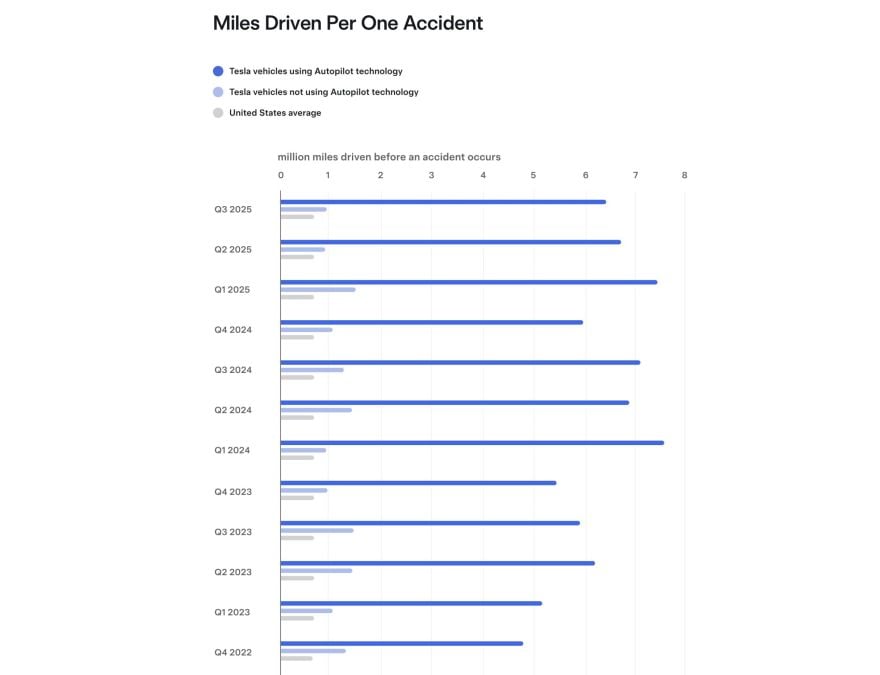
Tesla’s new Vehicle Safety Report for Q3 2025. The company says that when drivers use Autopilot, they experience one crash for every 6.36 million miles driven. Compare that to the U.S. national average of one crash every 702,000 miles, and Tesla’s claim looks jaw-dropping—nine times safer than the average human driver. But what’s behind that number, and how should we interpret it?
Autopilot & FSD Supervised safety data
In Q3 2025, we recorded 1 crash for every 6.36 million miles driven in which drivers were using Autopilot technology
By comparison, the most recent data available from NHTSA & FHWA (from 2023) shows that in the United States there was an… pic.twitter.com/8isNe7X4vg— Tesla (@Tesla) October 22, 2025
Understanding the Numbers Behind Tesla’s Claim
Let’s start with the basics. Tesla collects data from millions of miles driven by its vehicles worldwide. When Autopilot or Full Self-Driving (FSD) Supervised is active, Tesla can track real-world crash frequency and compare it to government-reported averages. In Q3 2025, the data shows improvement, but interestingly, it’s slightly lower than Tesla’s Q3 2024 figure of one crash every seven million miles. That tells us the results fluctuate, likely based on weather, road conditions, and how people use the system.
This isn’t about a perfect machine versus flawed humans—it’s about consistency. Humans get distracted, tired, or emotional. Software doesn’t. Tesla’s systems are designed to avoid those human limitations, which explains why its long-term safety average continues to beat national data. But to understand the full story, we have to look deeper at where and how these miles are driven.
Why Context Matters in Comparing Safety
Most miles logged with Autopilot happen on highways—straight roads, fewer intersections, and consistent traffic patterns. National averages, by contrast, include everything from congested city streets to back roads in bad weather. So yes, Tesla’s number is impressive, but it’s not entirely an apples-to-apples comparison.
This distinction doesn’t take away Tesla’s achievement. It just helps us understand the scope. Highway miles are safer overall, but Tesla’s technology still needs to perform accurately, detect lane markings, monitor surroundings, and react faster than a human could. The fact that it achieves this level of safety under those conditions shows how far advanced driver assistance has come.
Lives are being saved with Tesla Autopilot, and this story proves it. You need to hear how Autopilot made a critical difference in saving a motorcyclist's life when both parties were unaware.
The Trend and What It Says About Tesla’s Progress
Tesla’s safety reports have a consistent pattern. Q1 tends to deliver the best numbers each year, while Q4 often shows higher crash frequency. Seasonal factors play a role—winter weather, lower visibility, and more challenging driving conditions all make a difference.
Still, the steady long-term improvement shows Tesla’s Autopilot and FSD systems are getting smarter through data. Every mile driven sends information back to Tesla’s servers, training the algorithms to predict hazards and recognize rare situations. In other words, every Tesla on the road helps make all Teslas safer.
That’s a powerful concept—cars improving themselves over time. It’s also what sets Tesla apart from traditional automakers who rely heavily on hardware recalls or periodic software updates.
Watch my podcast on Tesla's new safety report at our Torque News Youtube channel below.
From Assisted Driving to Full Autonomy
Tesla’s endgame is clear: Full Self-Driving, completely unsupervised. But that’s still a work in progress. Today’s Autopilot is officially “driver assist,” meaning the driver remains responsible and must stay alert at all times. Tesla calls it “Supervised FSD” because it still needs human oversight.
Elon Musk has hinted that the company is close to achieving true autonomy, but regulators remain cautious. For now, Tesla continues refining its vision-based approach, relying on cameras and neural networks rather than lidar or radar. Whether this approach will lead to fully driverless Teslas remains one of the most debated questions in the automotive world.
Why This Matters for Everyday Drivers
This story isn’t just about Tesla’s marketing—it’s about trust. Would you trust a car that says it’s nine times safer than you behind the wheel? For many, the answer depends on personal experience. Some Tesla owners swear by Autopilot’s reliability, saying it reduces stress and helps them stay calm on long drives. Others remain skeptical, citing occasional failures or driver misuse.
Safety is also about perception. People want to feel in control. Handing that control to a computer—even one that statistically performs better—requires a mental shift. But as technology evolves, that shift might be unavoidable. The same debates once surrounded automatic transmissions, seatbelts, and ABS braking systems.
The Broader Implications: Insurance, Regulation, and Responsibility
If Tesla’s data proves accurate across diverse conditions, it could reshape not only driver behavior but also industries. Insurers could begin offering lower premiums for vehicles with active Autopilot engagement. Regulators might set new standards for automated safety reporting. And automakers competing with Tesla would be pushed to publish similar transparency reports.
But there’s also accountability. If a crash happens under Autopilot, who’s responsible—the driver or Tesla? The legal system hasn’t fully answered that question yet. These reports, impressive as they are, also serve a strategic purpose: they build Tesla’s case that its technology is statistically safer than human drivers, reinforcing the company’s stance in potential liability disputes.
The Human Element Still Matters
Technology aside, driving is still a deeply human activity. We rely on instincts, quick judgments, and emotional awareness. Tesla’s technology replaces some of that with precision, but it can’t replace intuition—at least not yet. When something unexpected happens—a child running into the street, debris flying off a truck—it’s not just about sensors; it’s about context and prediction.
That’s why Tesla repeatedly reminds drivers to stay engaged even when Autopilot is on. It’s a partnership between human and machine, not a handover. As these systems evolve, that balance may shift, but for now, human responsibility remains at the center.
Looking Ahead: What Tesla’s Report Tells Us About the Future
The 2025 safety report is more than a set of numbers—it’s a snapshot of where we are in the journey toward automated driving. Nine times safer is a headline, but the real story is progress. Every year, Tesla gets closer to a world where human error, the leading cause of accidents, could be drastically reduced or even eliminated.
Still, the path ahead involves solving big questions: Can the system handle unpredictable environments? Will regulators ever approve fully autonomous driving? How do we ensure transparency in how these safety stats are collected and presented?
These are the discussions that matter as we stand on the edge of the next transportation revolution.
Questions for You
So now, I want to hear from you.
Have you personally used Tesla’s Autopilot or a similar driver-assist feature? How did it make you feel—more confident, or more nervous?
And here’s another question: if data showed a car is nine times safer than a human driver, would you be ready to let it take full control, or do you still prefer to keep your hands on the wheel?
Share your experiences and opinions in the comments below. I read them all, and I love hearing real-world stories from drivers who are living this evolution firsthand.
Tesla’s Q3 2025 report paints an optimistic picture of how far automated driving has come. Whether or not the “nine times safer” claim stands up to every scrutiny, it’s clear that the company’s technology is setting new safety benchmarks and changing how we think about trust behind the wheel.
As these systems evolve, one thing is certain—our roads are becoming laboratories for the future of mobility. The next big leap might not come from horsepower or range, but from how much smarter and safer our cars can become.
Armen Hareyan is the founder and Editor-in-Chief of Torque News. He founded TorqueNews.com in 2010, which since then has been publishing expert news and analysis about the automotive industry. He can be reached at Torque News Twitter, Linkedin, and Youtube. He has more than a decade of expertise in the automotive industry with a special interest in Tesla and electric vehicles.
Set Torque News as Preferred Source on Google
Follow us today...



Comments
I have 83k on my 2021 Tesla…
Permalink
I have 83k on my 2021 Tesla Y with FSD. A few weeks ago at a construction zone 2 lane exit it turned to the left toward oncoming traffic. I took over, stopped, backed up and made the correction. It is not perfect yet and I have to stay alert but I am totally impressed with the improvements over the last 4 years. I use FSD every day and find it very useful navigating for me in unfamiliar areas on city streets. I will trust it more and more as it improves. I feel it is in the high 90’s but not quite there yet. I hope they will upgrade my 2021 if additional equipment is needed to attain level 3 or 4.