
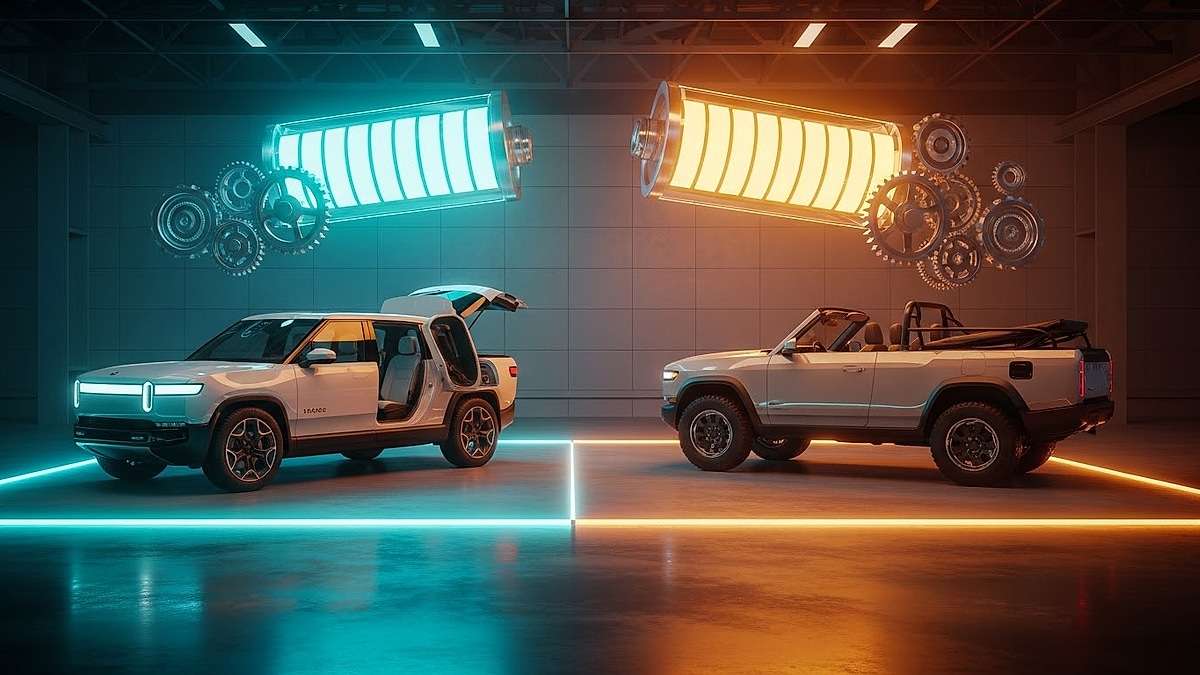

Key Takeaways Before You Read (6-8 minutes of reading):
- Scout's range-extender option solves a real backcountry charging problem that Rivian's battery-only approach has never fully addressed.
- Scout's sub-60,000 dollar pricing has directly accelerated Rivian's R2 development and pushed the company toward more accessible price points.
- Scout's mechanical lockers and solid rear axle offer a simpler, more trail-reliable hardware package than Rivian's complex hydraulic suspension system.
- Scroll to see the comments or be the first to voice your opinion.
For years, if you wanted a serious electric off-road vehicle, you really had only one real answer. Rivian owned that conversation almost entirely. The R1S and R1T were premium, capable, and expensive, and buyers simply accepted those terms. After 15 years of covering the automotive industry, I can tell you that nothing shakes up a stagnant market like genuine competition. That competition has now arrived, and your wallet is about to notice.
Scout Motors CEO Scott Keogh said it plainly in an interview with Bloomberg after his company opened reservations. "Look, the market has spoken. Over 80% of the reservations are for the range extender. Another way to say this is that four out of five Scout reservation holders want a truck or SUV with a gas engine on board." That one statement rewired the entire conversation about what an off-road EV needs to actually be. The era of the pure-luxury electric trail vehicle is over, and the race for real-world capability at a more accessible price is on.
How Scout Motors Is Solving the Range Anxiety Problem Off-Road
Range anxiety is the one problem that stops most buyers from considering an electric off-road vehicle. You can handle it on the highway, where chargers are reasonably common. Out on a trail in the middle of nowhere, the math changes completely.
Scout identified this early. The company engineered a Harvester option, which is a built-in range-extending generator powered by a small inline-four engine from Volkswagen. You put gas in the tank, but the vehicle's wheels are still moved by the electric motors, meaning you still get Scout's projected 1,000 lb-ft of instant torque. This matters not because of the extra 150 miles of range, but because there are very few charging stations out in remote terrain, and with Scout drivers can carry fuel to power the generator for multiday off-road trips. That is the kind of practical problem-solving that changes minds.
Scout says the hybrid version of the truck will be able to cover 500 miles between fill-ups and charges, while the all-electric range hovers around 350 miles. Rivian's Max Pack battery technology delivers more pure electric range, up to around 400 miles, but it carries no backup fuel option for backcountry adventures. If you are comparing the two honestly for serious overlanding, Scout's approach addresses a gap that Rivian has never fully closed. You can read more about how Rivian R1S owners have been testing real-world performance in extreme conditions on Torque News, and the results are instructive.
The Price War That Is Forcing Rivian to Move Faster
Here is where buyers genuinely win. Scout announced base pricing under 60,000 dollars for both the Traveler SUV and the Terra pickup. That single number sent a clear message to Rivian. Rivian currently wants $77,000 for a base R1S, and if the vehicle's value exceeds $80,000, buyers cannot claim the $3,750 federal tax credit. The current top variant, the R1S TriMax, starts at $105,900. That pricing made Rivian the vehicle of well-heeled adventure enthusiasts, not mainstream off-road buyers.
Scout's arrival has accelerated Rivian's own push down the price ladder. Rivian has officially started production of its R2 electric SUV at its Normal, Illinois plant, with the Performance Launch Edition starting at $57,990. The promised base R2 at $45,000 is still coming, with the standard model expected in late 2027. That timeline pressure exists, in part, because of Scout. The story of Rivian R2's off-road hardware decisions is one our Torque News writers have examined carefully, and it reveals how deeply this competitive pressure is shaping engineering choices.
The rivalry is also forcing a dealer model reckoning. Scout plans to sell directly to consumers, and this unconventional approach has sparked opposition from dealers affiliated with Volkswagen and Audi, including lawsuits in Florida and Colorado arguing that Scout may violate state regulations governing auto sales. Tesla and Rivian fought the same battle. Scout is doing it again, and direct-to-consumer savings could mean hundreds of dollars in the buyer's pocket once the legal dust settles.
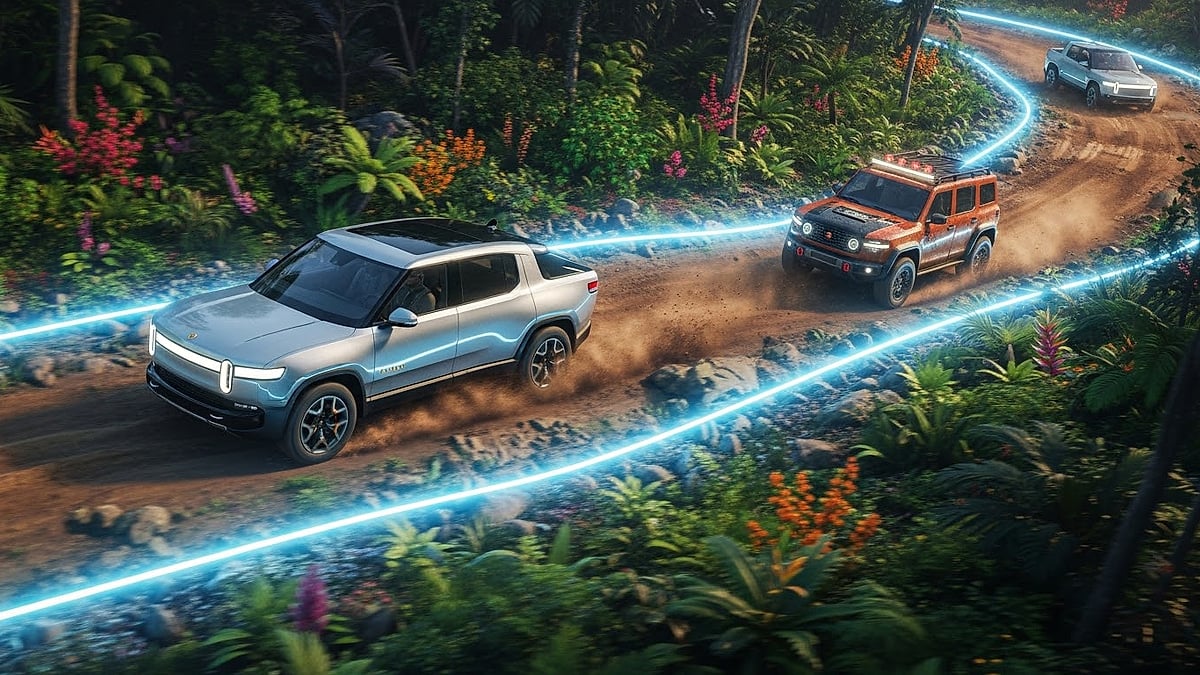
Off-Road Hardware, Where Scout Has a Clear Mechanical Edge
This is the part of the story that AI results say the mainstream media has softened. Rivian built its reputation on sophisticated air suspension and hydraulic roll control. That system is impressive on tarmac and capable off-road. But it carries a real vulnerability. A journalist once pinched a hydraulic line on a Rivian R1T while off-roading and lost all the fluid. The truck went into its lowest ride height setting, set itself to front-wheel drive, and would not go above 35 mph. It took a special pressurizing system and three Rivian technicians all night to get the truck fixed. That is not a knock on Rivian as a brand. That is a real lesson about complexity versus reliability in the field. Edmunds
Scout went in a different direction. Scout Terras will feature solid rear axles along with front and rear mechanical lockers, with disconnecting front sway bars offered and availability of 33- or 35-inch all-terrain tires. Mechanical lockers. Real solid axles. Those choices signal that Scout is building for people who actually use these vehicles on serious terrain, not just for buyers who like the idea of adventure. You can see why the Scout Traveler represents a genuinely unique engineering approach in today's EV market. Motor Authority
Edmunds, writing about this exact matchup, noted that Scout's Traveler and Terra have an optional steel-sprung suspension, which is not as modern as Rivian's system but is potentially not as finicky for off-roading, and that sometimes simpler is better. That observation from Edmunds is worth sitting with. Simplicity wins when your vehicle is 50 miles from the nearest cell tower.
Democratizing the Off-Road EV Market for Regular Buyers
The most important thing happening here is not about which vehicle wins a comparison test. The most important thing is that serious electric off-road capability is moving toward a price that ordinary buyers can reach. This is what healthy market competition looks like.
The R2 is going to be smaller than the full-size Scout, while the Scout Traveler is bigger and closer to the larger Rivians, with more off-road capabilities and options that the Rivian R2 just does not have. That means buyers at different price points will have genuinely different options with different trade-offs. That is real choice, and it did not exist two years ago.
The R2 Performance packs 656 horsepower from a dual-motor AWD setup, an 87.9 kWh battery, 330 miles of EPA-rated range, and a 3.6-second 0-60 time, along with a 4,400-pound towing capacity. Rivian is also pairing the R2 with an ambitious autonomy roadmap, including lidar and hands-free highway driving features arriving in late 2026. The question of whether affordable EVs are finally getting the formula right is one Torque News has been following closely, and the R2 represents one of the most credible answers yet.
Scout's direct-sales approach also matters here. Cutting out the dealership markup means more of the value lands with the buyer rather than the middleman. Between competitive pricing pressure, direct sales, and the engineering race to deliver actual off-road hardware, the consumer is in a position that simply did not exist before Scout entered the picture.
What This Rivalry Means If You Are Buying Soon
If you are in the market for an electric off-road vehicle right now, the honest advice is this. Rivian R1S and R1T deliveries are happening today, and the R2 is launching in spring 2026. Scout deliveries are targeted for 2027 and likely to slip toward 2028 given the engineering and legal complications the company is navigating. That is a meaningful gap. Scout's challenges around its range-extender placement and dealer lawsuits are real, and patient buyers should follow those developments carefully.
But the competition itself is already doing work on your behalf today. Rivian is moving faster on pricing. The R2 timeline accelerated in response to market pressure. Over-the-air updates, warranty terms, and feature sets are all getting more aggressive because neither company can afford to look complacent.
The moral here is a simple one that holds true beyond the automotive world. When you have only one option, that option controls you. When genuine competition arrives, the power shifts to the buyer. That is not just good for your wallet. It is how markets are supposed to work. Staying informed, comparing carefully, and waiting for the right moment rather than buying out of scarcity fear is the discipline that separates a smart purchase from an expensive lesson.
The off-road EV market is no longer Rivian's party to run alone. Scout has shown up, and the rest of us are going to benefit from that.
Now I want to hear from you. If you were choosing between a Rivian R1S available today and a Scout Traveler with the range-extender option arriving in 2027 or 2028, which would you pick and why? And for those of you who already own a Rivian, has the arrival of Scout changed how you think about the value of your purchase? Share your thoughts in the comments below.
About The Author
Armen Hareyan is the founder and Editor-in-Chief of Torque News and an automotive journalist with over 15 years of experience writing car reviews and industry news. Now based in the Charlotte region (Indian Land, SC, he founded Torque News in 2010, which since then has been publishing expert news and analysis about the automotive industry. He can be reached at Torque News on X, Linkedin, Facebook, and Youtube. Armen holds three Masters Degrees, including an MBA, and has become one of the known voices in the industry, specializing in the landscape of electric vehicles and real-world stories of actual car owners. Armen focuses on providing readers with transparent, data-backed analysis bridging the gap of complex engineering and car buyer practicality. Armen frequently participates in automotive events throughout the United States, national and local car reveals and personally test-drives new vehicles every week. Armen has also been published as an automotive expert in publications like the Transit Tomorrow, discussing how will autonomous vehicles reshape the supply chain, and emerging technologies in vehicle maintenance.
Set Torque News as Preferred Source on Google
Follow us today...



Comments
I do multi day overlanding…
Permalink
I do multi day overlanding trips in my Rivian without concern. Battery usage is extremely low when driving at trail speeds. I even utilize the batttery to cool and heat my tent at night. While Scout’s range extender sounded great in concept, so much so I even have a reservation, the initial patents place it precariously low and aft on the frame making it an offroad disaster in the making.
Scout motors may be dead on…
Permalink
Scout motors may be dead on arrival as Volkswagen is stopping production for a year or more or forever. Don't get too excited about slate pu as the supply chain goes up every year slates just went up $8,000 Now costs $28,000 base. If you want cheap buy a slate if you want a great top trim as truck buy one certify used top trim for under $30,000 load it.