Follow us today...


Let me ask you a question I keep seeing in the comments lately.
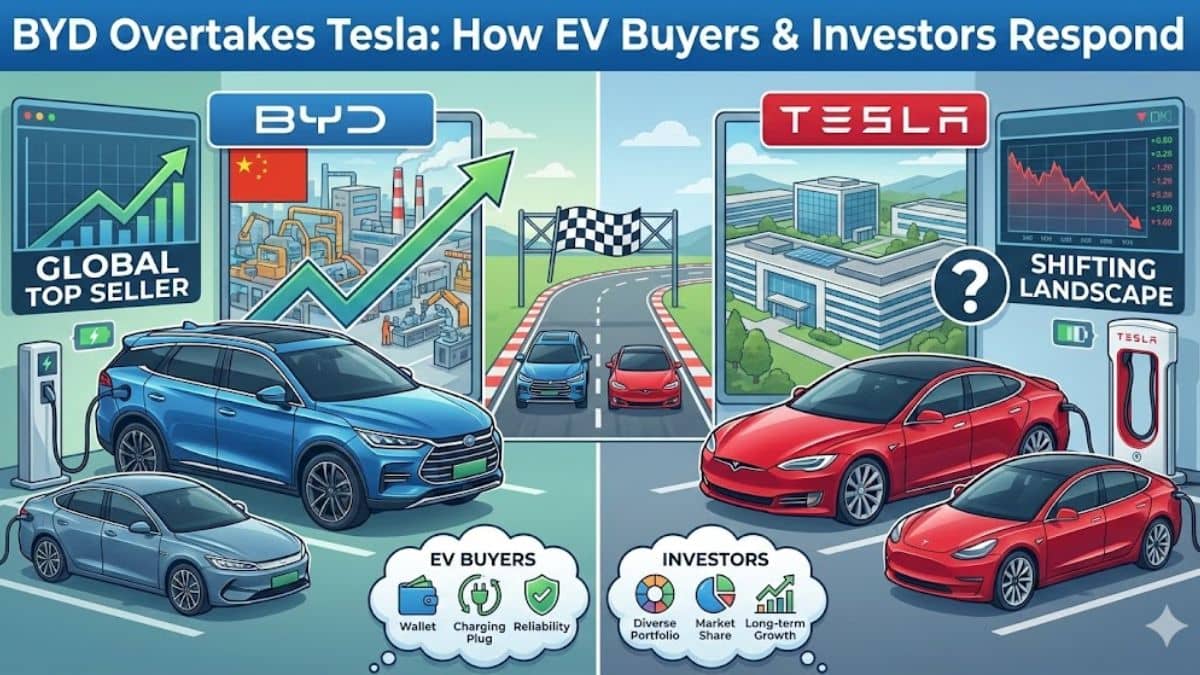
How did BYD actually overtake Tesla as the world’s top EV seller, and what does that really mean for everyday EV buyers and investors like you and me?
Because this story sounds dramatic on the surface, but once you slow it down, it’s actually very practical and very evergreen.
According to reporting from Yahoo! Finance and industry sales data, BYD delivered well over two million battery electric vehicles globally last year, while Tesla landed closer to about one point six million. That gap is not a rounding error. It’s hundreds of thousands of vehicles. And it didn’t happen overnight.
So how did BYD pull this off?
First, BYD plays a completely different volume game than Tesla. Tesla focuses on a tight lineup with a few global models. BYD, on the other hand, floods the market with options. Small city EVs, compact sedans, midsize SUVs, larger family vehicles, and they price many of them aggressively. In China and other global markets, BYD simply meets buyers where their budgets actually are.
Second, BYD controls more of its supply chain. Batteries, motors, power electronics, much of that is built in house. That matters when prices fluctuate or when supply chains get messy. It allows BYD to protect margins while still cutting prices when needed.
Now here’s the part that matters to you as a buyer.
If you’re asking how to choose an EV in a market where Tesla is no longer the automatic number one seller, the answer is simple. You should stop thinking in terms of brand dominance and start thinking in terms of ownership reality.
Tesla still has real strengths. The Supercharger network remains a huge advantage, especially in North America. Software, over the air updates, and efficiency are still strong selling points.
But BYD’s rise tells us something important. Price sensitivity is real. Buyers care about value, not just range numbers or brand hype. And globally, many EV buyers prioritize affordability and reliability over cutting edge tech.
For investors, this shift matters in a different way.
Tesla is no longer competing in an empty field. According to Yahoo Finance, Tesla’s sales dip came at the same time EV incentives changed in key markets, especially in the US. BYD benefited from strong demand in China and growing exports into Europe and other regions.
That tells me this is not a Tesla collapse story. It’s a competition story.
Practical Tips for EV Buyers in 2026 and Beyond
If you’re shopping for an EV today and wondering how this sales shift affects you:
Tip #1: Compare Total Cost of Ownership (TCO)
Don’t just look at MSRP. Factor:
- Charging costs
- Maintenance
- Depreciation trends
- Warranty coverage
BYD often wins on upfront cost, while Tesla may retain a residual advantage through stronger brand perception and resale value.
Tip #2: Real World Range vs. User Experience
Range numbers matter, but so do things like:
- Charging speeds & network density
- Software support and updates
- In-car features and comfort
Tesla’s Supercharger network remains a key advantage for long trips, while BYD’s global expansion means more dealerships and service points.
Tip #3: Incentive Timing
New buyers should time purchases to maximize incentives available in their region — federal, state, or local credits can significantly affect affordability.
Tesla’s future valuation is increasingly tied to autonomy, software, and AI driven services. BYD’s strength is manufacturing scale and cost discipline. Two very different bets on the future of electric vehicles.
So how should you respond to this shift?
As a buyer, compare total cost of ownership, not just sticker price. Charging access, insurance, resale value, and service networks matter more than ever.
As an investor, diversify your thinking. The global EV market is no longer a one brand narrative.
And long term, this is actually good news. More competition usually means better vehicles, lower prices, and faster innovation.
BYD overtaking Tesla doesn’t end Tesla’s story. It simply proves the EV market has grown up.
And that, honestly, is exactly what had to happen.
Let me know in the comments.
If you were buying an EV today, would you still default to Tesla, or are you now looking harder at competitors like BYD?
Armen Hareyan is the founder and Editor-in-Chief of Torque News. He founded TorqueNews.com in 2010, which since then has been publishing expert news and analysis about the automotive industry. He can be reached at Torque News Twitter, Linkedin, and Youtube. He has more than a decade of expertise in the automotive industry with a special interest in Tesla and electric vehicles.
Set Torque News as Preferred Source on Google
Follow us today...