
The promise of futuristic automotive design often clashes with the harsh realities of daily use, a lesson one long-time Tesla owner is learning the hard way with his brand-new 2026 Model X. Just one week into ownership, the vehicle's signature falcon wing doors have become a source of profound frustration and, critically, a safety concern, prompting the owner's immediate desire to return the vehicle. This isn't just a minor inconvenience; it's a fundamental failure of a core design element that impacts the vehicle's primary function and safety.
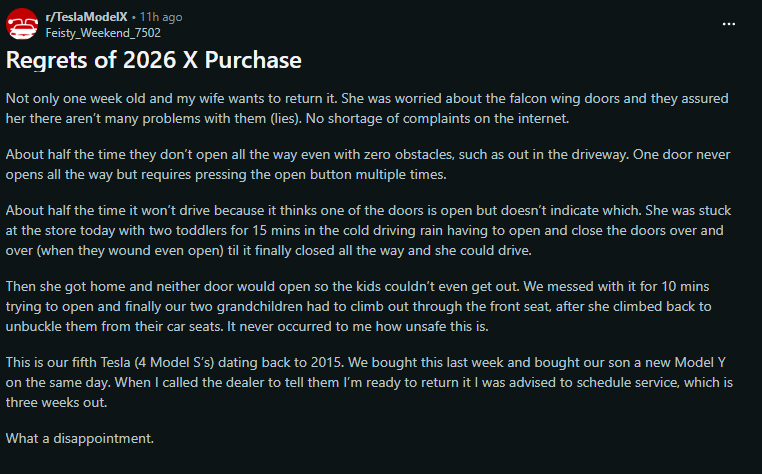
The owner, posting under the username Feisty_Weekend_7502 on Reddit, detailed the harrowing experience:
"Not only one week old, but my wife wants to return it. She was worried about the falcon wing doors, and they assured her there weren’t many problems with them (lies). No shortage of complaints on the internet. About half the time, they don’t open all the way, even with zero obstacles, such as out in the driveway. One door never opens all the way but requires pressing the open button multiple times. About half the time, it won’t drive because it thinks one of the doors is open, but doesn’t indicate which. She was stuck at the store today with two toddlers for 15 mins in the cold driving rain, having to open and close the doors over and over (when they wouldn't even open) til it finally closed all the way and she could drive. Then she got home, and neither door would open, so the kids couldn’t even get out. We messed with it for 10 mins trying to open, and finally our two grandchildren had to climb out through the front seat, after she climbed back to unbuckle them from their car seats. It never occurred to me how unsafe this is. This is our fifth Tesla (4 Model S’s), dating back to 2015. We bought this last week and bought our son a new Model Y on the same day. When I called the dealer to tell them I’m ready to return it, I was advised to schedule service, which is three weeks out. What a disappointment."
This narrative paints a stark picture of a vehicle that, despite its cutting-edge aesthetics, is failing at basic functionality. The core issue isn't merely a faulty sensor; it's a systemic problem that renders the car unusable and, as the owner rightly points out, potentially unsafe. For a vehicle barely out of its delivery bay, these are not teething problems; they are fundamental quality control oversights that undermine consumer confidence.
Tesla Model X: Falcon Wing Door Functionality Under Scrutiny
- The Model X's signature Falcon wing doors are designed to open vertically, offering wider access to the second and third rows than traditional doors. This design is intended to ease entry and exit, particularly for installing child seats.
- Despite their innovative appearance, these doors have been a consistent source of owner complaints since the Model X's introduction, ranging from sensor malfunctions to slow operation and complete failure. The complex electromechanical system relies on numerous sensors to detect obstacles.
- The 2026 Model X, like its predecessors, continues to feature these doors, suggesting Tesla has not fundamentally altered the design or manufacturing process to eliminate persistent reliability issues. This perpetuates a cycle of owner frustration and service dependency.
- In critical situations, such as the described incident where children were trapped, the doors' malfunction raises serious safety concerns, forcing unconventional and potentially dangerous exit methods. This challenges the vehicle's suitability as a family transporter.
One commenter, u/SquirrelTechGuru, offered a common refrain for disgruntled Tesla Model X owners: "You know the routine then. Service it until it is fixed or marked a lemon."
This response, while pragmatic, shows a troubling aspect of modern vehicle ownership, particularly with certain brands. The expectation that a brand-new, premium-priced vehicle will require immediate, repeated service to rectify major functional defects is a concession no consumer should have to make.
It suggests a manufacturing philosophy that pushes unvalidated designs to market, relying on the service network to iron out the creases, rather than comprehensive pre-production testing. Such an approach not only inconveniences owners but also erodes the brand's reputation for quality and reliability.
Another user, u/jpcali7, suggested a potential workaround: "Make sure to recalibrate the doors. I was having the same issue with my driver's side door on my 22 MX, and doing the recalibration fixed it immediately. There are a ton of how-tos on YouTube and google"
While a software recalibration might offer a temporary reprieve for some, the fact that a brand-new 2026 Model X owner is immediately resorting to YouTube tutorials for a critical safety feature speaks volumes about the vehicle's readiness for market. This isn't a complex infotainment setting; it's a door mechanism that, when faulty, can trap occupants or prevent driving. Relying on owners to diagnose and fix such issues via online guides suggests a deficiency in either the vehicle's initial setup or its inherent design robustness. It's akin to buying a new house and immediately needing to consult online forums to fix a leaky roof.
Conversely, some owners expressed satisfaction with their Model X Falcon wing doors, with u/HopzCO stating: "Sorry to hear that, we have a 24X and absolutely love the FWDs for car seats. Definitely make service visits until they are absolutely perfect; they shouldn’t be having any issues."
This perspective, while valid for those who have had positive experiences, often overlooks the cumulative effect of repeated service visits. The "love" for the FWDs for car seats is understandable in principle, but when that love is contingent on multiple trips to the service center to achieve basic functionality, it becomes a significantly diminished value proposition. The convenience of the door design is entirely negated if the doors themselves are unreliable, turning a premium feature into a liability.
The most polarizing take came from u/Dangerous-Writing-14, who asserted: "This isn’t mentioned enough. There is no car on the market that’s better for kids and car seats. The FWDs are a total game changer for kids in a parking lot and car seats."
This statement, while it shows a perceived benefit, completely sidesteps the fundamental issue of reliability. A feature, no matter how innovative or convenient in theory, becomes a critical flaw if it does not consistently perform its basic function. To claim it's a "total game changer" when it actively prevents children from exiting the vehicle, as in the original post, is to prioritize concept over execution. The best design is useless if it's unreliable, particularly when it impacts safety and accessibility for young children.
The owner's history with four previous Model S vehicles reveals a loyalty to the brand that is now severely tested. To purchase two new Teslas simultaneously, a Model X for himself and a Model Y for his son, only to be met with such immediate and severe issues on the flagship Model X, is a profound betrayal of that loyalty. The three-week wait for service is not just an inconvenience; it's an insult to a long-standing customer who has invested heavily in the brand. This experience shows a concerning trend where premium pricing no longer guarantees premium quality or immediate support.
The "unsafe" aspect of the doors, forcing children to climb through the front seats to exit, is not merely an inconvenience; it represents a significant design and safety oversight. While the Falcon wing doors offer a unique aesthetic and theoretical ease of access, their propensity for malfunction, as evidenced by this owner's experience and numerous online reports, transforms them from a luxury feature into a potential hazard. Tesla's continued reliance on these complex doors, despite a decade of reported issues, suggests a stubborn adherence to design over practical, real-world reliability and safety.
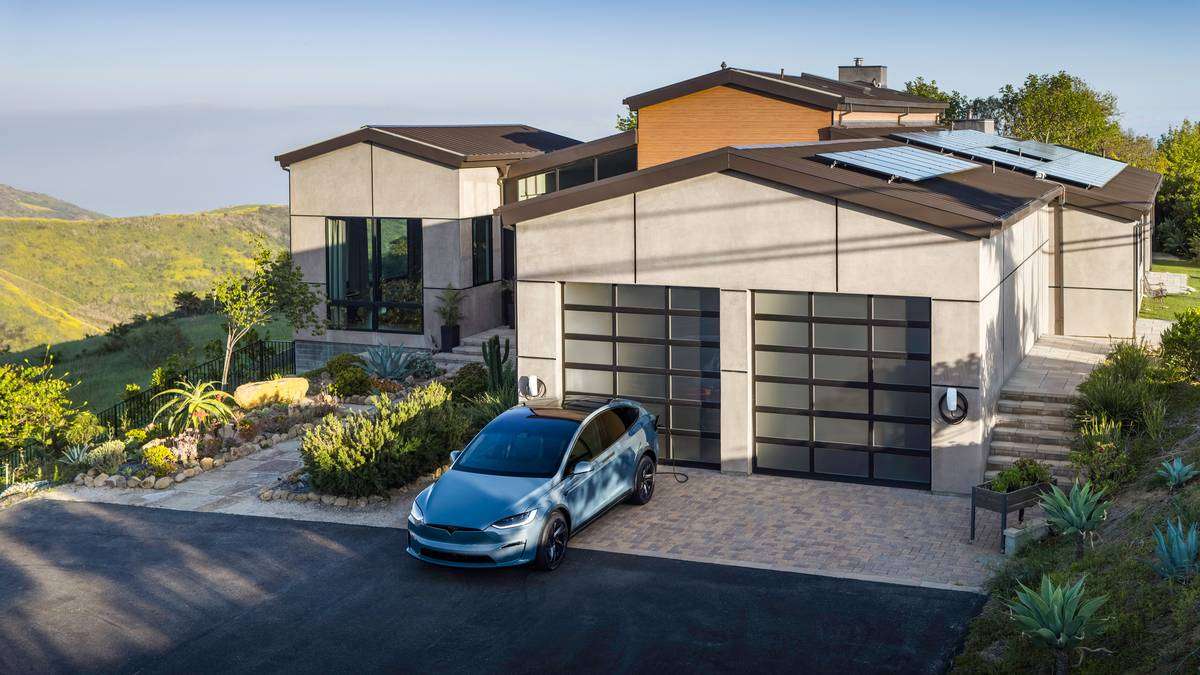
Image Sources: Tesla Media Center
Noah Washington is an automotive journalist based in Atlanta, Georgia. He enjoys covering the latest news in the automotive industry and conducting reviews on the latest cars. He has been in the automotive industry since 15 years old and has been featured in prominent automotive news sites. You can reach him on X and LinkedIn for tips and to follow his automotive coverage.
Set Torque News as Preferred Source on Google
Follow us today...