The ongoing debate surrounding Tesla's minimalist interior design philosophy has found a new focal point: the reintroduction of physical controls through aftermarket solutions.
For many owners, the pursuit of a screen-centric cabin has inadvertently created usability challenges, particularly concerning fundamental driving functions like turn signals and immediate access to performance settings. A recent social media post by a 2024 Tesla Model X owner shows a growing trend among enthusiasts who are taking matters into their own hands, opting for third-party modifications to restore what they consider essential tactile feedback and customizable vehicle behavior.
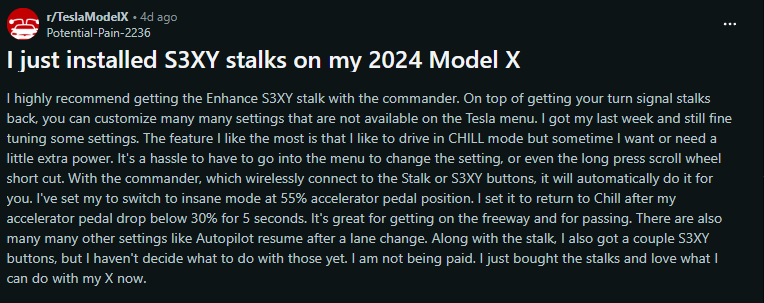
The owner, posting under the username Potential-Pain-2236 on r/TeslaModelX, detailed their recent installation:
"I just installed Model 3 stalks on my 2024 Model X. I highly recommend getting the Enhance Model 3 stalk with the commander. On top of getting your turn signal stalk back, you can customize many, many settings that are not available on the Tesla menu. I got my last week and am still fine-tuning some settings. The feature I like the most is that I like to drive in CHILL mode, but sometimes I want or need a little extra power. It's a hassle to have to go into the menu to change the setting, or even the long-press scroll wheel shortcut. With the commander, which wirelessly connects to the Stalk or Model 3 buttons, it will automatically do it for you. I've set my car to switch to insane mode at 55% accelerator pedal position. I set it to return to Chill after my accelerator pedal drops below 30% for 5 seconds. It's great for getting on the freeway and for passing. There are also many other settings, as Autopilot resumes after a lane change. Along with the stalk, I also got a couple of Model 3 buttons, but I haven't decided what to do with those yet. I am not being paid. I just bought the stalks and love what I can do with my X now."
This owner's experience reveals a critical disconnect between Tesla's design vision and the practical demands of daily driving. The ability to instantly switch drive modes based on accelerator pedal position, as described, offers a level of dynamic control that Tesla's native software simply does not provide. While Tesla aims for simplicity, the automotive industry has long understood that certain functions benefit from dedicated, physical interfaces, especially when driver attention is paramount. The fact that a third-party solution can offer such sophisticated, customizable control over vehicle dynamics suggests Tesla's software team might be overlooking significant opportunities for user-centric innovation.
Another owner, AltruisticPapaya1415, echoed the sentiment regarding physical controls: "I have a Model Y and had a loaner for a week while mine was serviced at the beginning of the month. Will absolutely be getting the stalks when I get an X later this year. The turn signal buttons drove me absolutely bonkers."
This comment shows the widespread frustration with Tesla's decision to replace traditional turn signal stalks with steering wheel buttons. For decades, drivers have relied on the intuitive, muscle-memory engagement of a stalk for signaling maneuvers. To force a driver to consciously locate and press a button on a rotating steering wheel is not just an inconvenience; it represents a fundamental regression in ergonomic design, akin to asking a pilot to use a touchscreen for landing gear deployment. The fact that owners are willing to invest in aftermarket solutions to correct such basic design flaws speaks volumes about the perceived necessity of these traditional controls.
The original poster, Potential-Pain-2236, further elaborated on Tesla's design choices: "Removing the turn signal stalks was the second dumbest thing any Automotive company has ever done. The number one was removing the center horn button from the steering wheel. Tesla did both of those things, but has since bought them back. I was hoping and waiting for a retrofit from Tesla, but since Tesla has cancelled the Model X, I don't see it happening, and decided to get the Model 3 stalks."
This candid assessment cuts to the core of Tesla's sometimes-questionable design decisions. While innovation is laudable, deliberately removing proven, safety-critical physical controls only to reintroduce them later, or forcing owners to seek aftermarket alternatives, is a pattern that suggests an engineering hubris over user experience. The absence of a center horn button, a feature standardized for safety and ease of use across the industry, was a particularly egregious misstep, demonstrating a disregard for established automotive ergonomics. Owners should not have to wait for a manufacturer to correct self-inflicted design wounds, especially for a premium vehicle.
However, the path to enhanced functionality is not without potential pitfalls, as tropicsun inquired: "Does this impact warranty? I was at the service center for a windshield inspection, and the tech said not to get 3rd party b/c it might impact warranty/ mess w/ electronics."
This is the perennial sword of Damocles hanging over any owner considering aftermarket modifications, particularly those that interface directly with a vehicle's core electronics. While the Magnuson-Moss Warranty Act generally prevents manufacturers from voiding a warranty solely because of an aftermarket part, they can deny coverage for repairs directly caused by the modification. For a system like the S3XY stalks, which taps into the vehicle's CAN bus or similar control networks, the risk of a service center attributing an unrelated electrical issue to the modification is a legitimate concern. Tesla's service centers are notoriously stringent, and any deviation from factory specification can be a convenient scapegoat for warranty denials, regardless of actual causation.
Despite these warranty concerns, the appeal of improved usability remains strong, with DryParamedic785 confirming: "Same here, love the Enhance. Installed the stalks and the buttons in my MX 2024 as well. Highly recommend ."
The consistent positive feedback from multiple owners who have installed these S3XY stalks in their 2024 Model X vehicles paints a clear picture: the benefits of restored physical controls and customizability outweigh the perceived risks for a significant portion of the owner base. This isn't merely about aesthetics; it's about reclaiming a more intuitive and responsive driving experience that many feel was sacrificed at the altar of minimalist design. The ability to fine-tune performance parameters, such as the automatic mode switching based on accelerator input, transforms the car from a static interface into a dynamic, personalized extension of the driver's intent.
The market for these aftermarket solutions is a direct indictment of Tesla's design choices. When a vehicle costing well over $100,000 requires owners to purchase third-party hardware to achieve basic ergonomic functionality and advanced performance customization, it suggests a fundamental miscalculation in the original product development. While Tesla has made strides in bringing back some physical controls, the pace is glacial, and the Model X, in particular, remains an outlier in its lack of traditional stalks. This forces owners into a difficult choice: endure a suboptimal user experience or risk warranty complications with aftermarket upgrades.
The enthusiasm for products like the S3XY stalks reveals a deeper truth about automotive design: innovation should enhance, not detract from, the fundamental act of driving. The ability to customize a vehicle's response to driver input, especially in a performance EV like the Model X, is a powerful tool for driver engagement and satisfaction. Tesla's reluctance to offer such granular control through its native interface leaves a substantial void that aftermarket companies are more than willing to fill, demonstrating a responsiveness to consumer demand that the OEM itself often lacks.
Image Sources: Tesla Media Center
Noah Washington is an automotive journalist based in Atlanta, Georgia. He enjoys covering the latest news in the automotive industry and conducting reviews on the latest cars. He has been in the automotive industry since 15 years old and has been featured in prominent automotive news sites. You can reach him on X and LinkedIn for tips and to follow his automotive coverage.
Set Torque News as Preferred Source on Google
Follow us today...