


Electric vehicle ownership often comes with the expectation of lower maintenance costs and robust warranty coverage, particularly for high-voltage components.
However, one 2025 Tesla Model Y Long Range owner, Simo Essakhri, recently discovered that real-world incidents, even seemingly minor ones, can quickly turn that expectation into a $17,000 nightmare. His experience reveals the critical need for owners to understand the nuances of EV warranties and the potential for seemingly unrelated damage to trigger costly repairs.
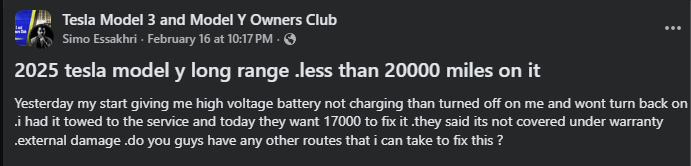
Essakhri detailed his ordeal on a social media forum dedicated to Tesla owners, seeking advice after his relatively new vehicle suddenly failed. His original post read:
"Yesterday, my start giving me high voltage battery not charging than turned off on me, and won't turn back on. I had it towed to the service, and today they want 17000 to fix it. They said its not covered under warranty. External damage, do you guys have any other routes that I can take to fix this?"
The immediate reaction from the community highlighted the shock and concern such a situation evokes. Ignacio Tapia, a commenter, quickly suggested that the owner should consider an insurance claim rather than absorbing the repair cost directly. "Sorry, I mean to be helpful, but this shouldn’t even be a question. Common sense is to file a Collision Claim. You should not haveto pay to repair this." This advice, while seemingly pragmatic, often overlooks the long-term implications of filing a collision claim, such as increased premiums and a potentially diminished vehicle history report, which can be a significant deterrent for many owners.
2025 Tesla Model Y Long Range: Understanding Battery Damage and Warranty Coverage
- The 2025 Tesla Model Y Long Range features an advanced high-voltage battery pack integrated into its chassis, providing an estimated EPA range of over 300 miles. This design contributes to structural rigidity but can expose the battery to impact forces from below.
- Tesla's standard battery warranty typically covers 8 years or 120,000 miles, whichever comes first, for retention of 70% battery capacity. However, this warranty explicitly excludes damage caused by external factors such as collisions or road hazards.
- The battery pack is protected by an underbody shield, but severe impacts from potholes or debris can still compromise its integrity, leading to internal cell damage or breaches in the cooling system. Such damage often requires complete battery pack replacement due to the sealed and complex nature of the unit.
- Repair costs for high-voltage battery packs can be substantial, often ranging from $15,000 to $25,000 or more, depending on the model and extent of damage. Owners should verify their insurance coverage for comprehensive protection against road hazard damage.
While an insurance claim might mitigate the immediate financial burden for the Tesla Model Y, it doesn't address the fundamental issue of why a relatively new vehicle with under 20,000 miles would incur such a catastrophic failure from what the owner describes as a pothole impact.

The notion that a vehicle's high-voltage battery system, a component designed to be robust and protected, could be so susceptible to road debris or common road hazards raises serious questions about design resilience and underbody protection. Automakers, particularly those pioneering new technologies, have a responsibility to engineer for the realities of daily driving, not just ideal conditions.
Another commenter, Aaron Lor, questioned the owner's awareness of the impact, asking, "Bro, how did you not notice this at the time of impact??!!" This query, while understandable from an outsider's perspective, often oversimplifies the dynamics of driving. Pothole impacts, especially at speed, can be jarring but not always immediately indicative of severe undercarriage damage, particularly if the initial symptoms are subtle. The owner's subsequent clarification sheds light on the sequence of events, revealing a delay between the initial impact and the system failure.
Essakhri responded to Lor, providing crucial context: "Aaron Lor took the car to service and didnt say anything about it. Got 2 tires and one rim changed, and that was it. A day after the car powered off while I was driving took it back, and they hit me with a 17000 bill." This detail is critical. It suggests that the initial service visit, which addressed visible wheel and tire damage, either failed to identify the underlying battery damage or that the damage manifested later. This raises a red flag regarding the diagnostic thoroughness of the initial repair, or perhaps the insidious nature of the damage itself, which might have been a hairline fracture or slow-developing internal short.
The delay in the battery failure, occurring a day after the initial tire and rim replacement, further complicates the narrative. It's plausible that the impact caused latent damage that only fully compromised the battery system after subsequent driving or even a software update, which the owner mentioned downloading. This scenario shows a common challenge in automotive diagnostics: correlating a past event with a delayed failure. For a service center to immediately attribute the battery failure to "external damage" without a more thorough investigation into the timeline and potential latent issues feels like a convenient dismissal rather than a comprehensive analysis.
John Williams then expressed skepticism, stating, "You haven't indicated what was found to be wrong. I am doubting your story." This type of response, common in online forums, often reflects a lack of understanding of how frustratingly opaque service diagnoses can be for the average consumer. Owners are frequently told what is wrong (e.g., "external damage") but not how or why it happened in precise technical terms, leaving them in the dark about the root cause.
Essakhri's final response to Williams filled in the remaining gaps about the Model Y: "John Williamsi have no idea I hit a pothole two days ago, took it to service, changed two driver side tires and one rim cost me 1800, took the car home Saturday. Sunday, I downloaded the update, drove the car, and this happened." This sequence, pothole, tire/rim replacement, software update, then catastrophic battery failure, paints a picture of a complex issue. The software update is an interesting variable; while unlikely to directly cause physical damage, it could potentially alter power management or diagnostic parameters, making a pre-existing latent issue suddenly manifest.
This entire situation with the Model Y reveals a fundamental disconnect between manufacturer warranty policies and real-world driving conditions. To deny warranty coverage for a high-voltage battery, a core component, due to "external damage" from a pothole, a common occurrence on many roads, suggests an expectation of driving on pristine surfaces that simply doesn't exist. Automakers must design for resilience and provide clearer, more transparent warranty terms that account for the rigors of daily use, rather than leaving owners with a $17,000 bill for what amounts to a road hazard.
Image Sources: Tesla Media Center
Noah Washington is an automotive journalist based in Atlanta, Georgia. He enjoys covering the latest news in the automotive industry and conducting reviews on the latest cars. He has been in the automotive industry since 15 years old and has been featured in prominent automotive news sites. You can reach him on X and LinkedIn for tips and to follow his automotive coverage.
Set Torque News as Preferred Source on Google
Follow us today...






Comments
That must have been one heck…
Permalink
That must have been one heck of a pothole. Its like running over a brick and taking out your oil pan in a non-EV, that's what insurance is for. Ironically, the Full Self Driving / autopilot does little to avoid potholes, at least in my 2022. That's why its got the (supervised) on the end, I suppose.