


Today, while scrolling through the Tesla Cybertruck Owners group on Facebook, I found a post that immediately pulled me in. It was from a Cybertruck owner named Raymond, who is already dealing with a series of warning alerts at just under 10,000 miles. These aren’t your average reminders about low tire pressure or washer fluid. They’re system-level warnings that could make any owner pause before starting the next drive.
“The last week or so I've been getting these alerts when I get in my Cybertruck. Has anyone had this issue before? My truck rolls when stopped. I feel the truck shake a little when I start driving. My truck doesn't even have 10,000 miles yet.
Here are those alerts:
1. Adaptive ride control degraded.
2. Lane Departure Avoidance features unavailable.
3. Traction control disabled. 4. Stability control disabled.
5. Automatic vehicle hold disabled.”
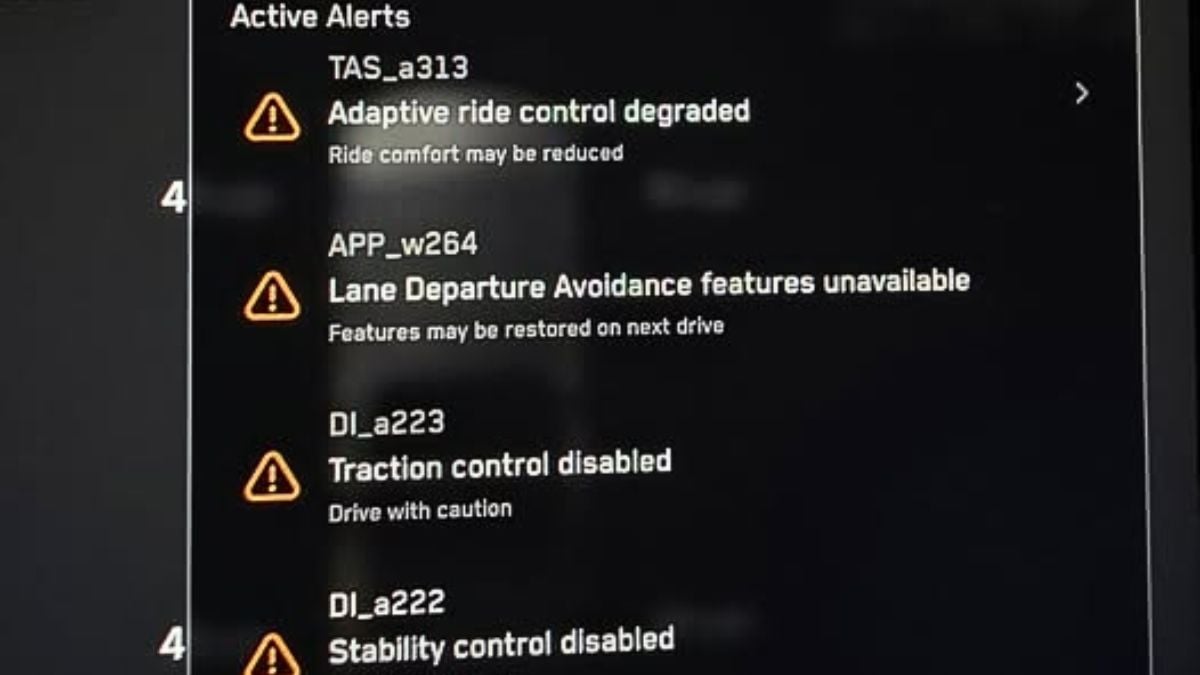
That’s a lot to take in for any new truck owner. If your vehicle rolls while stopped or shakes when pulling out of the driveway, that’s an unlikeable feeling, especially when the dashboard lights up like a Christmas tree. It’s both unexpected and worrying, yet it seems to be happening to more owners than Tesla may want to admit.
Cybertruck Owners Begin Sharing Similar Experiences
What makes Raymond’s post compelling is how quickly others began sharing similar stories. Within minutes, the comment section filled with experiences that sound oddly familiar.
Gabriel commented, “Take it to Tesla service. Put a ticket and they will be fixed.” That kind of advice has become standard in Tesla communities, as if creating a service ticket is now part of routine ownership.
Bob added, “Yes. I had a bad caliper. Replaced. No more issues.” That one line might hold a clue. A failing brake caliper could easily explain why traction control or stability systems throw alerts. But at less than 10,000 miles, that’s not what any new truck owner expects.
Then Aaron joined in, saying, “Yes I got the same thing just started.” And that’s where it starts to sound more like a pattern than coincidence.
David’s experience brought even more context. “Happened to me 3 times. Has cleared quickly on restart twice, once it was persistent. Alerts continued after hard and soft resets. But then parked for two hours at dinner and they were gone when I restarted. I wonder if I have a bad sensor.”
This kind of randomness, where alerts appear and disappear without warning, suggests a possible sensor or communication issue rather than a physical failure. Tesla’s advanced electronics rely heavily on modules that constantly talk to each other. When one piece of that network misfires, the car can act like it’s having a bad day.
Jennifer shared a practical tip that many owners know by heart. “My auto hold disables any time I go over rumble strips but resets the next drive. You might try a reboot by holding both buttons on the steering wheel down.” Tesla owners have learned to reboot their vehicles almost instinctively. It’s become a ritual, like restarting your laptop when it freezes.
Marvic wrapped it up with a simple but cautious note: “Hmmm, do roadside assistance and get it towed to the service center so they can service it within the day.” It’s probably the safest advice in this case.
But if you look at the pattern in these replies, something stands out. Tesla’s cutting-edge technology also requires owners to be patient troubleshooters. That’s an unspoken part of the Cybertruck ownership experience.
If this sounds familiar, you might remember our coverage of a Tesla Cybertruck owner who said he ran into a major issue Tesla couldn’t identify in our detailed report on Cybertruck error messages that Tesla service couldn’t diagnose. That story showed how complex and interconnected the vehicle’s electronic systems really are.
Are These Alerts Signs of a Larger Pattern?
Raymond’s story doesn’t stand alone. In fact, similar issues have surfaced across Tesla forums and social media, leading some to believe there’s a deeper pattern forming. A few months ago, Torque News reported that Tesla service centers were overwhelmed after widespread powertrain alerts hit several owners (see the full story on powertrain alert issues affecting Cybertruck owners).
That event led to long service delays, which further fueled the debate about whether the Cybertruck’s complexity might be outpacing Tesla’s service capacity. Raymond’s case fits right into that puzzle. It may not be catastrophic, but it’s part of a growing list of system alerts that early owners are experiencing.
So, what could actually be causing these alerts?
Given the combination of ride control, traction, and stability messages, it’s possible there’s a communication glitch between the adaptive suspension and the main control module. These systems depend on precise data sharing. Even a brief voltage drop or sensor hiccup can trigger multiple warnings at once.
Some owners have found that parking the truck and restarting it later clears the errors. Others say it requires a trip to the service center, where Tesla runs diagnostics and often replaces components like brake calipers or suspension sensors.
In one reported case, a Tesla Cybertruck alarm went off at night because a door was slightly open and the window dropped for no reason (you can read the full story about Cybertruck’s strange alarm incident). These strange, unpredictable issues suggest the truck’s electronic system is still learning to manage its many functions.
Interestingly, there have also been cases where alerts fixed themselves after a software update. One owner said she was extremely happy after Tesla fixed multiple error codes faster than expected (you can read that happy owner’s experience here). This shows the other side of Tesla ownership — the company’s ability to respond quickly when everything aligns.
Still, these cases show that the Cybertruck’s ecosystem is evolving in real time. Every owner experiencing issues contributes data that helps Tesla fine-tune future models.
What Owners Can Do When Their Cybertruck Shows Multiple Alerts
The natural question now is, what can you do if your Cybertruck starts displaying a list of warnings like Raymond’s?
The first step is simple. Stay calm. Most of these alerts are related to the truck’s software communication rather than physical breakdowns. Start by performing a full reboot by pressing both steering wheel buttons. If that doesn’t clear the alerts, take note of what you were doing when the warnings appeared. Were you braking, accelerating, or going over bumps? Context helps Tesla diagnose issues faster.
Next, use the Tesla app to open a service request. Provide screenshots of the alerts and describe the behavior. Tesla’s system automatically logs these alerts, but giving context speeds up the troubleshooting process.
Owners who prefer to be proactive are also using advanced vehicle monitoring tools. These small plug-in devices can read diagnostic codes and track voltage fluctuations in real time. While they don’t replace Tesla’s service system, they offer valuable insight into what’s happening under the hood. They also reflect a growing movement among Tesla owners to take control of their vehicle data.
This shift raises an ethical question that’s worth discussing. Should automakers give owners greater access to their own diagnostic information? The Cybertruck, like many modern electric vehicles, behaves more like a rolling computer than a traditional truck. If you buy something that complex, shouldn’t you have the right to understand what it’s doing? Transparency might not eliminate errors, but it builds trust — something every brand needs.
We’ve also seen other concerning incidents, like when a Cybertruck suddenly lost power and bricked on the highway at night (read that full story on Cybertruck shutdown while driving at night). When events like that happen, owners realize just how dependent these vehicles are on software stability.
Finally, in another case, we examined the mysterious Zap O Tron 8000 Cybertruck warning (read about the Zap O Tron 8000 warning issue here), which again showed how interconnected these alerts can be. Each incident provides another piece of the puzzle in understanding the Cybertruck’s growing pains.
Understanding Software Updates and Their Side Effects
One area we didn’t explore deeply enough is the impact of Tesla’s frequent software updates on Cybertruck performance. These updates often improve driving dynamics, user interface design, or Autopilot behavior, but they can also inadvertently trigger new alerts. Sometimes, after a major update, owners report new warning lights or sudden system recalibrations that eventually clear up after a few drives. For Cybertruck owners, understanding how updates interact with adaptive systems such as the air suspension and traction control is crucial. When an update installs, it can reset calibrations, creating what feels like a mechanical issue when it’s actually just software adjusting itself.
To stay ahead of this, Cybertruck owners should make a habit of reading the update notes and waiting a few drives before panicking about new alerts. Tesla’s internal systems often take time to re-sync sensor data after an update. Knowing this can save unnecessary service visits. Owners can also enable automatic update logs in their Tesla account to track which software versions preceded the alerts. That kind of awareness turns confusion into clarity and gives you a better handle on whether your issue is mechanical or digital.
Suspension and Air Ride Maintenance Basics
Another area worth covering is preventive maintenance for the Cybertruck’s adaptive air suspension. This system is one of the truck’s biggest innovations but also one of its most complex. Even small leaks in the air lines or uneven height sensors can trigger multiple cascading alerts, like the ones Raymond reported. While the Cybertruck doesn’t require traditional suspension service like oil changes, it still needs visual inspections and system checks. Tesla may not list these as scheduled maintenance items, but owners who drive frequently on rough terrain should inspect air struts and lines every few months.
It’s also helpful to understand how ambient temperature affects air suspension systems. Cold weather can temporarily lower air pressure in the struts, confusing the onboard sensors and producing temporary warnings. In some cases, simply letting the system stabilize before driving off can prevent the appearance of “ride control degraded” or “vehicle hold disabled” messages. Knowing how to interpret your suspension’s behavior in real-world conditions can prevent unnecessary worry and help owners communicate better with Tesla technicians when something actually does go wrong.
When to Trust Roadside Assistance Versus Waiting It Out
Finally, Cybertruck owners should know when to engage Tesla Roadside Assistance versus when to safely wait out a glitch. Many owners, like Raymond and those in his thread, report that alerts sometimes disappear after the truck rests for an hour or two. That suggests transient software faults rather than hardware failure. But distinguishing between a harmless false alert and a safety-critical issue takes judgment. If your Cybertruck shakes, rolls unexpectedly, or displays traction and stability warnings together, it’s best to park and call for roadside help immediately. These systems are directly tied to braking safety.
However, if alerts appear after an update or minor bump in the road and vanish on reboot, waiting and observing might be the wiser move. Every unnecessary tow adds stress and potential cost. A balanced approach - documenting the alerts, restarting the system, and monitoring patterns before calling Tesla - saves time and keeps the service system from being overloaded. This kind of practical wisdom is what separates reactive ownership from proactive care, and it’s a skill every early Cybertruck owner will benefit from mastering.
The Moral Behind These Cybertruck Alerts
Every story like Raymond’s offers more than a technical lesson. It’s also a human one. Owning a first-generation product often means accepting that you are part of its evolution. Cybertruck owners are not just drivers — they are pioneers testing the boundaries of electric truck technology.
That takes patience, understanding, and a willingness to learn. The moral here is that innovation often comes with discomfort. When your truck rolls or shakes at startup, it’s easy to lose faith. But when you approach it with curiosity rather than anger, you gain insight and help the community move forward.
Still, it’s fair to challenge Tesla and all automakers to treat owners as partners, not just service tickets. Every alert tells a story, and every owner deserves transparency about what that story means.
In the end, Raymond’s post is not just about alerts. It’s about trust, adaptability, and the shared journey of owners who are navigating the complexities of next-generation vehicles.
So, what do you think? Have you experienced these kinds of alerts on your Cybertruck or another Tesla model? Do you believe automakers should allow owners more access to diagnostic tools to understand what’s really happening? Share your experience and thoughts in the comments below. Your insight might help another owner facing the same unexpected alerts.
Armen Hareyan is the founder and Editor-in-Chief of Torque News. He founded TorqueNews.com in 2010, which since then has been publishing expert news and analysis about the automotive industry. He can be reached at Torque News Twitter, Linkedin, and Youtube. He has more than a decade of expertise in the automotive industry with a special interest in Tesla and electric vehicles.
Set Torque News as Preferred Source on Google
Follow us today...






Comments
But this is just part of the…
Permalink
But this is just part of the cyberturd ownership experience. You know how to solve this problem, so what are you waiting for?