
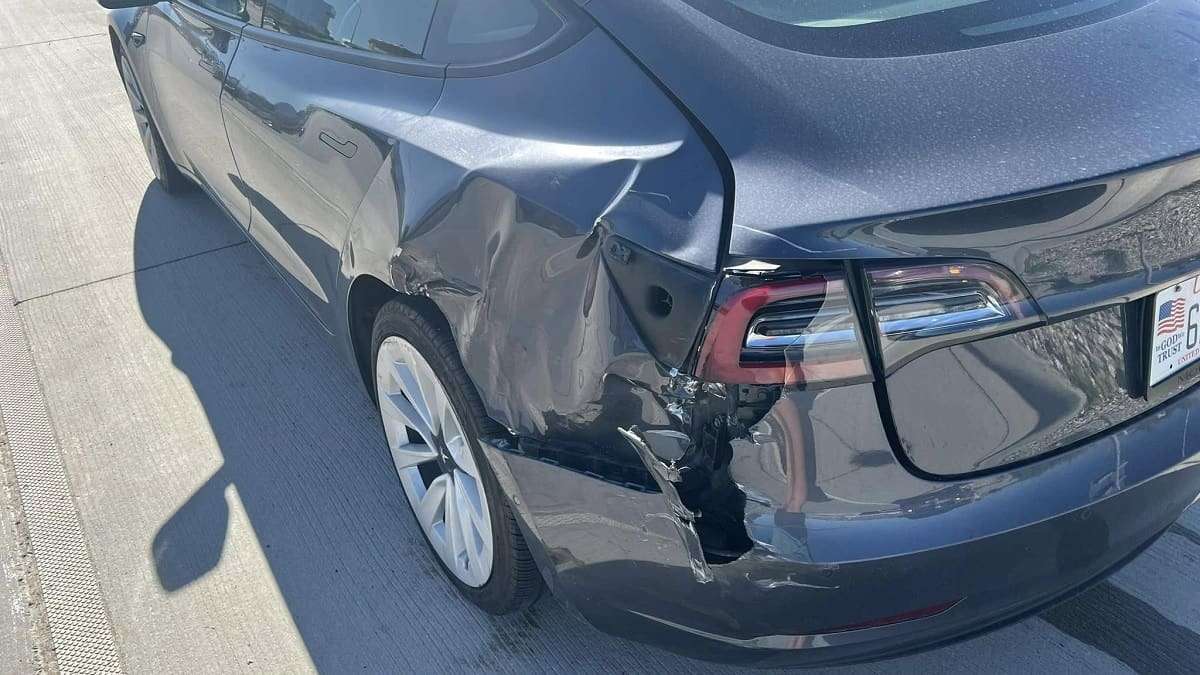

We are seeing lots of posts about EVs getting totaled by insurance companies after getting into what seem like minor fender benders. However, even if the car isn’t totaled and is repaired, the car will usually be “categorized” and can lose significant resell value. These are called “diminished value claims, and the good news is that you can push back against your insurance company. This recent Facebook post by Talha Sohail captures a common situation:
“I had an accident—someone hit my Tesla Model 3 from the side. It was completely their fault, and they’ve admitted it. Their insurance company Aviva called straight away and offered to send my car to a garage. I’ve just found out that if it’s repaired, it’ll be categorized, which means it’ll lose a lot of value. They won’t write it off if it’s still repairable, even though that would be better for me. Plus, my insurance premium might go up too. It feels like a total loss on my end, despite not being at fault. Can I challenge their decision if they choose to repair it? A write-off seems like the better option, and I could at least replace the car.”
In another Facebook post, an owner worries that his Ford F-150 Lightning will be totaled after striking a deer resulting in what seems like minor damage:
“We got a nice eight-point deer this afternoon! Actually, he got us! Thankful that a family in need could put it to good use! Those of you who have had fender benders…did they fix it or total it?”

An EV can look completely repairable and still receive a salvage title when the estimated repair cost is higher than the vehicle’s market value. This happens more often than people expect, especially when labor rates, parts availability, or structural work drive the total repair cost well beyond what insurers consider reasonable. Once the repair costs head in this direction, the vehicle can become a total loss on paper even if the damage appears minor to the owner.
EVs are totaled more frequently for what can look like small cosmetic damage. Battery inspections and potential battery replacements are expensive, which means even a light impact near the battery pack can push repair costs far above the value of the vehicle. EVs also have sensors and high voltage components that add to the repair bill. These factors combine to create situations where the car looks fixable, although insurers declare it a total loss.
Title branding is permanent in every state in the United States, which is an important consideration. Once a vehicle receives a salvage or rebuilt title, that brand stays with it for the rest of its life and shows up on Carfax and similar reports. The designation affects resale value, insurance options, and how buyers view the vehicle’s history.
Damaged vehicles with diminished value in the U.S. are categorized through permanent title brands rather than through a lettered category system like they do in other countries. When repair costs exceed a vehicle’s market value, insurers declare it a total loss and the state issues a salvage title. Once repaired and inspected, the car receives a rebuilt title that identifies it as a previously totaled vehicle. Some cars with severe structural or flood damage receive a non-repairable or junk title that prevents them from returning to the road. These title brands stay with the vehicle for life and play a major role in its long-term value. If the vehicle isn’t totaled, it can end up with a “diminished value claim.”
Understanding Diminished Value Claims
Many people feel bummed out after learning that their car lost value even after receiving quality repairs. The idea of diminished value can feel confusing because owners often do not know how to measure the loss, or how to prove it to an insurance adjuster. It is a common situation, which is why clear guidance is helpful for anyone trying to recover the money they are owed.
Why the 10 Percent Rule Is Misleading
Insurance companies often begin the conversation with what they call the 10% rule. They claim the diminished value is either 10% of the repair cost or 10% of the vehicle’s value, whichever is cheaper. This sounds authoritative because they cite case law, send official letters, and present it as a legal standard. The problem is that it has no binding force. It is not the law and usually undervalues the real financial loss by thousands of dollars. The proper measure is the actual difference in fair market value before and after the accident, which requires real evidence, not a shortcut formula.
Why You Should Not Accept the First Offer
The first offer from an adjuster is rarely a true offer. Most of the time it is simply the 10% argument dressed up as a settlement. Once you push back and present your own estimated loss, the adjuster may increase the offer. The increase may look impressive, although it usually represents only a small fraction of the actual loss. Negotiation is expected at this stage, and owners should continue to counter until the numbers begin to reflect real market conditions rather than an insurer’s starting point.
When Hiring an Expert Makes Sense
There are situations where progress stalls and the adjuster and owner remain far apart. Bringing in an independent expert can help break the deadlock. These experts are usually independent adjusters who specialize in assessing market values after repairs. They review photos, repair invoices, and sales data to create a formal report that supports a realistic diminished value number. The cost usually ranges from two hundred fifty to one thousand dollars, which is reasonable when the gap between the two sides is large enough to make the investment worthwhile.
Whether You Need an Attorney
Most diminished value claims are not large enough to justify hiring an attorney. Personal injury lawyers typically work on contingency fees, although diminished value cases rarely involve enough money to make that fee structure practical. Hiring a lawyer on an hourly basis can also become expensive. Since attorney fees can consume a large portion of the claim, many owners find that it makes more sense to negotiate on their own, especially when armed with strong evidence or an expert report. Attorneys are helpful only in the rare cases where the diminished value is extremely high, such as claims involving exotic or collectible vehicles.
Putting These Tips Into Practice
Using these strategies shows the adjuster that you understand your rights and are prepared to support your claim. It signals that you are not misled by generic formulas or low opening offers. This confidence can narrow the negotiation gap and reduce the need for an attorney. The goal is to bring the discussion close enough to a fair number that you can settle efficiently and avoid unnecessary expenses.
Bottom Line
Diminished value claims often feel intimidating, although they follow predictable patterns once you know how insurers operate. Rejecting the 10% rule, challenging low opening offers, calling in an expert when needed, and avoiding unnecessary legal costs create a practical path to a fair outcome. These steps help owners recover the value their vehicle truly lost, which is the purpose of a diminished value claim in the first place.
What Do You Think?
Have you ever had a car that looked repairable, yet the insurance company pushed to fix it instead of totaling it?
Have you dealt with a diminished value claim on a Tesla Model 3 or any other EV?
Chris Johnston is the author of SAE’s comprehensive book on electric vehicles, "The Arrival of The Electric Car." His coverage on Torque News focuses on electric vehicles. Chris has decades of product management experience in telematics, mobile computing, and wireless communications. Chris has a B.S. in electrical engineering from Purdue University and an MBA. He lives in Seattle. When not working, Chris enjoys restoring classic wooden boats, open water swimming, cycling and flying (as a private pilot). You can connect with Chris on LinkedIn and follow his work on X at ChrisJohnstonEV.
Photo credit: Jacob Millett (with permission), Tracy Misekow (with permission)
Set Torque News as Preferred Source on Google
Follow us today...




Comments
Total damage cost has to be…
Permalink
Total damage cost has to be based on estimate. Because of parts shortages, especially on new vehicles, they might sit for long periods while the insurance company pays for rentals and whatever else the owner needs and collect.
Example: I was driving by a parked car as the driver opened his door. It took out headlight, bumper cover, hood++, and dented both right side doors. Estimate $4300, which I thought wasn't out of line. This would not have resulted in a total loss. Final cost was $11,800, majority car rental while waiting for parts, and probably more than half wholesale value of the car.
I have no idea, but just…
Permalink
I have no idea, but just saying, that is tragic.